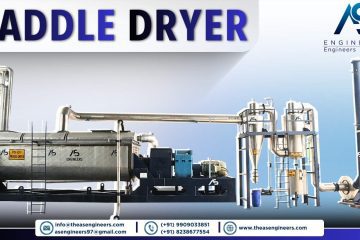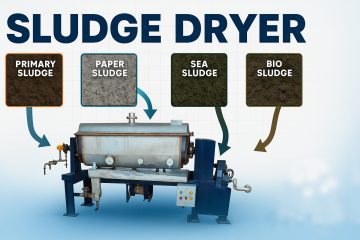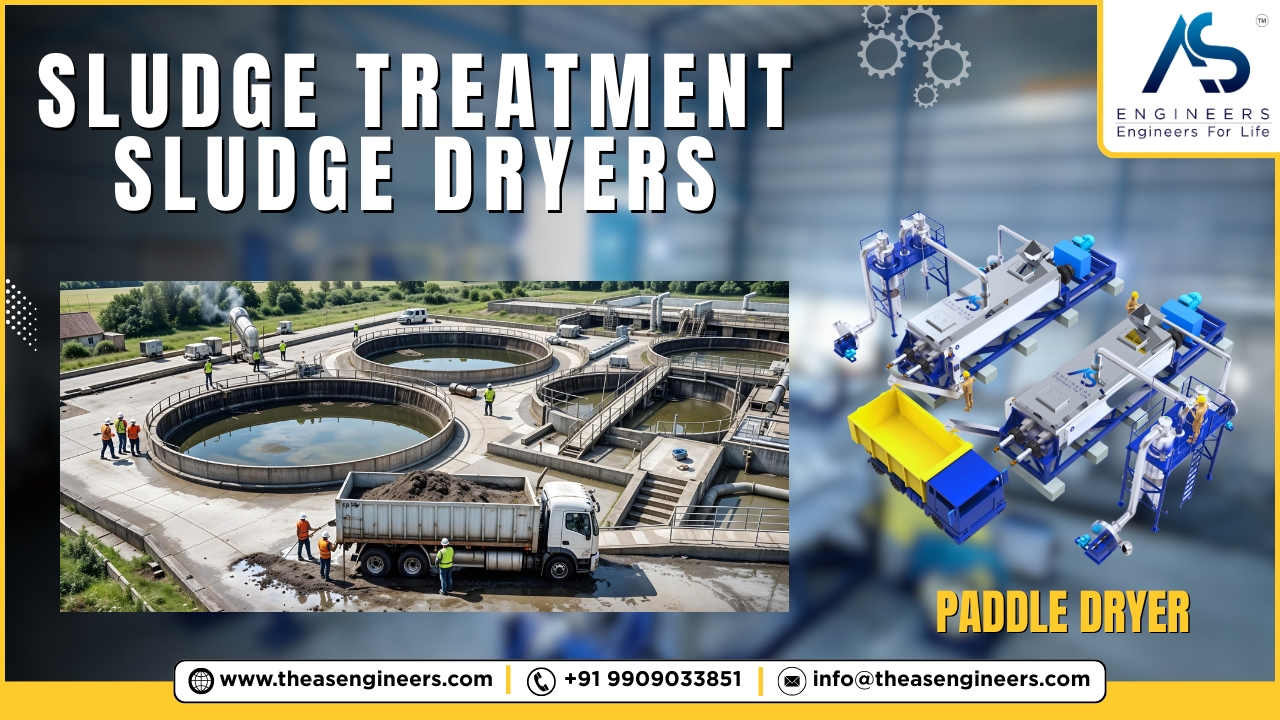
Conductive sludge dryers treat wet sludge by using indirect heat instead of direct hot gas contact. In a paddle dryer, wet ETP, STP, municipal, industrial, or process sludge enters an enclosed chamber where heated hollow shafts, paddles, and jacket surfaces transfer heat into the material. The rotating paddles mix, shear, and move the sludge while moisture evaporates and vapours are taken to a suitable handling system.
This makes conductive paddle dryer technology useful where sludge is sticky, difficult to transport, expensive to dispose, or unsuitable for open drying beds due to space, odour, weather, hygiene, or handling concerns.
At AS Engineers, I look at sludge drying as a process decision, not only as a machine purchase. The right dryer depends on feed moisture, final moisture target, sludge behaviour, heating medium, vapour load, MOC, disposal route, and site utilities.
What Is a Conductive Sludge Dryer?
A conductive sludge dryer is an indirect thermal dryer that transfers heat to sludge through heated metal surfaces. The sludge does not need to be exposed directly to a large stream of hot combustion gas. Instead, heat reaches the material through surfaces heated by steam, thermal oil, hot water, or another site-approved heating system.
In sludge treatment, common conductive dryers include paddle dryers, disc dryers, and thin-film dryers. A paddle dryer is widely considered for sticky sludge and wet cake because it combines three actions in one system:
- Heat transfer through the jacket, hollow shafts, and heated paddles
- Mixing and shearing of wet sludge during the sticky phase
- Controlled movement from inlet to discharge
For a deeper dryer selection route, also review how to choose a sludge paddle dryer before final RFQ.
How Paddle Dryer Technology Treats Sludge
A paddle dryer works by exposing sludge continuously to heated surfaces while rotating paddles keep the material moving. The goal is not only to evaporate water. The goal is to move sludge through the difficult transition from wet paste to semi-dry mass to a more manageable dried product.
The practical process is:
| Step | What happens | Why it matters |
|---|---|---|
| Feed preparation | Dewatered sludge, wet cake, paste, or slurry is fed through a screw feeder, conveyor, or pump | Stable feeding avoids surging, choking, and uneven drying |
| Indirect heat transfer | Hollow shafts, paddles, and jacket surfaces transfer heat into the sludge | Heat reaches the material without relying on large direct hot-air flow |
| Mixing and shearing | Rotating paddles expose fresh wet surfaces and break sticky lumps | Helps reduce buildup and improves contact with heated surfaces |
| Moisture evaporation | Water or solvent evaporates as the sludge temperature rises | Vapour load must be handled correctly |
| Vapour and fines handling | Vapours and entrained fines move toward cyclone, scrubber, condenser, ID fan, or chimney as required | Important for odour, emissions, solvent, and plant hygiene control |
| Dried sludge discharge | Dried output exits through conveyor, bagging, silo, or truck-loading arrangement | Final handling depends on disposal or reuse route |
For layout planning, the connected system should be reviewed along with the paddle dryer configuration guide, not only the dryer body.
Why Conductive Paddle Dryers Are Used for Sludge
Sludge is not a simple free-flowing powder. It may be sticky, abrasive, corrosive, odorous, biologically active, chemically contaminated, or inconsistent from shift to shift. A conductive paddle dryer is considered when the plant needs controlled drying with a compact, enclosed, and continuous system.
Key reasons include:
- Lower dependence on weather compared with open solar or drying-bed methods
- Better containment than open sludge storage and manual handling
- Lower off-gas volume compared with many direct hot-air systems
- Continuous mixing during the sticky phase
- More compact layout than large-area drying beds
- Adjustable heating medium based on site utilities
- Flexible use with ETP sludge, STP sludge, biological sludge, chemical sludge, paper sludge, and some industrial wet cakes
This does not mean a paddle dryer is correct for every sludge. Sludge with severe corrosive chemistry, high solvent risk, explosive dust potential, high chloride content, toxic vapours, or unknown composition needs material testing and engineering review before selection.
Conductive Paddle Dryer vs Other Sludge Drying Options
| Method | Where it fits | Main limitation | Buyer note |
|---|---|---|---|
| Mechanical dewatering | First-stage moisture reduction through filter press, screw press, belt press, or centrifuge | Output still contains high moisture and may remain costly to dispose | Usually comes before thermal drying |
| Solar drying bed | Low-energy drying where land, climate, and time are available | Weather dependent, large area required, odour and hygiene concerns | Compare with solar sludge drying before choosing |
| Direct hot-air dryer | High evaporation duty where direct air contact is acceptable | Higher off-gas handling and dust/odour control load | Needs careful emissions and fire-risk review |
| Thin-film dryer | Good for certain sticky or viscous feeds needing high heat-transfer intensity | Often more specialized and sensitive to feed behaviour | Compare with belt vs thin-film sludge dryer |
| Disc dryer | Conductive drying option for some sludge duties | Selection depends on fouling, maintenance, and sludge movement | Review against site duty |
| Paddle dryer | Sticky sludge, wet cake, enclosed continuous drying, compact layout | Needs correct feed control, vapour handling, MOC, and residence-time design | Strong option when sludge behaviour matches the dryer design |
When a Conductive Paddle Dryer Is a Good Fit
A conductive paddle dryer is usually worth evaluating when the plant has:
- Dewatered sludge or wet cake with consistent feeding possibility
- High wet-sludge transport or disposal cost
- Limited storage space for wet sludge
- Odour or hygiene concerns around open sludge handling
- Need for continuous thermal drying
- Available steam, thermic fluid, hot water, gas, LDO, coal, briquette, electricity, or other approved heat source
- A disposal or reuse route that benefits from lower moisture
- Requirement for enclosed vapour handling through cyclone, scrubber, condenser, bag filter, ID fan, or chimney
For ETP-specific selection, read ETP sludge challenges and proven treatment solutions.
When a Paddle Dryer May Not Be the Right First Choice
A paddle dryer should not be selected blindly. It may not be the best first choice when:
- The sludge composition is unknown
- The plant has not completed lab analysis for hazardous constituents
- The sludge contains high volatile solvents without proper solvent recovery and safety design
- Combustible dust or explosive vapour risk is possible
- The feed is too watery and needs dewatering before thermal drying
- The buyer expects exact final moisture without a trial
- Local disposal/reuse approval is not clear
- The plant has no plan for vapour, condensate, odour, or fines management
This is where pilot trials and duty-data review become important. A dryer is selected from sludge behaviour, not from keyword, catalogue size, or motor HP alone.
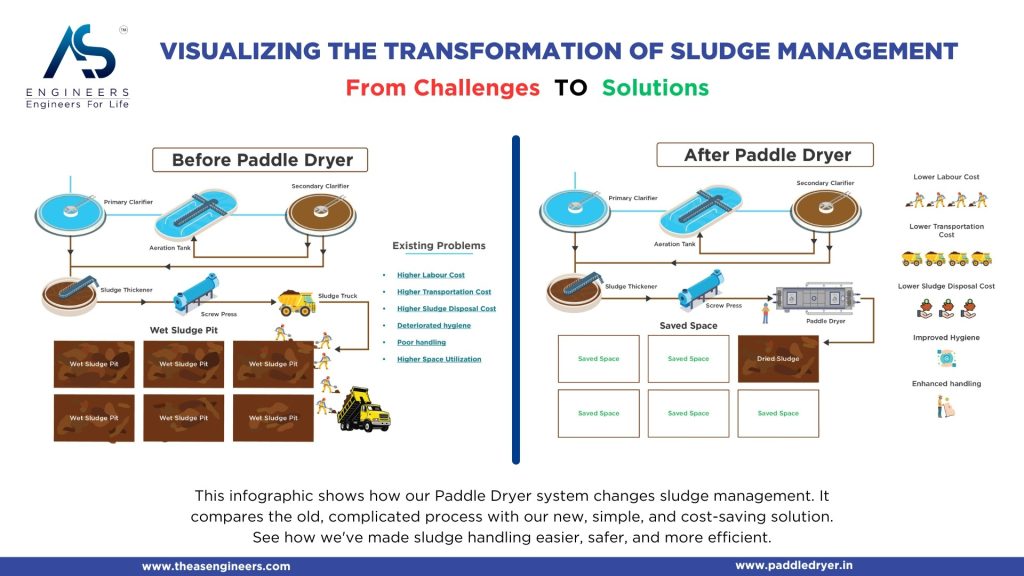
Key Design Areas in a Conductive Paddle Dryer System
Heating Medium
The heating medium decides heat-transfer behaviour, control range, utility cost, and system complexity. AS Engineers source documents describe indirect heating through steam and thermal oil, with steam up to 14.06 kg/cm² and thermal oil up to 400°C, depending on dryer design and application requirement.
Common options include:
| Heating source or medium | Practical use |
|---|---|
| Steam boiler | Common where process steam is already available |
| Thermic fluid | Useful when higher temperature control is needed |
| Hot water generator | Lower-temperature duties where suitable |
| Natural gas, LDO, coal, wood, briquette, electricity | Site-dependent fuel route for generating heat |
Do not choose fuel only by purchase price. Compare fuel availability, maintenance, emissions controls, operator skill, safety approvals, and actual moisture evaporation load.
Feed System
The feed system is often where sludge drying problems start. Sticky wet cake can bridge inside hoppers, overload screws, or enter the dryer unevenly.
Useful RFQ inputs include:
- Sludge source: ETP, STP, CETP, paper mill, chemical plant, pharma, food, textile, refinery, or other source
- Feed form: slurry, paste, wet cake, filter cake, granule, or mixed sludge
- Initial moisture percentage
- Daily throughput
- Bulk density
- Stickiness and lump size
- pH, chloride, sulphate, solvent, oil, heavy metal, and abrasive content
- Existing dewatering equipment
- Feeding hours per day
Dryer Body and Paddles
The dryer body must be selected for heat transfer, mechanical load, material behaviour, and corrosion. Important design points include:
- Hollow shaft heating
- Jacket heating
- Wedge or hammer-style paddle geometry
- Dual counter-rotating shafts where applicable
- Self-cleaning intermeshing action
- Low-speed, high-torque movement
- No uncontrolled metal-to-metal contact
- Residence-time control
- Access for maintenance and inspection
A useful buyer check is simple: ask how the dryer will handle the sticky phase. If this answer is weak, the selection is not ready.
Vapour Handling and Pollution Control
Moisture does not disappear. It becomes vapour and must be handled.
Depending on the sludge and site requirement, the system may need:
- Vapour ducting
- Cyclone separator
- Scrubber
- Condenser
- Bag filter
- ID fan
- Chimney
- Condensate handling
- Odour control
- Heat tracing to prevent condensation
- Instrumentation and interlocks
If the sludge contains only water vapour, the design is different from sludge containing solvents, VOCs, acids, odorous compounds, or fine carryover. For related system understanding, see thermal sludge drying system guide.
Product Handling
Dried sludge may be discharged into:
- Screw conveyor
- Bagging system
- Silo
- Bucket elevator
- Truck-loading system
- Container or disposal bin
The discharge route must match the final moisture and end use. Dried sludge for disposal, co-processing, fuel evaluation, brick use, cement use, or agricultural evaluation may need different moisture, size, packaging, and testing requirements.
Sludge Reuse Needs Testing, Not Assumptions
A common mistake is assuming that dried sludge automatically becomes fertilizer, fuel, or a saleable material. That is not safe.
Dried sludge can sometimes be evaluated for:
- Alternative fuel, if calorific value and contaminants are suitable
- Cement plant co-processing, where accepted by the receiving facility
- Brick or construction material blending, where allowed
- Soil or agricultural use, only when contaminant, pathogen, and local regulatory requirements are satisfied
Sludge can contain pathogens, heavy metals, and other contaminants. The European Commission notes that sewage sludge may contain contaminants but also valuable organic matter and nutrients, so its use must be regulated to protect soil, vegetation, animals, and people.
In practical plant language: drying improves handling and reduces water content. It does not automatically make sludge legally reusable.
RFQ Checklist for Conductive Sludge Dryer Selection
Before asking for a final offer, prepare these inputs:
| RFQ input | Why AS Engineers needs it |
|---|---|
| Sludge source and industry | ETP, STP, CETP, pharma, chemical, food, textile, paper, refinery, municipal, etc. |
| Initial moisture | Determines evaporation load |
| Final moisture target | Defines residence time, heating duty, and discharge handling |
| Feed rate | Required for sizing and throughput |
| Working hours per day | Affects equipment size and duty cycle |
| Sludge behaviour | Sticky, pasty, fibrous, abrasive, corrosive, oily, solvent-bearing, or granular |
| Lab analysis | Required for pH, ash, volatile matter, heavy metals, chloride, sulphate, oil/grease, calorific value, and hazards |
| Heating utility | Steam, thermic fluid, hot water, fuel route, electricity, or waste heat |
| Vapour route | Condenser, scrubber, cyclone, bag filter, ID fan, chimney, or solvent tank |
| Material of construction | CS, SS304, SS316, duplex, alloy, hard-facing, or special finish based on chemistry |
| Disposal/reuse route | TSDF, landfill, co-processing, cement, fuel, brick, or other permitted route |
| Site layout | Floor space, height, access, maintenance clearance, foundation, and utilities |
| Automation level | Manual, semi-automatic, or integrated control requirement |
Common Selection Mistakes
Choosing Dryer Size Only From Tons Per Day
A 10 TPD sludge load can behave very differently depending on initial moisture and final moisture target. Dryer duty must be based on water to be evaporated, not only wet tonnage.
Ignoring Sticky Phase Behaviour
Many sludges pass through a sticky phase during drying. If paddle geometry, mixing, residence time, and torque are not reviewed, buildup and uneven drying can occur.
Treating Vapour Handling as an Afterthought
Vapour handling should be part of the original design. Retrofitting ducts, scrubbers, condensers, or ID fans later can create layout and performance problems.
Expecting One MOC for Every Sludge
Municipal sludge, chemical sludge, biological sludge, paper sludge, and refinery sludge do not behave the same way. MOC selection should consider corrosion, abrasion, temperature, pH, chlorides, solvents, and cleaning requirement.
Skipping Pilot Trials
For unknown or high-risk sludge, pilot testing is often the safest route. It helps check feeding, sticking, drying curve, vapour load, final moisture, discharge behaviour, and handling.
AS Engineers source material mentions a 50 kg/hr paddle dryer pilot trial machine for demonstrations, with trials possible at AS Engineers’ works or at client site, subject to project review.
Maintenance Points for Paddle Dryer Operation
A conductive paddle dryer has fewer air-handling demands than many direct dryers, but it still needs disciplined maintenance. Plant teams should monitor:
- Shaft condition
- Paddle wear
- Gearbox health
- Bearing temperature and lubrication
- Drive alignment
- Seal condition
- Steam or thermic-fluid leakage
- Jacket and hollow shaft heat-transfer performance
- Build-up inside dryer body
- Vapour duct choking
- Cyclone, scrubber, bag filter, condenser, and ID fan condition
- Discharge conveyor loading
- Instrumentation and interlocks
For long-term reliability, maintenance should be planned before installation. AS Engineers also supports paddle dryer repair, OEM spare parts, shaft/gearbox/bearing replacement, system upgrades, retro-fitment, and service support.
Practical Buyer View: What I Check Before Recommending a Paddle Dryer
When I review a sludge dryer requirement, I do not start with dryer model size. I first check these points:
- What is the sludge source?
- Is the sludge already dewatered?
- What is the real inlet moisture?
- What final moisture is commercially useful?
- Is the target disposal, reduction, reuse, or co-processing?
- Does the sludge contain oil, solvent, salt, heavy metals, or hazardous constituents?
- What heating medium is available at site?
- Is vapour only water vapour, or does it need scrubbing/condensing?
- What is the available floor space?
- How will the dried sludge be collected?
- What proof is needed before purchase: lab test, pilot trial, GA drawing, utility estimate, or site visit?
This approach avoids one of the biggest buyer mistakes: selecting a dryer only because it is called a sludge dryer.
Conclusion
Conductive sludge dryers are useful in sludge treatment because they remove moisture through indirect heat transfer while keeping sludge enclosed, mixed, and continuously moving. In a paddle dryer, hollow shafts, heated paddles, and the jacket transfer heat into the sludge, while rotating paddles manage the sticky phase and move the material toward discharge.
For ETP, STP, CETP, municipal, chemical, paper, biological, and industrial sludge, paddle dryer selection should be based on feed moisture, final moisture target, sludge behaviour, heating medium, vapour handling, MOC, site layout, and disposal or reuse route.
If you are evaluating a conductive paddle dryer for sludge treatment, share your sludge source, moisture data, daily quantity, lab analysis, heating utility, vapour handling requirement, and final disposal or reuse plan. AS Engineers can review the duty condition and suggest a practical sludge drying configuration based on actual plant requirements.
Frequently Asked Questions
What is a conductive sludge dryer?
A conductive sludge dryer is an indirect thermal dryer that heats sludge through metal surfaces such as a jacket, hollow shaft, disc, or paddle. In a paddle dryer, heated paddles rotate inside the sludge while transferring heat and mixing the material.
How does a paddle dryer dry sludge?
A paddle dryer dries sludge by feeding wet sludge into an enclosed chamber where hollow shafts, heated paddles, and the jacket transfer heat into the material. The paddles mix and shear the sludge while moisture evaporates and vapours are removed through a suitable vapour-handling system.
Is a conductive paddle dryer suitable for ETP sludge?
Yes, a conductive paddle dryer can be suitable for many ETP sludge applications, but only after checking moisture, composition, stickiness, pH, salts, oil, solvents, hazardous constituents, heating medium, and disposal route. Unknown sludge should be tested before final selection.
Can dried sludge be reused?
Sometimes, but not automatically. Dried sludge may be evaluated for fuel, cement, brick, or agricultural use depending on lab results and local approvals. Drying reduces moisture and improves handling, but it does not remove every contaminant or guarantee reuse permission.
What data is required for sludge dryer RFQ?
Share sludge source, initial moisture, final moisture target, daily quantity, operating hours, sludge behaviour, lab analysis, heating medium, vapour handling requirement, MOC preference, site layout, and final disposal or reuse plan.