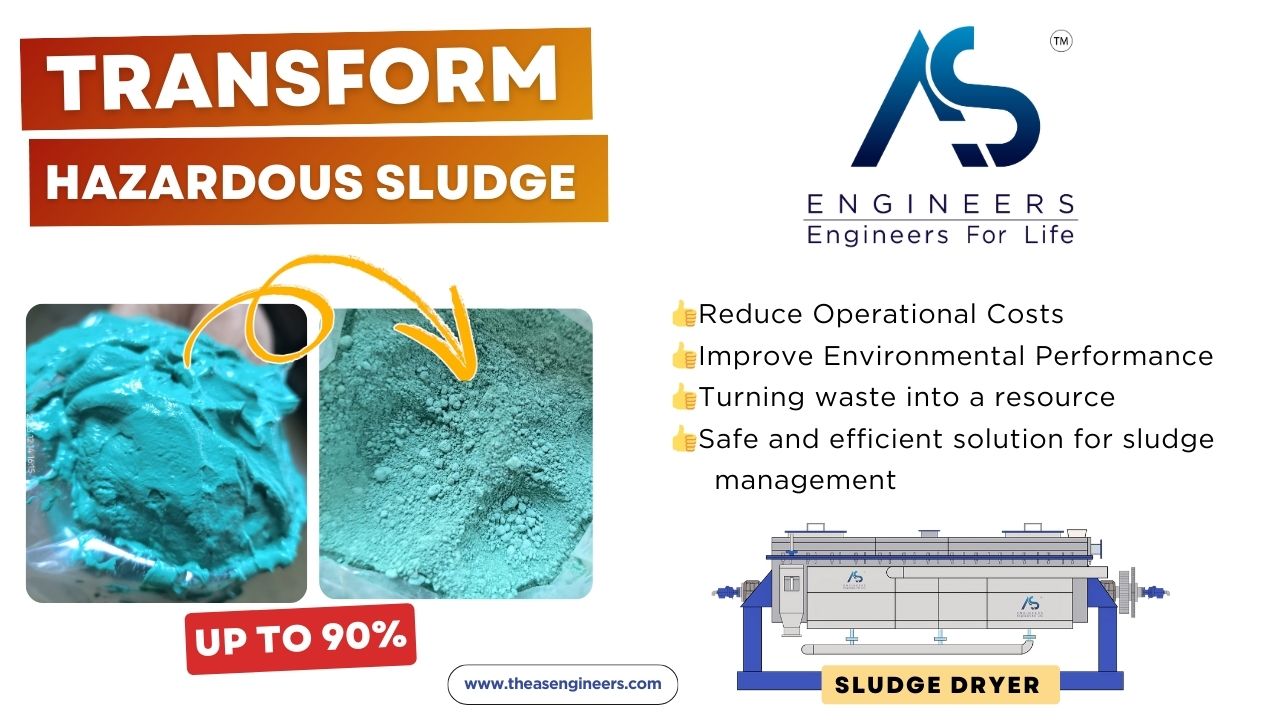
Hazardous sludge drying is the controlled thermal removal of moisture from industrial ETP sludge that may contain heavy metals, chemicals, toxic organics, solvents, salts, or biological contaminants. The goal is not just to “make sludge dry.” The real goal is to reduce handling risk, reduce disposal weight, improve storage hygiene, and prepare the sludge for authorised disposal, co-processing, incineration, or other approved routes based on lab analysis and local regulatory approval.
What Is Hazardous Sludge Drying?
Answer capsule: Hazardous sludge drying is a thermal treatment step used after mechanical dewatering to reduce moisture from difficult industrial sludge. It is common in chemical, pharma, textile, electroplating, refinery, dye, pigment, and CETP applications. A properly selected dryer must control vapour, odour, corrosion, stickiness, discharge behaviour, and pollution control load.
Hazardous sludge is not ordinary wastewater residue. It can carry chromium, nickel, cadmium, lead, solvents, oils, dyes, APIs, high chlorides, acidic residues, or other regulated substances depending on the industry.
This is why drying hazardous sludge needs a different mindset from drying food waste, biomass, or non-hazardous municipal sludge. The dryer must be selected around the sludge chemistry, not only the moisture percentage.
For buyers starting from the basics, the difference between general sludge and industrial sludge is explained in the industrial sludge management guide. For chemical-heavy streams, the chemical sludge treatment and reuse guide is a useful supporting read.
Why Does Hazardous Sludge Become a Serious Plant Risk?
Answer capsule: Hazardous sludge becomes risky because wet sludge is heavy, unstable, odorous, difficult to store, and costly to transport. If the sludge is corrosive or toxic, poor handling can also damage equipment and increase worker exposure. Drying helps, but only when the complete system includes safe feed handling, vapour treatment, discharge control, and authorised disposal planning.
In many plants, the ETP runs daily, but sludge planning is treated as an afterthought. That is where problems start.
Wet hazardous sludge creates five practical risks:
- High disposal weight because the plant is paying to move water.
- Poor storage hygiene because wet sludge smells, leaks, and attracts handling issues.
- Difficult manual handling because sticky sludge bridges, cakes, and blocks conveyors.
- Higher regulatory attention because hazardous waste needs traceable disposal.
- Equipment damage if corrosion, chlorides, abrasion, or solvent vapours are ignored.
A common mistake is assuming that a filter press has “solved” sludge disposal. A filter press reduces free water, but the cake may still be too wet, sticky, heavy, and unstable for easy disposal. The ETP sludge challenges and disposal solutions article explains this gap in more detail.
Dewatering vs Drying: Where Does Each Process Stop?
Answer capsule: Dewatering removes free water mechanically, while drying removes additional moisture using heat. Dewatering is usually the first step because it reduces load on the dryer. Drying is the next step when the plant needs lower disposal weight, better handling, stable storage, or a target moisture level for downstream use.
A plant should not compare dewatering and drying as if one replaces the other. They work in sequence.
Dewatering equipment such as filter presses, centrifuges, belt presses, and screw presses reduces moisture without thermal energy. This is useful, but it cannot remove bound moisture effectively. Once sludge becomes a wet cake, further moisture reduction usually needs heat.
Drying then converts that wet cake into a more manageable dry solid or semi-dry solid, depending on the target. The exact outlet moisture should be decided after feed testing, disposal route selection, and buyer acceptance criteria.
For process comparison, review sludge dewatering techniques before selecting the dryer. For a wider technology view, use the guide to sludge dryers.
How Does an Indirect Paddle Dryer Handle Hazardous Sludge?
Answer capsule: An indirect paddle dryer dries sludge through heated hollow shafts, paddles, and jacket surfaces without direct flame contact with the sludge. The enclosed design helps control vapour volume, odour, and operator exposure. This makes paddle drying suitable for many sticky, pasty, corrosive, and hazardous ETP sludge streams when the system is correctly engineered.
In a paddle dryer, sludge enters a heated trough where rotating shafts and wedge-shaped paddles continuously mix, shear, and expose wet material to heated surfaces. Heat is transferred indirectly through steam, thermal oil, or another selected heating system.
For hazardous sludge, indirect heating matters because it avoids blowing large volumes of hot air directly through toxic or odorous sludge. Lower vapour volume usually makes downstream vapour handling more practical.
A hazardous sludge dryer system may include:
- Wet sludge storage and controlled feeding.
- Paddle dryer with suitable material of construction.
- Vapour ducting to condenser, scrubber, or other pollution control equipment.
- Dried sludge discharge through screw conveyor, bagging, silo, or truck loading.
- Dust, odour, and vapour control based on site risk.
AS Engineers’ paddle dryer design uses hollow shafts and jacket heat transfer, with steam pressure capability up to 14.06 kg/cm² and thermal oil temperature capability up to 400°C, depending on application selection. The design is relevant for sludge, paste, cake, granule, and powder handling where indirect heat transfer is preferred.
For technical background, see hollow paddle dryer technology and AS Engineers’ paddle dryer for wastewater treatment.
What Should Buyers Check Before Selecting a Hazardous Sludge Dryer?
Answer capsule: Buyers should check feed moisture, sludge chemistry, corrosiveness, stickiness, volatile content, target outlet moisture, fuel availability, disposal route, site layout, and pollution control requirement before selecting a dryer. Dryer sizing without sludge characterisation is risky. A pilot trial is the safest way to confirm drying behaviour before final design.
The most important selection factor is not only capacity. It is sludge behaviour.
On the shop floor and during commissioning, the difficult points usually appear in four areas: feeding, sticking, vapour handling, and discharge. Sticky sludge can bridge in hoppers. High-chloride sludge can attack weak material selection. Fine dried sludge can create dust. Solvent-bearing sludge needs stronger vapour control.
Before finalising a system, the plant should prepare:
- Inlet moisture range.
- Daily sludge quantity.
- pH, chloride, heavy metal, oil, solvent, and ash data.
- Current dewatering method.
- Required outlet moisture.
- Disposal or reuse pathway.
- Available fuel or utility.
- Site layout and height restrictions.
- Pollution control expectations.
- Operator access and maintenance access.
For sludge dryer selection logic, the thermal sludge drying system guide is useful. For hazardous waste disposal context, review CPCB guidelines for hazardous waste disposal.
Hazardous Sludge Drying Decision Table for Plant Teams
Answer capsule: A hazardous sludge drying project should be evaluated as a complete drying and handling system, not as a standalone machine purchase. The table below shows the key buyer decisions that affect safety, cost, reliability, and approval risk. Exact values should be confirmed through sludge testing and engineering review.
| Buyer decision area | What to check | Risk if ignored | Safe selection approach |
|---|---|---|---|
| Sludge chemistry | pH, chlorides, solvents, oils, heavy metals | Corrosion, unsafe vapour, poor disposal route | Requires lab report and engineering review |
| Moisture range | Average and peak inlet moisture | Undersized dryer or unstable discharge | Use realistic operating range, not one sample |
| Stickiness | Plastic, pasty, or lumpy behaviour | Hopper bridging, shaft load, discharge blockage | Needs pilot trial or material test |
| Material of construction | CS, SS304, SS316, Duplex Steel, other alloys | Premature wear or corrosion failure | Match MOC to sludge chemistry |
| Vapour handling | Water vapour, odour, VOCs, acid mist | Odour complaint, unsafe release, scrubber overload | Use condenser, scrubber, cyclone, or bag filter as required |
| Heating utility | Steam, thermal oil, fuel source | High operating cost or unstable temperature | Select based on site utility and drying target |
| Disposal route | TSDF, co-processing, incineration, approved reuse | Dry sludge may still be rejected | Confirm acceptance criteria before design |
| Maintenance access | Shaft, paddles, bearings, seals, covers | Downtime and unsafe cleaning | Plan access before layout approval |
The buyer mistake I see most often is selecting a dryer based on wet sludge tonnage alone. Two plants may both say “5 TPD sludge,” but one sludge may be easy biological cake while another may be sticky, corrosive chemical ETP sludge. The dryer design should not be the same.
For broader volume-reduction thinking, see methods to reduce hazardous waste weight.
What Happens to Dried Hazardous Sludge After Drying?
Answer capsule: Dried hazardous sludge still needs authorised handling. Drying reduces moisture and improves handling, but it does not automatically make hazardous sludge non-hazardous. Final disposal or reuse depends on chemical analysis, calorific value, ash, metals, acceptance criteria, and approval from the relevant authority or authorised facility.
Drying gives the plant more options, but it does not remove responsibility.
Possible downstream routes include:
- Authorised TSDF disposal.
- Incineration where permitted.
- Cement kiln co-processing if the sludge meets acceptance criteria.
- Approved waste-to-energy route where applicable.
- Approved reuse for mineral-rich sludge only after testing and clearance.
Dry sludge is usually easier to store, load, transport, and feed than wet sludge. It also reduces the volume and weight sent outside the plant, which is why drying often becomes a disposal-cost decision as much as a treatment decision.
The industrial sludge disposal guide explains disposal routes in more depth. For waste-to-resource thinking, see ETP sludge management.
Where AS Engineers Fits in a Hazardous Sludge Drying Project
Answer capsule: AS Engineers supports hazardous sludge drying projects through paddle dryer design, utility selection, material handling planning, pollution-control integration, and trial-based validation. The company manufactures from GIDC Vatva, Ahmedabad, Gujarat, India and works with industrial drying, sludge drying, and related process equipment. AS Engineers is positioned as “The Leading Name in Paddle Dryer Industry” and has 25+ years of experience, 500+ clients, 1500+ projects, and 500+ dryers operational.
For hazardous sludge, the practical value is not only the dryer body. It is the engineering judgement around sludge behaviour.
AS Engineers can evaluate whether a standard dryer, dual-zone dryer, or vacuum dryer is more suitable. The company also offers material options such as Carbon Steel, SS304, SS316, Duplex Steel, and other alloys based on application need.
A 50 kg/hr pilot trial machine is available for performance evaluation, issue identification, feasibility checking, and process optimisation. For difficult hazardous sludge, this trial step is often the difference between assumption-based buying and confident design. You can also review the paddle dryer pilot trial page.
For equipment alignment, see AS Engineers’ sludge dryer manufacturer page. For chemical ETP streams, the chemical sludge treatment and disposal page is closely relevant. Where vapour and odour control is part of the project, AS Engineers’ scrubber manufacturers page supports the downstream pollution-control discussion.
FAQs
1. Is hazardous sludge drying enough to make sludge safe for disposal?
Hazardous sludge drying reduces moisture, improves handling, and can support safer storage and transport. It does not automatically remove hazardous classification. Final disposal must still follow lab analysis, authorised facility acceptance, and the applicable regulatory pathway.
2. Which dryer is best for sticky hazardous ETP sludge?
An indirect paddle dryer is often suitable for sticky hazardous ETP sludge because it provides continuous mixing, high contact with heated surfaces, and enclosed vapour handling. Final suitability depends on sludge chemistry, inlet moisture, stickiness, volatility, and required outlet moisture.
3. What material of construction is suitable for corrosive hazardous sludge?
Material selection depends on pH, chlorides, solvents, temperature, and abrasion. Carbon Steel may suit some non-corrosive streams, while SS304, SS316, Duplex Steel, or other alloys may be needed for more aggressive sludge. The correct MOC should be selected after reviewing lab data.
4. Should we run a pilot trial before buying a hazardous sludge dryer?
Yes, a pilot trial is strongly recommended for hazardous, sticky, variable, or corrosive sludge. It helps confirm feed behaviour, drying time, discharge quality, vapour load, and achievable moisture target before final machine sizing.
5. Can dried hazardous sludge be used in cement plants or incineration?
It may be possible if the dried sludge meets the acceptance criteria for calorific value, ash, heavy metals, moisture, and handling safety. This must be confirmed with the receiving facility and the relevant regulatory authority. Drying improves feasibility, but approval is application-specific.
Closing
Hazardous sludge drying should be engineered from sludge sample to discharge point, not selected only by capacity. If your plant is dealing with sticky, corrosive, odorous, or disposal-heavy ETP sludge, AS Engineers can review your sludge data, utility condition, layout, and target outlet moisture before recommending the right system. Start with a technical discussion through AS Engineers paddle dryer services.