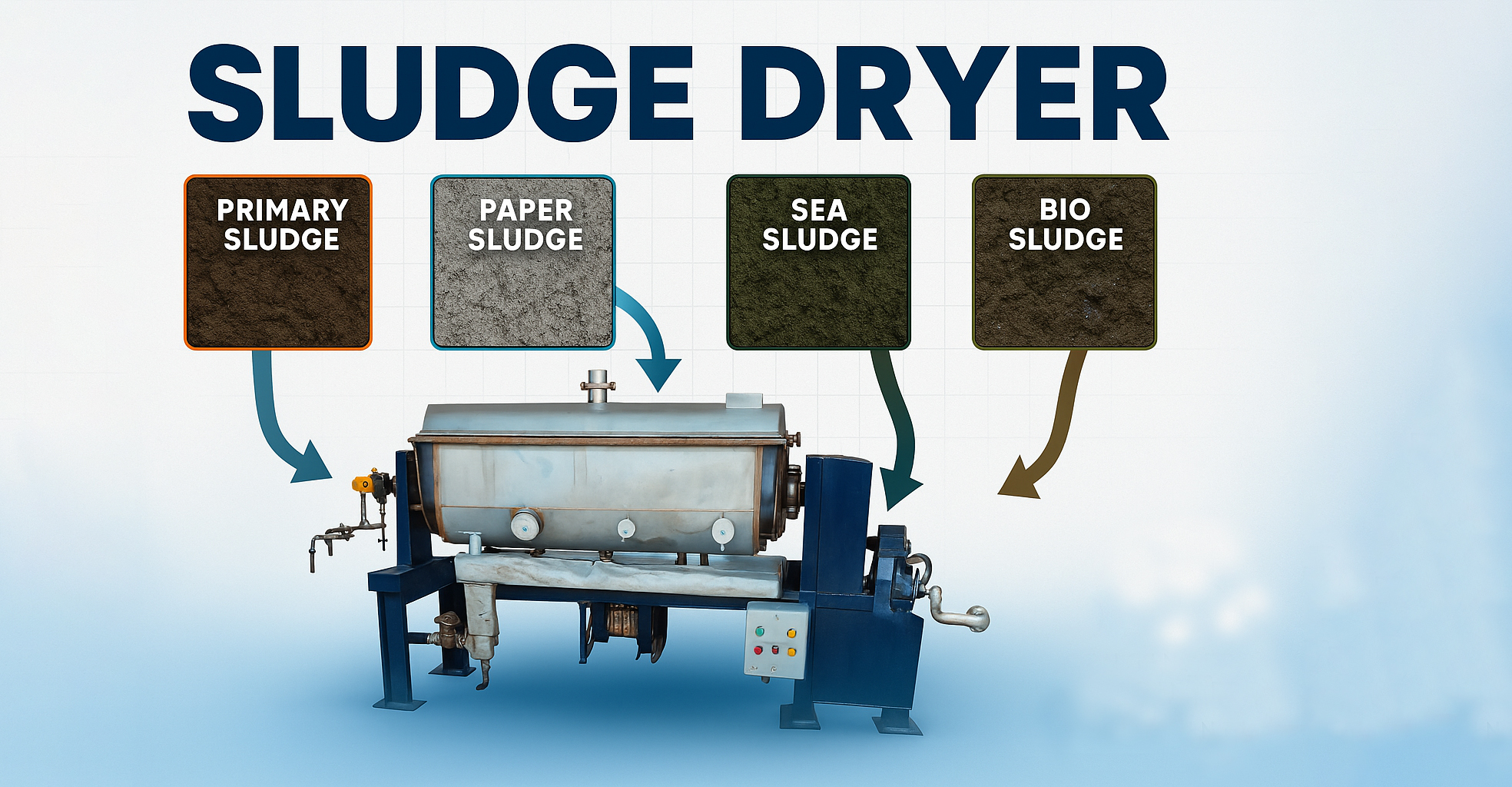
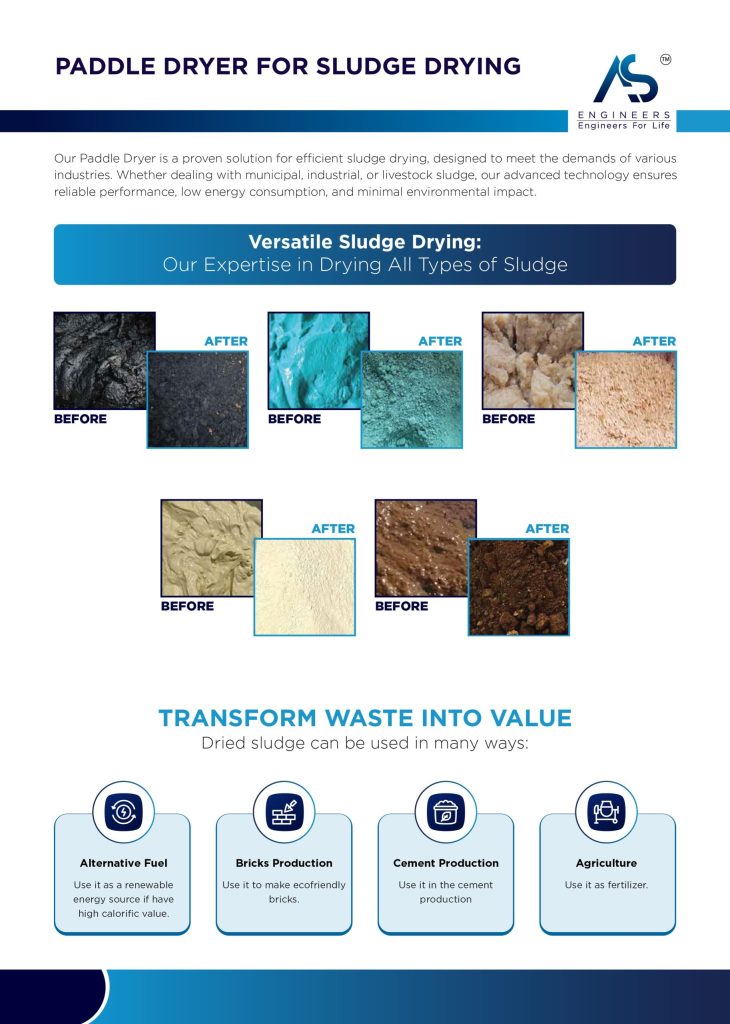
A sludge dryer is a thermal drying system used after sludge dewatering to reduce moisture, volume, handling difficulty, storage load, and disposal weight. For ETP and STP plants, the right sludge dryer is not selected by machine name alone. It is selected from sludge type, inlet moisture, final moisture target, daily wet-cake quantity, stickiness, heat source, vapour treatment, available space, and final disposal or reuse route.
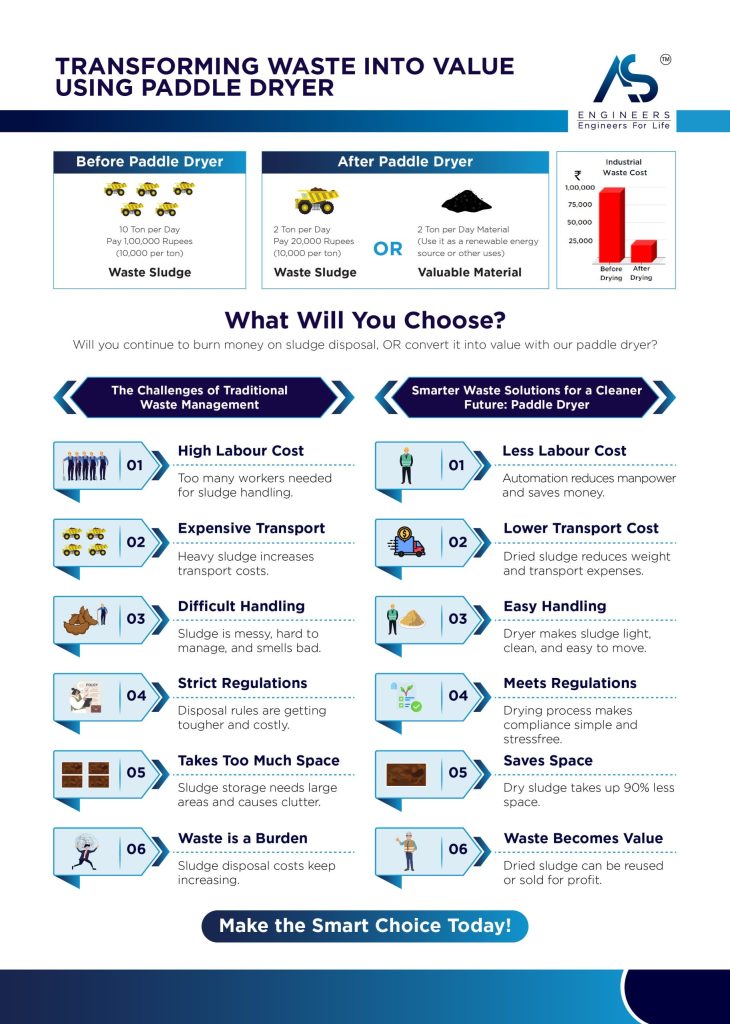
In many plants, the real problem is not only “wet sludge.” The bigger issue is that wet sludge is heavy, inconsistent, difficult to store, costly to transport, and harder to document for disposal. A properly selected sludge drying system helps convert that wet cake into a more stable, lighter, and easier-to-handle output.
Quick Answer: When Does a Sludge Dryer Make Sense?
A sludge dryer makes sense when your plant already has sludge dewatering, but the discharged cake is still too wet, heavy, sticky, or costly to handle.
It is usually worth evaluating a sludge dryer when:
| Plant Situation | Why Drying Helps |
|---|---|
| Wet sludge transport cost is high | Lower moisture reduces weight and disposal load |
| Sludge storage space is limited | Dried sludge occupies less space than wet cake |
| Dewatered cake is sticky or difficult to move | Thermal drying can improve handling behavior |
| Disposal vendors charge by weight | Moisture reduction can reduce disposal burden |
| Sludge has possible reuse value | Drying may support cement, fuel, brick, or fertilizer routes, only where testing and permission allow |
| ETP/STP sludge output is consistent | Continuous or semi-continuous drying becomes easier to plan |
A dryer should not be treated as a shortcut for poor dewatering. First check whether your filter press, centrifuge, belt press, or screw press is performing properly. If dewatering is weak, the dryer will receive unnecessary water load, which increases heating demand.
For readers who are still at the earlier stage, first review why sludge dewatering is important before drying and how to choose the right sludge dewatering equipment.
Where a Sludge Dryer Fits in the Treatment Line
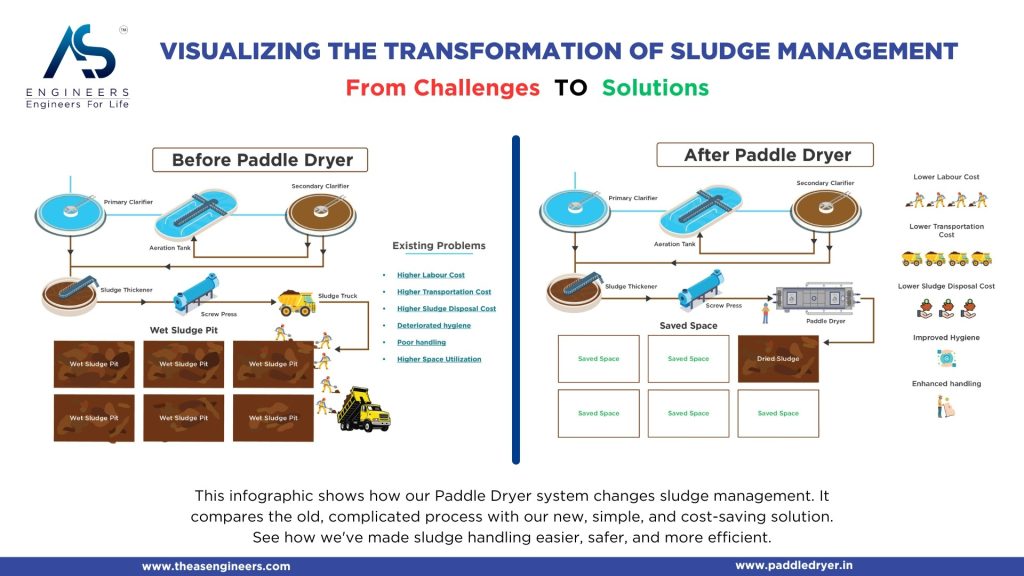
A sludge dryer usually comes after thickening and mechanical dewatering.
A practical sludge processing route looks like this:
Wastewater treatment → sludge thickening → sludge dewatering → sludge drying → vapour treatment → dried sludge handling → disposal or reuse
Before you select the dryer, understand the sludge source. ETP sludge from chemical, textile, pharma, food, dye, paper, or refinery plants behaves differently from municipal STP sludge. Biological sludge, chemical sludge, oily sludge, hazardous sludge, and mixed sludge all need different handling logic.
For basic sludge classification, see what sludge is and how it is formed.
Data Required Before Selecting a Sludge Dryer
Do not start with dryer capacity or motor HP. Start with sludge data.
| Input Required | Why It Matters |
|---|---|
| Wet sludge quantity, kg/day or kg/hr | Defines feed load |
| Inlet moisture range | Determines water evaporation load |
| Target final moisture | Defines dried output and heat duty |
| Sludge source | ETP, STP, CETP, chemical, pharma, textile, food, paper, municipal |
| Sludge behavior | Sticky, pasty, fibrous, granular, abrasive, corrosive, heat-sensitive |
| pH and chemical composition | Helps decide material of construction and safety review |
| Solvent, odour, VOC, or oil presence | Affects vapour handling and condenser/scrubber requirement |
| Hazardous waste classification | Affects disposal, documentation, and EHS review |
| Available heat source | Steam, thermic fluid, hot water, gas, coal, biomass, electricity |
| Operating hours | Affects dryer size and duty cycle |
| Final disposal or reuse route | Determines final moisture target and product handling |
| Existing pollution-control system | Helps decide cyclone, scrubber, bag filter, condenser, chimney, and ID fan scope |
When I review a sludge drying requirement, I first ask for moisture data and sludge behavior. Two sludge samples with the same moisture percentage can behave very differently inside the dryer if one is sticky chemical sludge and the other is biological STP sludge.
Sludge Dryer Types: Practical Comparison
Different sludge dryers solve different problems. The best dryer is the one that matches feed behavior, heat source, space, emissions control, and final product requirement.
| Dryer Type | Heat Transfer Method | Best Fit | Practical Caution |
|---|---|---|---|
| Paddle dryer | Mostly indirect heat transfer through hollow shafts, jacket, and heated paddles | Sticky, pasty, dewatered ETP/STP sludge where enclosed operation and compact layout are needed | Needs correct feed control, MOC, vapour handling, and torque design |
| Belt dryer | Hot air passes through or over a sludge layer on a belt | Spreadable sludge, larger floor area, low-temperature drying | Feed must spread evenly; odour and air volume handling can become large |
| Rotary dryer | Direct or indirect rotating drum drying | Granular or less sticky bulk solids | Sticky sludge can build up unless pre-conditioned |
| Fluidized bed dryer | Heated air fluidizes particles | Granular, conditioned, or pelletized feed | Not suitable for very sticky wet cake without pre-treatment |
| Solar dryer | Sun-assisted drying in covered drying beds or greenhouse systems | Low energy approach where land and climate allow | Weather-dependent, space-heavy, slower, less predictable during monsoon |
| Disc or thin-film dryer | Indirect heating through discs or heated surfaces | Certain industrial sludge and pastes | Selection depends strongly on sludge rheology and maintenance access |
For a closer comparison, see paddle dryer vs solar bed for sludge drying and the sludge-focused thermal sludge drying system guide.
Why Paddle Dryers Are Often Used for ETP and STP Sludge
A paddle dryer is commonly selected for industrial sludge because it uses indirect heating and strong mechanical agitation. In a typical paddle dryer, heat is transferred through hollow shafts, jacketed body surfaces, and paddles while the sludge is mixed and moved forward.
AS Engineers’ paddle dryer design can be configured with steam or thermic fluid heating, hollow shafts, jacket heating, wedge-shaped self-cleaning paddles, dual counter-rotating shafts, plug-flow movement, and suitable material of construction such as CS, SS304, SS316, Duplex Steel, or other alloys depending on duty conditions.
This makes the paddle dryer useful when the sludge is:
| Sludge Condition | Why Paddle Dryer Helps |
|---|---|
| Sticky or pasty | Paddles break and mix the sludge during drying |
| High moisture after dewatering | Indirect heat supports controlled evaporation |
| Space-constrained | Compact layout compared with some large drying systems |
| Odorous or vapour-forming | Enclosed design supports controlled vapour handling |
| Variable in feed behavior | Mechanical mixing can handle a wider range than passive drying |
| Disposal-cost sensitive | Moisture reduction can reduce weight and handling burden |
For more technical detail, read sludge treatment with conductive paddle dryers and the paddle dryer configuration guide.
Basic Sludge Dryer Sizing Logic
Sludge dryer sizing starts with moisture balance, not just wet sludge quantity.
Use this simple mass-balance method for first-level estimation:
| Step | Formula |
|---|---|
| Dry solids | Wet sludge quantity × (1 − inlet moisture fraction) |
| Dried output | Dry solids ÷ (1 − target final moisture fraction) |
| Water to evaporate | Wet sludge quantity − dried output |
Example:
If your plant generates 1,000 kg/day wet sludge at 75% moisture and wants to dry it to 20% final moisture:
| Item | Calculation | Result |
|---|---|---|
| Wet sludge feed | Given | 1,000 kg/day |
| Dry solids | 1,000 × 25% | 250 kg/day |
| Dried output | 250 ÷ 80% | 312.5 kg/day |
| Water evaporation load | 1,000 − 312.5 | 687.5 kg/day |
This is only the first calculation. Final sizing also needs operating hours, moisture variation, sludge stickiness, residence time, bulk density, heat-transfer area, heating medium temperature, vapour load, and safety margin.
Key Integration Points in a Sludge Drying System
A sludge dryer is not only one machine. It is a system. Poor integration can create feeding problems, vapour handling issues, odour complaints, poor final moisture, and maintenance load.
Feeding System
The feed system must deliver wet sludge at a controlled and steady rate.
Common feeding arrangements include:
| Feeding Option | Where It Fits |
|---|---|
| Screw feeder | Dewatered cake and semi-solid sludge |
| Belt conveyor | Cake transfer from filter press or storage area |
| Sludge pump | Pumpable sludge or slurry before higher-solids cake stage |
| Wet material silo or hopper | Buffer between dewatering and drying |
If the sludge comes in batches from a filter press, the feed system must smooth out the batch nature before continuous drying.
Heating System
The heat source decides the economics and operating stability of the dryer.
Common heating arrangements include:
| Heat Source | Practical Note |
|---|---|
| Steam | Useful where boiler steam is already available |
| Thermic fluid | Useful for higher temperature indirect heating |
| Hot water | Used where lower temperature drying is suitable |
| Direct fuel-based system | Needs site-specific heat integration and safety review |
| Electricity | Usually considered where scale, control, or utility constraints justify it |
AS Engineers’ sludge/paddle dryer systems can be configured around available site utilities such as steam boiler, thermic fluid, hot water generator, or fuel-based heating systems depending on the duty requirement.
Dryer Body and Mechanical Design
The dryer body must match sludge behavior. Sticky sludge needs torque, mixing, and self-cleaning action. Corrosive sludge needs suitable MOC. Abrasive sludge needs wear-aware design. Solvent-bearing sludge needs enclosed vapour management.
Important design points include:
| Design Point | Why It Matters |
|---|---|
| Paddle geometry | Affects mixing, shearing, and self-cleaning |
| Shaft design | Affects heat transfer and mechanical reliability |
| Drive and gearbox | Must handle starting torque and sludge load |
| MOC | Depends on pH, chlorides, solvents, corrosion, and abrasion |
| Sealing | Important for vapour, odour, and dust control |
| Access doors | Needed for inspection and maintenance |
Vapour and Pollution-Control System
During drying, evaporated water, vapours, fine particles, odour, and solvent traces may leave the dryer. The vapour handling system must be designed from actual sludge composition.
Possible system components include:
| Component | Function |
|---|---|
| ID fan | Moves vapour through the system |
| Cyclone | Separates coarse fines |
| Scrubber | Handles odour, soluble gases, or vapour treatment where suitable |
| Bag filter | Handles dry dust where applicable |
| Condenser | Used when solvent or condensable vapour recovery is needed |
| Chimney | Final discharge point after suitable treatment |
For air pollution control and vapour-side selection, the system must be reviewed according to actual site duty, not copied from another plant.
Dried Product Handling
Dried sludge handling must be planned before equipment purchase.
Possible output handling systems include:
| Output System | Use |
|---|---|
| Screw conveyor | Transfers dried sludge from discharge |
| Rotary airlock valve | Controlled discharge where air separation is required |
| Bagging system | Manual, semi-automatic, or automatic bagging |
| Silo or bin | Intermediate dried sludge storage |
| Truck loading | Bulk disposal or co-processing route |
The final handling method depends on whether the dried product will go to TSDF, landfill, cement co-processing, captive incineration, brick production, fertilizer route, or another permitted route.
Cost and ROI: What to Calculate Before Purchase
Do not rely on generic payback claims. Sludge drying economics change from plant to plant.
Calculate these inputs first:
| Cost Input | Why It Changes the ROI |
|---|---|
| Wet sludge disposal cost | Higher disposal rate improves drying economics |
| Current sludge quantity | Higher daily wet sludge volume improves utilization |
| Inlet moisture | More moisture means more heat duty |
| Final moisture target | Lower final moisture needs more energy |
| Fuel or steam cost | Directly affects operating cost |
| Operating hours | Affects dryer size and capacity utilization |
| Labour and storage cost | Drying can reduce handling pressure |
| Pollution-control scope | Adds capital and maintenance cost |
| MOC requirement | Corrosive sludge may need higher-cost materials |
| Maintenance and spares | Must be included in lifecycle cost |
A good sludge dryer ROI study should compare the current wet sludge route with the proposed dried sludge route using the plant’s own data.
For deeper cost planning, see industrial sludge dryer machine price and the hidden cost of wet sludge disposal.
Fit and No-Fit Guide
Good Fit for a Sludge Dryer
A sludge dryer is a strong fit when:
| Condition | Reason |
|---|---|
| Sludge is already dewatered | Dryer receives less free water |
| Daily sludge generation is predictable | Capacity can be matched properly |
| Disposal is weight-based | Moisture reduction can reduce disposal load |
| Site has heat utility | Steam or thermic fluid improves feasibility |
| Sludge is difficult to store | Drying improves storage and handling |
| Final disposal or reuse route is known | Output moisture can be designed accordingly |
Needs Extra Review Before Final Selection
A sludge dryer needs deeper technical review when:
| Condition | Risk |
|---|---|
| Sludge composition is unknown | MOC, vapour, and safety risks remain unclear |
| Sludge contains solvents or VOCs | Condensation, recovery, and safety review may be required |
| Sludge is hazardous | Disposal and documentation remain regulated even after drying |
| Feed moisture varies widely | Dryer may face unstable output moisture |
| Sludge is highly abrasive or corrosive | Wear and material selection become critical |
| Plant has no clear disposal route | Drying alone does not solve final disposal responsibility |
For hazardous waste-related planning, review CPCB guidelines for hazardous waste disposal and verify the final route with the plant’s EHS consultant or regulatory advisor.
RFQ Checklist for a Sludge Dryer
Before requesting a quotation, prepare this data:
| RFQ Input | Details to Share |
|---|---|
| Industry | Chemical, pharma, textile, food, paper, municipal, refinery, CETP, etc. |
| Sludge source | ETP, STP, primary, secondary, biological, chemical, mixed |
| Wet sludge quantity | kg/hr, kg/day, or tons/day |
| Inlet moisture | Average plus minimum and maximum range |
| Target final moisture | Required final moisture or dry solids |
| Sludge analysis | pH, chloride, ash, volatile matter, heavy metals, oil, solvents, calorific value if reuse is planned |
| Physical behavior | Sticky, pasty, fibrous, granular, abrasive, corrosive |
| Dewatering equipment | Filter press, centrifuge, screw press, belt press, drying bed, or other |
| Heating medium | Steam pressure, thermic fluid temperature, fuel availability |
| Operating hours | Hours/day and days/month |
| Site layout | Available floor space, height, access, civil constraints |
| Pollution-control need | Existing scrubber, bag filter, cyclone, chimney, condenser |
| Output handling | Bagging, silo, truck loading, conveyor, disposal vendor requirement |
| Documentation need | Test reports, drawings, inspection, material certificates, or compliance documentation as applicable |
This RFQ preparation reduces back-and-forth and helps avoid wrong sizing.
Common Mistakes in Sludge Dryer Selection
| Mistake | What Happens |
|---|---|
| Selecting only by wet sludge tons/day | Dryer may be undersized or oversized because moisture load is ignored |
| Ignoring inlet moisture variation | Final moisture becomes inconsistent |
| Not testing sticky sludge behavior | Feeding, buildup, and torque issues may appear |
| Using generic MOC | Corrosion or wear risk increases |
| Forgetting vapour treatment | Odour, condensate, fines, or emission issues may occur |
| Not planning dried product handling | Dry sludge discharge becomes a new bottleneck |
| Assuming drying removes regulatory responsibility | Hazardous or regulated waste may still require authorized handling |
| Treating payback as fixed | Actual economics may differ from brochure-style assumptions |
Maintenance and EHS Notes
A sludge dryer should be reviewed as a rotating, heated, enclosed process system. Maintenance planning should include shafts, bearings, gearbox, seals, paddles, vapour ducts, discharge system, feeders, and pollution-control equipment.
Recommended operating checks include:
| Area | What to Monitor |
|---|---|
| Feed system | Bridging, inconsistent feed, screw wear, hopper blockage |
| Dryer body | Buildup, abnormal noise, temperature variation |
| Drive system | Gearbox load, vibration, lubrication, alignment |
| Seals | Vapour leakage, dust escape, odour signs |
| Vapour line | Condensation, choking, dust carryover |
| Pollution-control system | Scrubber flow, bag filter DP, cyclone discharge, condenser performance |
| Output | Final moisture, lumps, dust, discharge flow |
Drying can reduce volume and improve handling, but it does not automatically make sludge non-hazardous or freely reusable. Final disposal or reuse must follow sludge composition, test results, and applicable regulatory permissions.
AS Engineers Approach to Sludge Dryer Selection
AS Engineers designs and manufactures paddle dryers and sludge dryers for industrial drying applications. The system can include feeding, indirect heating, paddle drying, vapour handling, pollution-control equipment, solvent or condensate management, and dried product handling depending on the requirement.
For sludge dryer selection, the AS Engineers team reviews:
| Review Area | Why It Matters |
|---|---|
| Sludge type and source | Defines process risk |
| Moisture profile | Defines evaporation load |
| Final product requirement | Defines drying target |
| Heating medium | Defines thermal design |
| MOC | Defines corrosion and wear resistance |
| Site layout | Defines integration plan |
| Vapour handling | Defines pollution-control scope |
| Maintenance access | Defines long-term reliability |
AS Engineers also supports repair, upgrades, retrofitment, shaft, gearbox, bearing replacement, OEM spare parts, and service support for paddle dryer systems.
For application-level guidance, see sludge dryer machine applications and scope and ETP sludge challenges and drying solutions.
FAQs
What is a sludge dryer?
A sludge dryer is a thermal system used to remove moisture from dewatered sludge. It reduces weight, improves handling, reduces storage burden, and prepares sludge for approved disposal or reuse routes.
Which sludge dryer is best for sticky ETP sludge?
For sticky, pasty, dewatered ETP sludge, an indirect paddle dryer is often suitable because it combines heated surfaces, mechanical mixing, and enclosed vapour handling. Final selection still depends on sludge analysis, moisture, stickiness, MOC, heat medium, and disposal route.
Can a sludge dryer replace a filter press or screw press?
Usually no. A sludge dryer should normally come after mechanical dewatering. If liquid sludge is sent directly to a dryer, the evaporation load becomes high and operating cost can increase. Dewatering first usually improves drying economics.
How do I calculate sludge dryer capacity?
Start with a moisture balance. Calculate dry solids from wet sludge quantity and inlet moisture, then calculate dried output from the target final moisture. The difference between wet feed and dried output is the water evaporation load. Final sizing needs equipment design review.
What information is needed for a sludge dryer quotation?
Share wet sludge quantity, inlet moisture, final moisture target, sludge source, sludge analysis, pH, stickiness, abrasiveness, heating medium, operating hours, site layout, pollution-control requirement, and final disposal or reuse plan.
Conclusion
A sludge dryer should be selected from real plant data, not only from brochure capacity or machine name. The most important inputs are sludge type, wet quantity, inlet moisture, target final moisture, heat medium, sludge behavior, MOC, vapour handling, pollution-control requirement, and final disposal route.
For ETP and STP plants, the strongest results usually come when dewatering, drying, vapour treatment, and dried product handling are designed as one connected system. Share your sludge analysis, moisture range, daily quantity, available utilities, and site layout with AS Engineers so the sludge drying system can be reviewed around actual operating conditions.