What is municipal sludge, and why does it need drying?
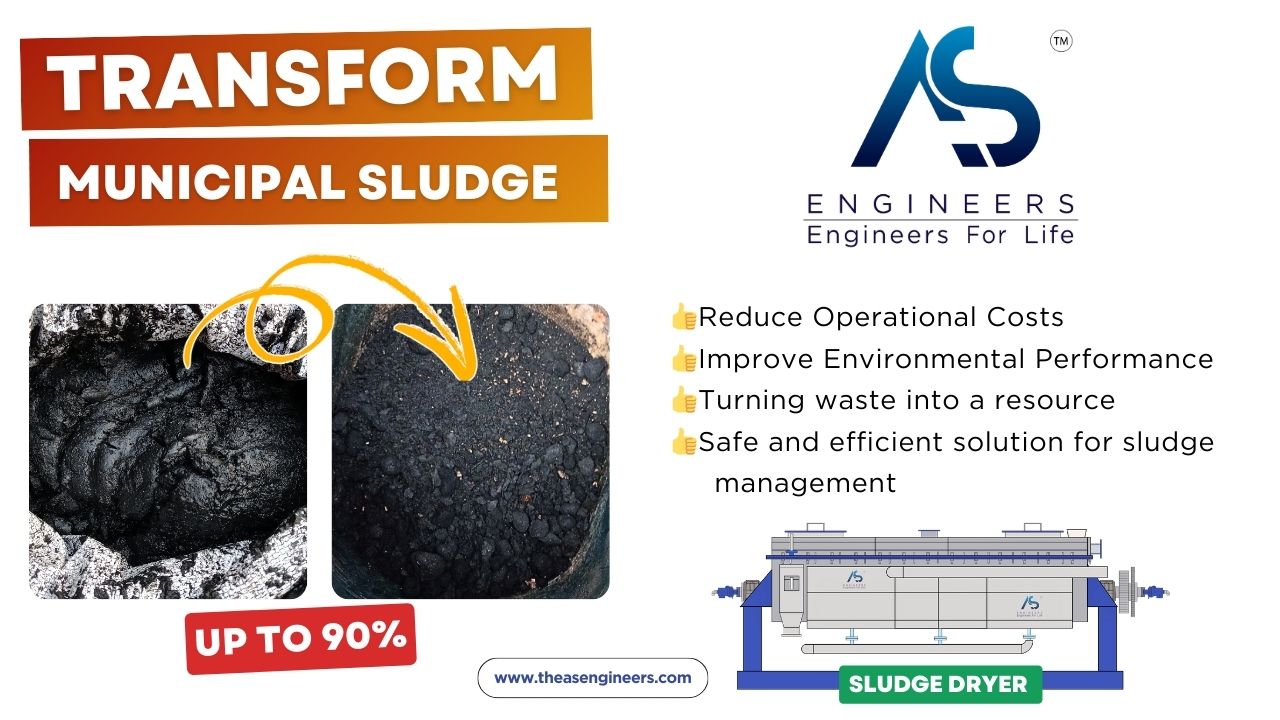
Municipal sludge is the semi-solid residue generated after sewage treatment in an STP. A municipal sludge dryer reduces moisture so the sludge becomes easier to store, transport, document, and send for approved disposal or reuse.
For most STP operators, the problem is not only sludge generation. The real problem is wet sludge handling. Dewatered municipal sludge still behaves like a heavy, sticky cake. It occupies space, smells quickly, attracts hygiene complaints, and increases vehicle trips.
A dryer does not replace biological treatment or dewatering. It comes after thickening and dewatering, when the plant already has sludge cake from a centrifuge, belt press, screw press, or filter press. For a wider process context, see this guide on sewage sludge treatment and the different types of sewage sludge.
Where does a municipal sludge dryer fit after dewatering?
Dewatering removes free water. Drying removes more bound moisture and improves final sludge handling. This is why STP sludge drying should be treated as the final volume-reduction step, not as a replacement for dewatering.
A good plant sequence is: sludge collection, thickening, stabilization if required, mechanical dewatering, then thermal drying. When dewatering is weak, the dryer carries unnecessary moisture load. When dewatering is stable, the dryer can run with better heat use and steadier discharge.
Many buyer mistakes start here. They compare a dryer without checking inlet moisture variation. If the cake sometimes comes at 65% moisture and sometimes at 82%, dryer sizing, fuel use, discharge behaviour, and vapour load will change. Before freezing specifications, review sludge dewatering techniques and confirm real plant data.
How does a paddle-type municipal sludge dryer work?
A paddle dryer uses indirect heat transfer. Heat passes through the hollow shafts, paddles, and jacketed body, while the sludge is mixed and moved forward by rotating paddles.
In AS Engineers paddle dryer systems, dual counter-rotating shafts and wedge-shaped paddles help break sticky sludge, expose fresh surface area, and reduce material build-up. The sludge does not need direct flame contact. Vapour is collected and routed for suitable downstream handling.
For STP sludge, this matters because municipal sludge can pass through sticky phases before becoming granular. Poor mixing creates lumps, wet pockets, and uneven discharge. A properly selected thermal sludge drying system must consider feed consistency, heat medium, residence time, odour control, dust/fines handling, and discharge equipment.
For dryer technology details, AS Engineers explains its paddle dryers for sludge drying and supporting sludge drying guide to paddle dryer technology.
What should buyers check before selecting a municipal sludge dryer?
A municipal sludge dryer should be selected from sludge data, not from catalogue capacity alone. The minimum inputs are wet feed quantity, inlet moisture, target outlet moisture, working hours, heat source, sludge stickiness, site layout, and vapour treatment requirement.
For procurement teams, the most dangerous shortcut is asking only for “TPD capacity.” TPD without moisture basis is incomplete. Ten tonnes per day at 70% moisture is not the same thermal load as ten tonnes per day at 82% moisture.
Ask these before sending an enquiry:
| Buyer check | Why it matters on site | Safe decision method |
|---|---|---|
| Inlet moisture range | Controls evaporation load | Test multiple sludge samples |
| Sludge stickiness | Affects shaft load and discharge | Needs pilot trial |
| Heat medium | Impacts operating cost and control | Steam, thermic fluid, or hot water based on site |
| Outlet moisture target | Depends on disposal or reuse route | Application-specific |
| Odour and vapour handling | Important near urban STPs | Needs enclosed ducting and treatment |
| Maintenance access | Reduces shutdown time | Check shaft, seal, bearing, and cover access |
| Dried sludge destination | Changes final moisture and handling needs | Confirm with authorised receiver |
AS Engineers’ paddle dryer for wastewater treatment is relevant when the plant wants one drying system aligned with STP, ETP, and wastewater sludge handling logic.

Municipal sludge dryer vs drying bed: what is the practical difference?
Drying beds depend heavily on land, weather, labour, and manual handling. A municipal sludge dryer gives enclosed, controlled, and more documentable drying when the plant has continuous sludge generation.
A sludge drying bed may work where land is available, climate is favourable, and sludge quantity is low. But municipal STPs often face land limits, monsoon disruption, odour complaints, and inconsistent dried output. The hidden cost is not only land. It is the daily uncertainty.
A paddle dryer is more suitable when the plant needs predictable output, smaller footprint, faster processing, and cleaner material movement. For a direct comparison, refer to paddle dryer vs solar bed and the external comparison on thermal vs solar drying methods.
What outlet condition is practical for disposal or reuse?
The right outlet condition depends on the final route. Dried municipal sludge may go for authorised disposal, co-processing, incineration, composting support, soil-conditioning use, or other approved routes only after testing and local approval.
Do not assume every dried sludge automatically becomes fertilizer or fuel. Municipal sludge can contain pathogens, grit, salts, heavy metals, or mixed contaminants depending on sewage source and upstream discharge. Drying improves handling and volume, but lab testing decides reuse suitability.
AS Engineers’ sludge drying reference data includes strong volume-reduction logic. One documented example reduces 10 TPD wet sludge to 2 TPD dried sludge under the stated basis. AS Engineers also provides fuel-reference data for drying from 80% initial moisture to 20% final moisture: 1 kg wood for 5 kg sludge, 1 kg coal for 8.25 kg sludge, 1 Nm³ gas for 22.5 kg sludge, and 1 kg LDO for 21 kg sludge. These are selection references, not universal guarantees.
For waste-to-value routes, review the end-use carefully with the receiving facility. A sludge dryer manufacturer should help define the drying target around the disposal path, not around a generic moisture number.
What maintenance and layout issues affect STP sludge dryer performance?
Maintenance access affects long-term dryer reliability. A municipal sludge dryer should allow practical inspection of shafts, paddles, seals, bearings, gearbox, feed screw, discharge screw, vapour line, cyclone, scrubber, and condensate or odour-control system.
From a commissioning viewpoint, small layout mistakes become daily operating problems. Keep enough clearance around drive assemblies. Avoid difficult sludge transfer angles. Place discharge handling where operators can remove dried sludge without spillage. Design vapour lines to avoid condensation pockets.
Operator mistakes are also common. Overfeeding, inconsistent feed pump control, poor dewatering upstream, delayed cleaning, and ignoring unusual vibration can reduce performance. Planned service and genuine spare parts help protect dryer life, especially where sludge is abrasive or sticky. AS Engineers provides paddle dryer services for support, maintenance, and related service needs.
Why is pilot testing important before final dryer sizing?
Pilot testing reduces selection risk because sludge behaviour cannot be judged fully from a lab moisture report. It shows stickiness, phase change, vapour behaviour, discharge texture, drying response, and operator handling issues.
AS Engineers offers a 50 kg/hr pilot trial option at its facility or at the client site, with the trial fee waived upon order placement. For municipal sludge, this is valuable because STP sludge can change between seasons, wards, and inlet composition.
A good pilot trial should record inlet moisture, feed rate, heat medium conditions, outlet moisture, discharge form, odour behaviour, and any sticking zones. Buyers can also compare the result with sludge dewatering and drying principles and request a focused paddle dryer pilot trial before final purchase.
FAQs
1. Is municipal sludge drying required after dewatering?
Yes, when the plant needs further moisture reduction, lower transport load, cleaner handling, or a more stable final material. Dewatering reduces free water, while drying reduces more moisture from the sludge cake.
2. Can dried municipal sludge be reused as fertilizer?
Only if the dried sludge passes required quality checks and the reuse route is permitted locally. Drying improves handling, but it does not automatically remove all biological, chemical, or heavy-metal risks.
3. Which dryer is suitable for sticky STP sludge?
An indirect paddle dryer is commonly suitable for sticky sludge because it mixes, shears, and heats the sludge through hollow shafts, paddles, and jacketed surfaces. Final suitability should be confirmed through sample testing or a pilot trial.
4. What data is needed to size a municipal sludge dryer?
The key data includes wet sludge quantity, inlet moisture range, required outlet moisture, operating hours, heat source, sludge characteristics, available area, vapour-treatment needs, and final disposal route.
5. Does sludge drying reduce disposal cost?
It can reduce disposal cost where transport or disposal is weight-based, because water removal lowers final sludge quantity. The actual saving depends on inlet moisture, outlet moisture, fuel cost, disposal fee, and plant utilisation.
Closing
For municipal STP operators, the best dryer decision starts with sludge data, not assumptions. Share your inlet moisture, daily sludge quantity, heat source, and disposal route with AS Engineers for a practical drying review through the AS Engineers contact team.