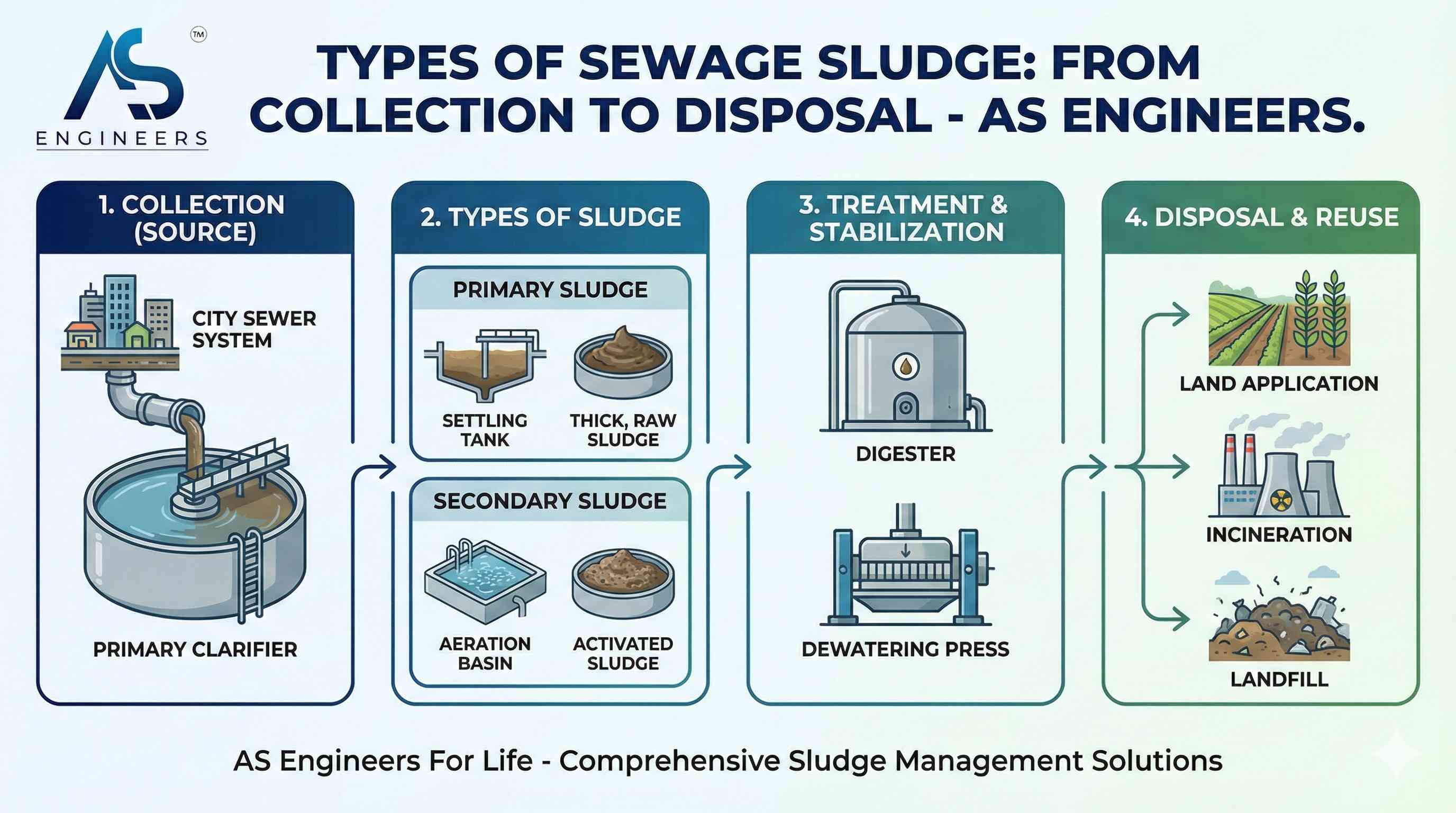
Types of sewage sludge are usually classified by where the sludge is generated in a wastewater treatment plant. The main types are primary sludge from settling, secondary or activated sludge from biological treatment, tertiary sludge from advanced treatment, and mixed sludge when different streams are combined.
For plant teams, the name is only the starting point. Each sludge type behaves differently during thickening, digestion, dewatering, drying, transport, disposal and reuse.
A sludge that settles easily may still create odor and pathogen risks. A biological sludge may look soft but become difficult to dewater. A chemical sludge may require extra attention to pH, salts, metals, material of construction and final disposal route.
This guide explains the main types of sewage sludge and how to evaluate them before selecting treatment, dewatering or sludge drying equipment.
Quick answer: main types of sewage sludge
| Sludge type | Where it comes from | Typical nature | Main handling concern |
|---|---|---|---|
| Primary sludge | Primary clarifier or settling tank | Raw settleable solids, organic matter, grit and heavier particles | Odor, fast decay, pathogen risk and volume reduction |
| Secondary sludge | Biological treatment stage, such as activated sludge, MBBR or SBR | Microbial biomass and fine biological solids | High water retention, biological activity and dewatering behavior |
| Tertiary sludge | Advanced treatment or polishing stage | Chemical or fine suspended solids from nutrient or pollutant removal | Chemical composition, pH, salts, metals and disposal limits |
| Mixed sludge | Combined primary, secondary and sometimes tertiary sludge | Variable mixture depending on plant operation | Testing required before treatment or drying selection |
| Septage or faecal sludge | Septic tanks and decentralized sanitation systems | Highly variable sludge from non-sewered sources | Screening, grit, odor, pathogens and co-treatment suitability |
| Dewatered sludge cake | After mechanical dewatering | Semi-solid cake from centrifuge, filter press, belt press or screw press | Drying, storage, transport and final disposal cost |
| Dried sludge | After thermal drying | Lower-moisture solid, granule or powder depending on system | Dust control, cooling, storage, reuse route and regulatory approval |
Why sludge type matters before treatment or drying
Sewage sludge is not one fixed material. The same STP can produce different sludge behavior depending on influent quality, treatment technology, chemical dosing, seasonal flow, industrial discharge mixing and operator practice.
Correct sludge classification helps decide:
- whether the sludge needs stabilization before drying;
- whether mechanical dewatering is enough or thermal drying is justified;
- whether the final route is landfill, co-processing, composting, agriculture, brick, cement, fuel or restricted disposal;
- whether the sludge contains chemicals, salts, metals, oil, grease or other contaminants;
- what material of construction may be needed for pumps, conveyors and dryer contact parts;
- what vapour, odor, dust and pollution-control arrangement is required.
In practical terms, sludge type affects equipment sizing, operating cost, safety review, disposal approval and long-term maintenance.
For India-specific planning, reuse and disposal should be checked against current central, state pollution control board and local authority requirements. India’s official water resources department currently lists National Guidelines on Sewage Sludge Management, so sludge reuse or disposal should not be treated as a casual decision.
How sewage sludge is generated in an STP
A sewage treatment plant separates pollutants from wastewater in stages. Each stage produces a different sludge stream.
Preliminary treatment does not usually create sewage sludge
Screening and grit removal remove rags, plastics, sand, stones and other coarse material. This material is not normally called sewage sludge. It is screening waste or grit and needs separate handling.
Primary treatment creates primary sludge
In primary clarifiers, heavy solids settle at the bottom. Floating oil and grease are skimmed. The settled solids become primary sludge.
Primary sludge is usually rich in raw organic matter. It can decay quickly and produce odor if not handled properly. Because it contains larger settleable solids, it often thickens more easily than biological sludge, but it still needs stabilization, dewatering or drying depending on the final disposal route.
Secondary treatment creates secondary or activated sludge
In biological treatment, microorganisms consume dissolved and fine organic matter. These microorganisms form biological flocs or biomass. When this biomass is separated in a secondary clarifier, it becomes secondary sludge.
Secondary sludge is also called activated sludge when it comes from the activated sludge process. It can contain high biological activity and may hold water strongly. That is why dewatering performance can vary significantly from plant to plant.
For a deeper comparison, link this section to primary sludge vs secondary sludge.
Tertiary treatment creates tertiary or chemical sludge
Some STPs use tertiary treatment to remove nutrients, color, fine suspended solids or specific pollutants. Chemical dosing, filtration or advanced polishing can generate tertiary sludge.
This sludge may contain precipitated chemicals, metal salts, phosphorus compounds, fine solids or other concentrated contaminants. It should not be judged only by appearance. Laboratory testing and disposal-route clarity are important.
Combined handling creates mixed sludge
Many STPs combine primary and secondary sludge before thickening, digestion, dewatering or drying. Mixed sludge is common in real plants, but its behavior depends on the mixing ratio and treatment process.
For drying selection, mixed sludge should be tested as the actual feed material, not as a theoretical category.
Primary sludge: features, risks and drying behavior
Primary sludge comes from the first settling stage of wastewater treatment. It contains settleable organic and inorganic solids that are removed before biological treatment.
Key features
- Higher raw organic content compared with many later-stage sludges.
- Larger settleable particles.
- Strong odor potential if storage time is high.
- Faster degradation if untreated.
- Often combined with secondary sludge for further treatment.
Handling concerns
Primary sludge should not be stored casually. If it remains untreated for too long, odor, gas generation, vector attraction and hygiene issues can increase. Plants usually route it to thickening, digestion, dewatering or other stabilization processes.
Drying consideration
Primary sludge can be suitable for thermal drying after proper thickening or dewatering, but the dryer supplier needs actual feed data. The most important inputs are moisture level, organic content, consistency, odor behavior, volatile matter, contamination profile and intended final disposal or reuse.
Secondary sludge or activated sludge: features, risks and drying behavior
Secondary sludge is produced during biological treatment. It is mostly microbial biomass and fine biological solids separated from treated wastewater.
Key features
- High biological activity.
- Softer and more gelatinous behavior compared with primary sludge.
- Can retain water strongly.
- May require polymer conditioning before dewatering.
- Usually generated continuously in STPs with biological treatment.
Handling concerns
Secondary sludge can be more difficult to dewater than primary sludge. Poor biological control, filamentous growth, foaming, low settling performance or wrong polymer selection can reduce dewatering efficiency.
If the plant already struggles with sludge volume, drying should be evaluated only after reviewing the dewatering stage. Drying wet, poorly dewatered sludge directly can increase operating cost.
Drying consideration
Secondary sludge is often dried after it is converted into dewatered cake. For dryer selection, the plant should share whether the sludge comes from ASP, SBR, MBBR, MBR or another process. Each treatment system can produce different sludge characteristics.
For supporting reading, add an internal link to activated sludge troubleshooting and sludge dewatering techniques.
Tertiary sludge: features, risks and drying behavior
Tertiary sludge comes from advanced treatment or final polishing. It is often generated when chemicals are used to remove phosphorus, color, fine suspended solids or other targeted pollutants.
Key features
- Chemical composition depends on the treatment objective.
- May contain alum, iron salts, lime, polymers or other dosing residues.
- May have different pH and salt levels.
- May contain concentrated contaminants from the polishing stage.
- Disposal or reuse options can be more restricted.
Handling concerns
Tertiary sludge should be evaluated chemically before drying or reuse. The issue is not only water removal. The plant must understand what will remain in the dried solid after moisture is reduced.
If heavy metals, high salts, toxic compounds or restricted pollutants are present, drying may reduce volume but will not remove those contaminants. Disposal classification remains important.
Drying consideration
A sludge dryer can reduce moisture and improve handling, but it does not make unsuitable sludge automatically safe for agriculture, composting or open reuse. Final reuse or disposal should be decided only after testing and regulatory review.
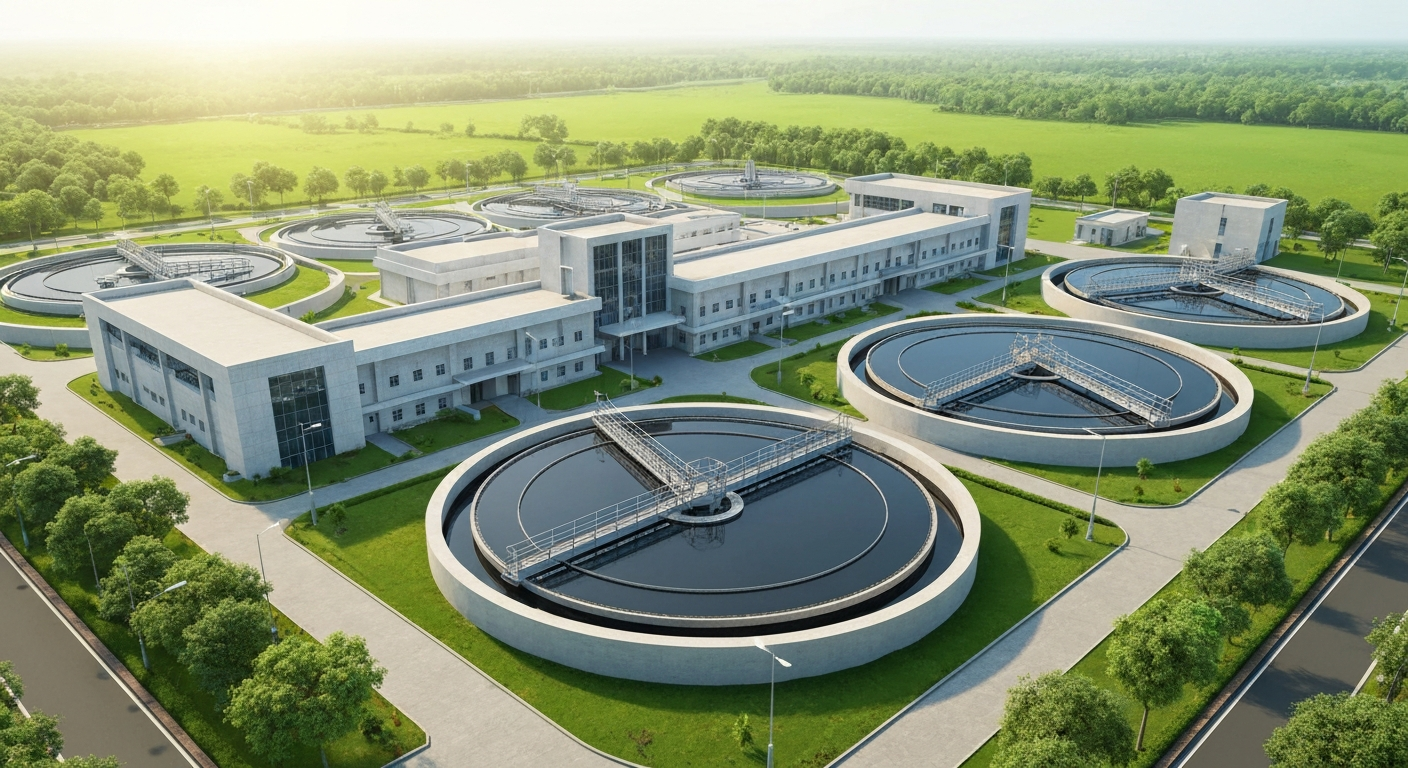
Mixed sludge: the practical reality in many STPs
In many plants, primary sludge and secondary sludge are mixed before digestion, thickening, dewatering or drying. This is practical, but it creates a variable feed.
Why mixed sludge varies
Mixed sludge changes when:
- influent wastewater strength changes;
- industrial wastewater enters the sewer;
- polymer dosing changes;
- biological treatment performance changes;
- tertiary chemical dosing changes;
- plant operators bypass or alter sludge routes;
- sludge age and storage time change.
How to evaluate mixed sludge
Before selecting a dryer or disposal route, collect representative samples from the actual dewatered sludge cake. Do not test only one random sample from the wet sludge pit.
The sample should represent normal operating days, peak-load days and any special discharge condition. For industrial areas, samples may need separate checks for metals, salts, solvents, oil, grease or hazardous characteristics.
For broader sludge strategy, link to industrial and municipal sludge management.
Septage and faecal sludge: related but not always the same as STP sludge
Septage or faecal sludge comes from septic tanks, pit latrines or decentralized sanitation systems. It is related to sewage management, but it is not always the same as sludge generated inside a conventional STP.
Key differences
- Septage may contain grit, plastics, sanitary waste and floating debris.
- Characteristics vary widely from one tanker load to another.
- Odor and pathogen risk can be high.
- Screening and grit removal are important before treatment.
- Co-treatment at STPs needs capacity and process compatibility review.
Drying consideration
Septage drying or faecal sludge drying needs careful pre-treatment. Directly feeding uncontrolled septage into a dryer can create mechanical, odor, hygiene and vapour-handling problems.
For this topic, link to faecal sludge management and faecal sludge treatment plants.
Sludge form vs sludge type: do not confuse origin and treatment condition
A common mistake is mixing up sludge origin with sludge condition.
Primary, secondary and tertiary describe where the sludge comes from. Thickened, digested, dewatered and dried describe what has been done to the sludge.
| Term | What it means | Important note |
|---|---|---|
| Raw sludge | Sludge before major stabilization | Higher odor and pathogen concern |
| Thickened sludge | Sludge with some water removed | Easier to pump or process than dilute sludge |
| Digested sludge | Sludge biologically stabilized by aerobic or anaerobic digestion | More stable than raw sludge |
| Dewatered sludge cake | Sludge after mechanical water removal | Common feed form for thermal sludge drying |
| Dried sludge | Sludge after thermal moisture reduction | Final use depends on composition and approval |
| Biosolids | Treated sewage sludge suitable for approved beneficial use | Not all sewage sludge qualifies as biosolids |
The term biosolids should be used carefully. International references also distinguish sewage sludge as wastewater treatment solids and biosolids as treated material suitable for approved land application or beneficial use.
Which types of sewage sludge are suitable for drying?
Sludge drying is mainly used when the plant needs volume reduction, better handling, lower transport load, disposal-cost control or a more stable final solid.
Drying suitability depends more on actual sludge behavior than on the category name.
Usually suitable after review
- Dewatered STP sludge cake.
- Mixed primary and secondary sludge after mechanical dewatering.
- Biological sludge where dewatering performance is stable.
- Municipal sludge where final disposal or reuse route is clear.
- Industrial wastewater sludge where chemical composition is known.
- Sludge with high transport, storage or disposal burden.
Needs stronger technical review
- Tertiary chemical sludge with high salts or metal compounds.
- Sludge with high oil and grease.
- Sludge with very low solids after dewatering.
- Sludge with variable pH.
- Sludge with unknown industrial contamination.
- Sludge from mixed municipal and industrial sewers.
- Sludge planned for agriculture, composting or land application.
Do not process without specialist review
- Sludge with flammable solvent vapours.
- Sludge with explosive dust risk after drying.
- Sludge with toxic fumes.
- Sludge with unknown hazardous waste classification.
- Sludge with highly corrosive chemistry.
- Sludge intended for unrestricted reuse without testing.
Drying reduces moisture. It does not erase contaminants. This distinction is critical for EHS and compliance decisions.
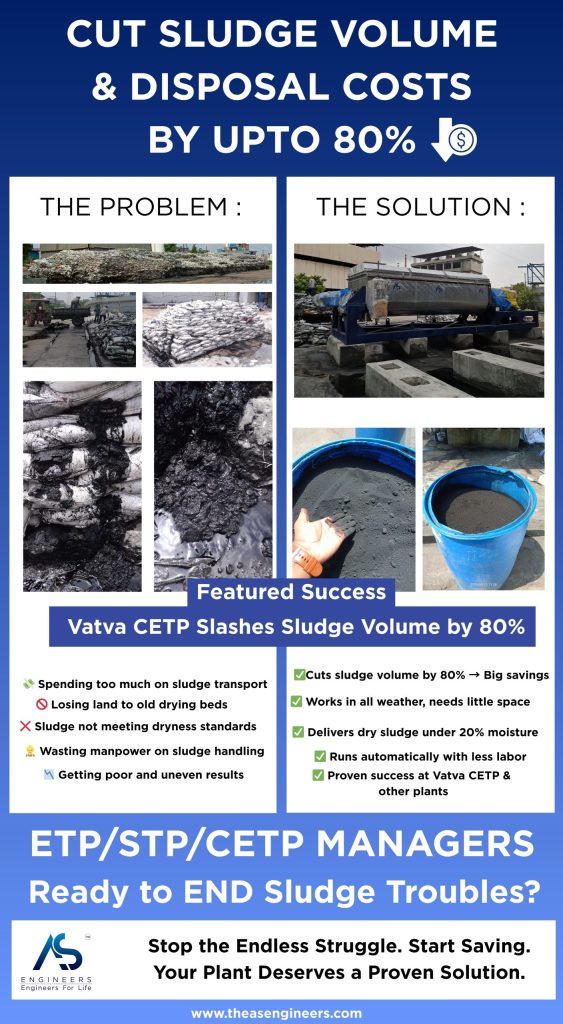
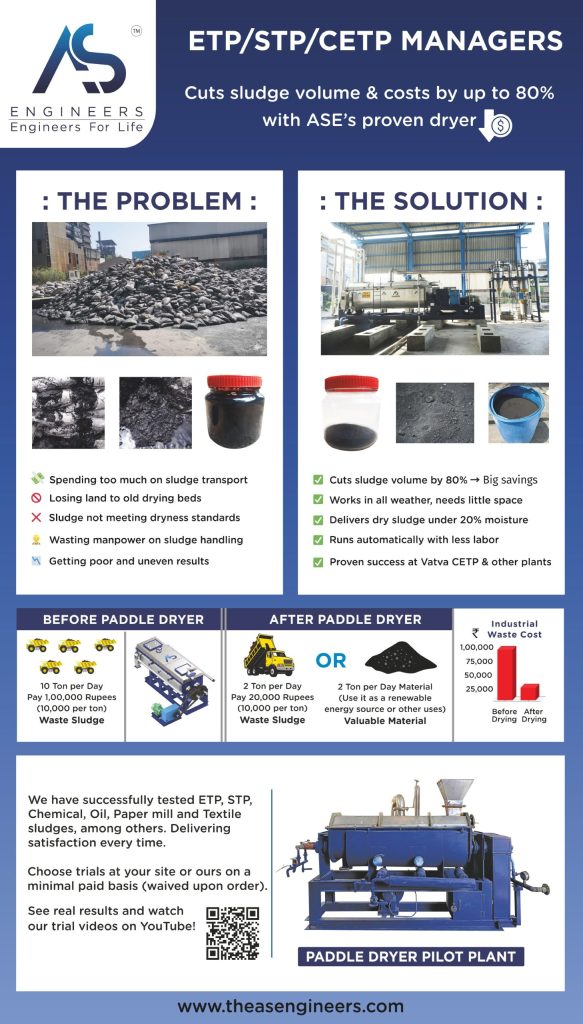
How a paddle dryer fits sewage sludge drying
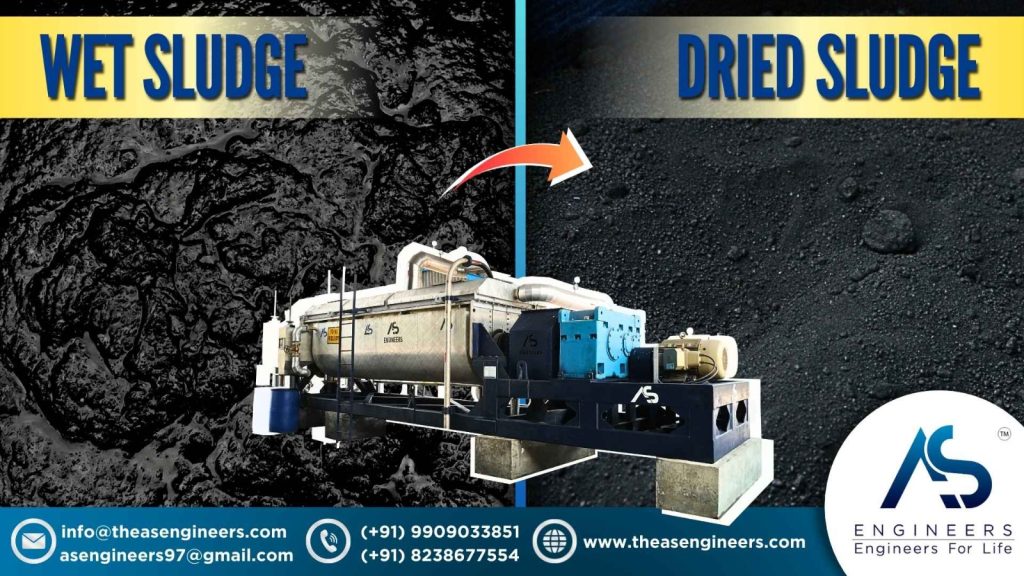
A paddle dryer is an indirect drying system. Heat is transferred through heated surfaces rather than direct flame contact with sludge. This makes it useful for many wet, sticky and paste-like materials when the process is designed correctly.
In AS Engineers paddle dryer systems, heat transfer takes place through hollow shafts and jacketed surfaces. Wedge or hammer-type paddles help agitate, shear and move the sludge through the dryer. The system can be supported with feeding, heating, vapour handling, pollution control and dried product handling equipment depending on the sludge and site requirement.
Why indirect drying is useful for sludge
- It can handle wet cake, paste-like and sticky sludge.
- It reduces the need for large hot air volume compared with many direct systems.
- It supports enclosed processing when vapour and odor control are important.
- It helps convert difficult wet sludge into a more manageable dried solid.
- It can be integrated with conveyors, sludge pumps, cyclone, scrubber, bag filter, condenser or product handling systems where required.
AS Engineers source material identifies sewage treatment plant sludge and biosludge among the materials handled in paddle dryer applications, and also references pilot trials for application-specific review.
For equipment-side reading, add internal links to thermal sludge drying systems, sludge drying methods and how to choose a sludge paddle dryer.
Treatment route by sludge type
| Sludge type | First review | Common treatment steps | Drying role |
|---|---|---|---|
| Primary sludge | Odor, organic load, grit, pathogen risk | Thickening, digestion, dewatering | Reduces final moisture and transport burden |
| Secondary sludge | Biological condition, dewaterability, polymer need | Thickening, stabilization, dewatering | Useful after stable cake formation |
| Tertiary sludge | Chemical composition, pH, metals, salts | Chemical testing, dewatering, controlled disposal | Volume reduction only after disposal route is clear |
| Mixed sludge | Representative sample, plant operating history | Thickening, digestion, dewatering | Common dryer feed when data is stable |
| Septage/faecal sludge | Screening, grit, variability, odor | Screening, stabilization, dewatering | Requires strong pre-treatment review |
| Dewatered sludge cake | Moisture, stickiness, particle size, final target | Thermal drying and product handling | Main feed form for many sludge drying systems |
RFQ checklist before selecting a sludge dryer
Before asking for a sludge dryer quotation, share the following information. This avoids wrong sizing, wrong MOC, wrong heating system and unrealistic moisture expectations.
Sludge source
- STP, CETP, ETP, municipal plant, hotel STP, township STP, industrial estate, food plant, pharma plant, chemical plant or other source.
- Primary, secondary, tertiary, mixed, septage or dewatered cake.
- Treatment technology, such as ASP, SBR, MBBR, MBR, UASB or other process.
Quantity and moisture
- Wet sludge quantity per day.
- Current feed moisture.
- Final moisture target.
- Hourly operating pattern.
- Seasonal variation.
- Existing dewatering equipment and cake condition.
Physical behavior
- Sticky, pasty, fibrous, granular, oily or slurry-like.
- Bulk density if available.
- Particle size or presence of grit.
- Odor level.
- Pumpability and conveyor behavior.
Chemical and safety data
- pH.
- Chlorides and salts.
- Oil and grease.
- Heavy metals if applicable.
- Solvents or volatile compounds.
- Hazardous classification if any.
- Pathogen stabilization status.
- Lab report and MSDS where applicable.
Site and utility data
- Available heating medium: steam, thermic fluid, hot water or other.
- Fuel option.
- Space availability.
- Power availability.
- Vapour treatment requirement.
- Dust collection requirement.
- Scrubber, bag filter, cyclone or condenser requirement.
- Final storage, bagging, silo or truck loading plan.
Final disposal or reuse route
- Landfill.
- Co-processing.
- Cement plant.
- Brick manufacturing.
- Composting.
- Agriculture or soil application.
- Incineration.
- Internal reuse.
- Approved third-party disposal.
If the final reuse route is not approved, the dryer selection should still proceed cautiously. A dryer can improve moisture and handling, but the final material must still meet the required quality and regulatory conditions.
Common mistakes in sewage sludge handling
Treating all sludge as the same
Primary sludge, activated sludge and tertiary sludge behave differently. One plant’s successful drying result cannot be copied blindly to another plant without testing.
Drying before fixing dewatering
If mechanical dewatering is poor, the dryer may receive too much water. This increases heat load and operating cost. Review polymer selection, sludge thickening, filter press, centrifuge, screw press or belt press performance first.
Ignoring chemical sludge composition
Tertiary sludge and industrially influenced sewage sludge may contain concentrated chemicals. Drying reduces moisture, not chemical risk.
Selecting equipment only by tonnage
Tonnage alone is not enough. The same tonnage can behave differently based on feed moisture, solids content, stickiness, volatile matter, chloride level, particle behavior and final moisture target.
Assuming dried sludge is automatically reusable
Dried sludge may be easier to transport and store, but reuse depends on composition, pathogen reduction, contaminants and regulatory approval.
Practical selection logic from AS Engineers
When reviewing a sewage sludge drying requirement, do not start only with machine size. Start with the sludge route.
First, identify whether the sludge is primary, secondary, tertiary, mixed or dewatered cake. Then check moisture, daily quantity, consistency, pH, contaminants, dewatering system, heating medium and final disposal route.
At AS Engineers, the dryer recommendation depends on actual sludge behavior and site conditions. For sewage sludge and industrial sludge, the safer route is to review the sample, feed condition, target moisture, vapour handling, pollution-control requirement and product handling plan before finalizing the dryer configuration.
For related equipment selection, add a link to sludge dryer machine applications and sludge dryer manufacturers for ETP/STP plants.
Conclusion
Types of sewage sludge are not just academic categories. They directly affect sludge treatment, dewatering, drying, disposal cost, EHS risk and reuse decisions.
Primary sludge is raw and organic-rich. Secondary sludge is biological and often harder to dewater. Tertiary sludge may carry chemical residues from advanced treatment. Mixed sludge is common, but it must be tested as the actual plant feed. Dewatered sludge cake is usually the practical feed form for sludge drying systems.
For sludge dryer selection, share the sludge source, treatment stage, wet quantity, moisture level, consistency, pH, contaminants, existing dewatering method, heating medium and final disposal or reuse plan. These inputs help the AS Engineers team review the drying requirement based on real operating conditions, not assumptions.
FAQs
What are the main types of sewage sludge?
The main types of sewage sludge are primary sludge, secondary or activated sludge, tertiary sludge and mixed sludge. Primary sludge comes from settling, secondary sludge comes from biological treatment, tertiary sludge comes from advanced or chemical treatment, and mixed sludge combines two or more sludge streams.
What is the difference between sewage sludge and biosolids?
Sewage sludge is the solid or semi-solid byproduct from wastewater treatment. Biosolids are treated sewage sludge that meets required quality conditions for approved beneficial use. All biosolids come from sludge, but not all sludge qualifies as biosolids.
Which sewage sludge is hardest to dewater?
Secondary or activated sludge is often more difficult to dewater because it contains biological flocs and microbial solids that can hold water strongly. Actual performance depends on the treatment process, sludge age, polymer conditioning and plant operation.
Can sewage sludge be dried directly?
Some sludge can be dried after proper thickening or dewatering, but direct drying of very dilute sludge is usually inefficient. For most STP applications, the practical route is thickening, stabilization if needed, mechanical dewatering, then thermal drying.
Can dried sewage sludge be used as fertilizer?
Only treated sludge that meets applicable quality and regulatory requirements should be considered for agriculture or soil application. Drying reduces moisture, but it does not automatically remove contaminants, pathogens, salts or metals.