If you are comparing a paddle dryer manufacturer in India, do not shortlist only by machine price or capacity. For sludge drying, the right manufacturer must understand feed moisture, final moisture target, stickiness, heating medium, vapour handling, pollution-control requirement, material of construction, site layout and discharge method.
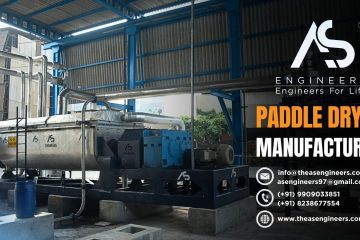
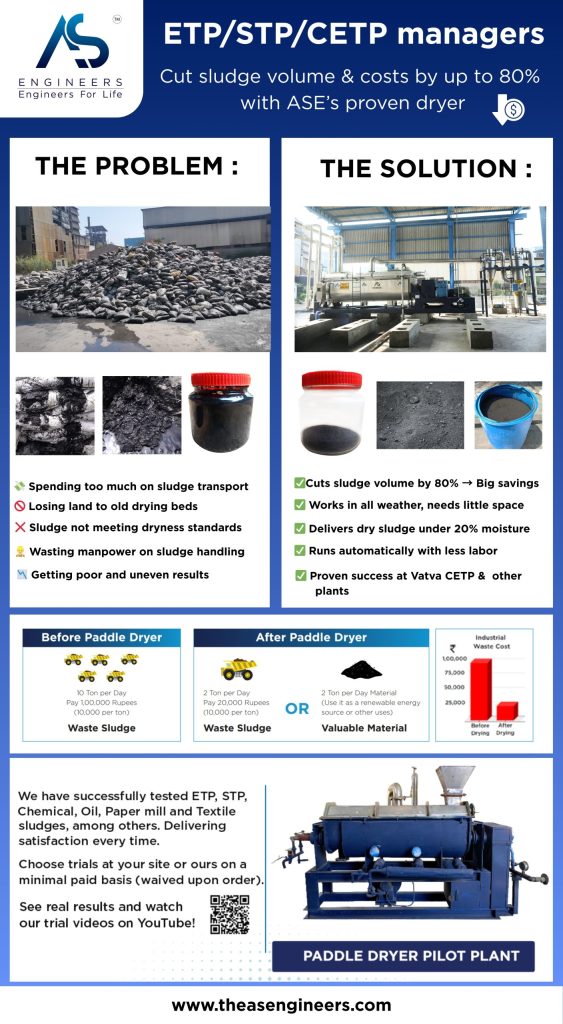
AS Engineers manufactures paddle dryer and sludge dryer systems for ETP, STP, CETP and industrial sludge drying applications. The goal is not only to dry sludge, but to make it lighter, easier to handle, easier to transport and better aligned with the plant’s approved disposal or reuse route.
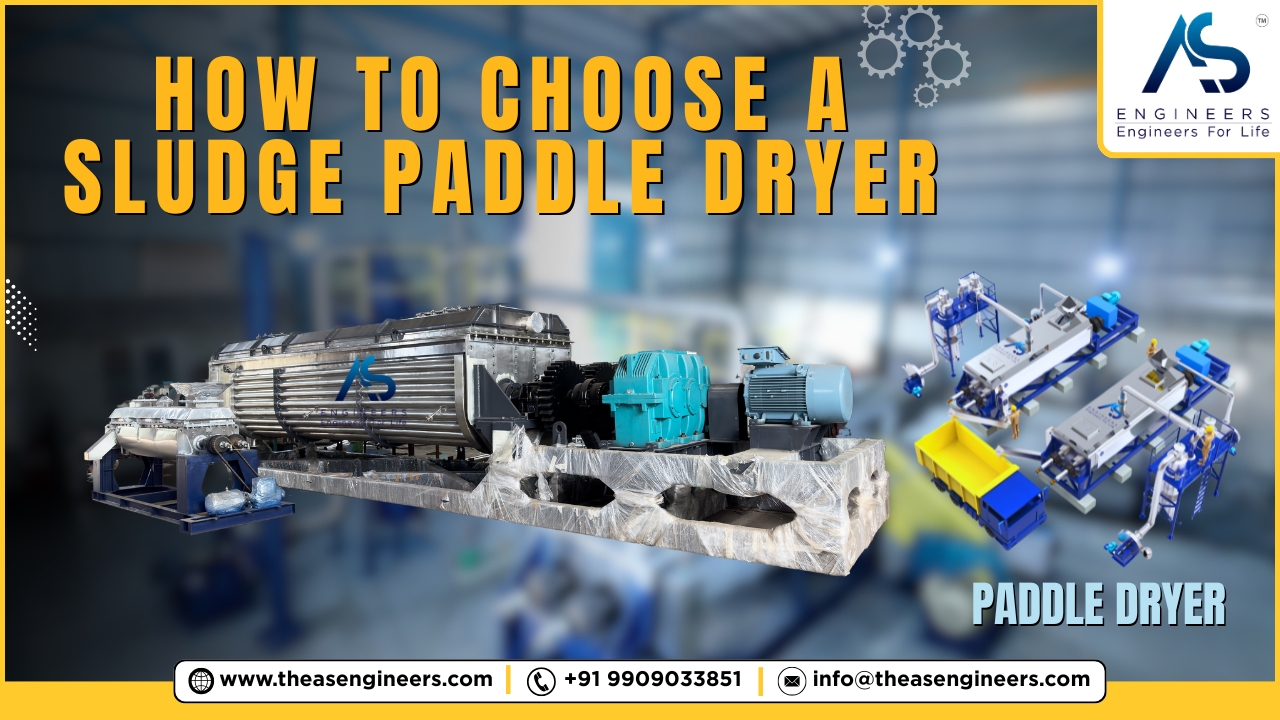
For a deeper selection checklist, you can also read this guide on how to choose a sludge paddle dryer.
What Is a Paddle Dryer?
A paddle dryer is an indirect heat transfer dryer used for wet cakes, sludge, pastes, slurries, powders and granular materials. In sludge drying, it is usually installed after dewatering equipment such as a filter press, screw press, belt press or centrifuge.
The drying happens inside a jacketed body with hollow shafts and wedge-shaped paddles. Steam, thermic fluid or another heating medium transfers heat through the jacket, hollow shaft and paddles. The wet sludge does not come in direct contact with flame or hot gas. This makes the system useful for sticky, wet and difficult-to-handle materials where controlled drying is required.
A paddle dryer is commonly used for:
| Application | Why paddle dryer is considered |
|---|---|
| ETP sludge drying | Reduces moisture after dewatering and improves handling |
| STP sludge drying | Supports volume reduction and easier disposal planning |
| CETP sludge drying | Helps manage mixed industrial sludge where wet disposal is costly |
| Chemical sludge drying | Supports enclosed drying with suitable vapour and pollution-control planning |
| Paper sludge drying | Helps reduce bulk and improve downstream handling |
| Pharma sludge or process residue drying | May require stainless steel, vacuum or solvent management depending on material |
| Food and agro residue drying | Requires hygiene-aware MOC and controlled process conditions |
Why Manufacturer Selection Matters More Than Brochure Capacity
A paddle dryer is not a standard catalogue item that should be selected only from tonnage. Two sludge samples with the same moisture percentage can behave very differently inside the dryer. One may flow easily, while another may bridge in the hopper, stick to paddles, create lumps, foam, smell, corrode metal or release vapours.
That is why a serious manufacturer should ask for process data before recommending dryer size, MOC, heating area, shaft design, feeding arrangement or vapour handling system.
A proper manufacturer review should include:
| Selection input | Why it matters |
|---|---|
| Feed moisture | Decides evaporation load and heat duty |
| Final moisture target | Prevents under-drying or unnecessary over-drying |
| Sludge source | ETP, STP, CETP, ZLD, paper, pharma, chemical or food sludge behave differently |
| Stickiness and lump formation | Affects feeding, shaft torque, paddle design and discharge |
| pH, chloride and corrosive content | Affects MOC selection such as CS, SS304, SS316, duplex or alloy steel |
| Heating medium | Steam, thermic fluid, hot water or other utility changes dryer design |
| Vapour composition | Decides condenser, scrubber, cyclone, bag filter or chimney requirement |
| Dust and fines | Affects cyclone, bag filter and housekeeping needs |
| Site layout | Affects feeding height, maintenance access, discharge route and civil planning |
| Disposal or reuse route | Final dryness depends on landfill, incineration, cement, brick, fertilizer or fuel evaluation |
If the plant is still evaluating the full sludge route, read this thermal sludge drying system guide before freezing the equipment specification.
How an AS Engineers Paddle Dryer System Works
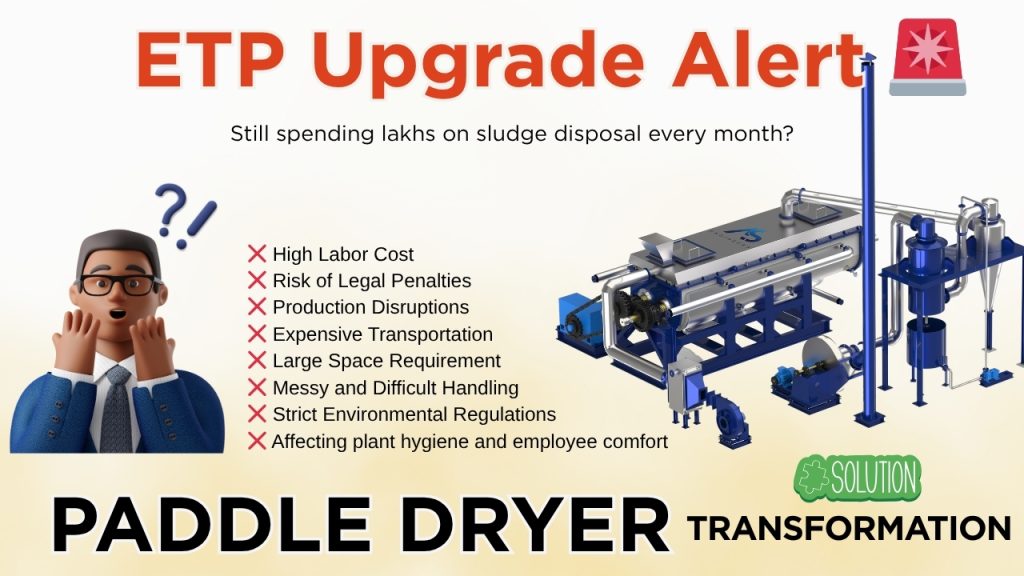
A complete paddle dryer system is more than one dryer body. For sludge drying, the supporting systems are equally important.
Feeding System
Wet feed is stored in a wet material silo or hopper and fed uniformly into the paddle dryer. Depending on the sludge condition, the system may use a belt conveyor, screw feeder or sludge pump.
Feeding is one of the most important points in sludge drying. Sticky sludge can bridge, form lumps or overload the feed screw if the inlet system is not designed around actual material behaviour.
Heating System
The heating medium can be steam, thermic fluid or hot water depending on utility availability and process requirement. AS Engineers’ source material mentions indirect steam heating up to 14.06 kg/cm² and thermal oil heating up to 400°C, depending on the application.
Heating medium selection affects heat transfer, operating cost, temperature control, safety review and utility integration.
Paddle Dryer Body
Inside the dryer, hollow shafts and jacketed surfaces transfer heat to the sludge. Dual counter-rotating shafts and wedge-shaped paddles help mix, shear and move the material forward.
The feed normally changes through stages such as plastic, shearing and granular behaviour as moisture is removed. This is why the dryer must be selected based on real sludge behaviour, not only inlet and outlet moisture numbers.
Scavenging and Vapour Handling
The system may include an FD blower, heat exchanger, heat-traced cover or other arrangement to manage vapour and reduce condensation risk.
For water vapour, the approach may be simpler. For solvent-bearing or odorous sludge, vapour management needs more careful review.
Pollution Control System
Depending on the application, the system may use a cyclone, scrubber, bag filter, ID fan, condenser, solvent tank or chimney. This part should be selected based on fines, vapour load, odour, solvent presence and statutory disposal route.
For hazardous or regulated sludge, the plant should confirm handling, storage, transport and disposal requirements with the responsible EHS team and applicable authorities before finalizing the system.
Product Handling System
Dried sludge can be discharged through a screw conveyor, bagging system, silo, bucket elevator or truck disposal system. The discharge plan depends on final moisture, temperature, granule condition, dust level and the approved end route.
For more system-level options, see this paddle dryer configuration guide.
AS Engineers Paddle Dryer Capabilities
AS Engineers designs paddle dryer and sludge dryer systems for industrial drying applications where the feed condition, moisture target and site requirement need custom review.
| Capability area | Available options |
|---|---|
| Dryer types | Standard dryer, dual zone dryer, vacuum dryer |
| Heating method | Indirect heating through hollow shafts and jacket |
| Heating medium | Steam, thermic fluid, hot water system, based on requirement |
| Feed forms | Slurry, paste, wet cake, granule, powder |
| Operating condition | Atmospheric, vacuum or pressurized, based on process need |
| MOC options | Carbon steel, SS304, SS316, duplex steel and other alloys as required |
| Surface finish options | Buffing, hard facing, electropolishing and application-specific finishes |
| Supporting equipment | Feeding system, heating system, FD blower, ID fan, cyclone, scrubber, bag filter, condenser, conveyor, silo or bagging system |
| Service support | OEM spares, repair, upgrades, retro-fitment, shaft/gearbox/bearing replacement, site service and AMC support |
AS Engineers’ approved company material also supports the use of a 50 kg/hr pilot trial machine for demonstration and material evaluation. This is useful when sludge behaviour is uncertain or when the buyer wants a more practical basis before final equipment selection.
When a Paddle Dryer Is a Good Fit
A paddle dryer can be a strong fit when the plant needs enclosed, indirect drying for difficult wet material.
It is especially useful when:
| Plant condition | Paddle dryer fit |
|---|---|
| Dewatered sludge is still costly to transport | Drying can reduce moisture and weight |
| Sludge is sticky or pasty | Paddle agitation can help expose wet material to heated surfaces |
| Off-gas volume needs control | Indirect drying generally creates lower off-gas volume than many direct hot-air systems |
| Site space is limited | Paddle dryers have a compact footprint compared with large drying beds or solar systems |
| Final product must be easier to handle | Dried material can be discharged for bagging, conveying or disposal |
| Plant wants a controlled process | Heating medium, residence time and discharge can be engineered around the duty |
For comparison with non-thermal and land-based options, read this guide on sludge drying bed selection.
When a Paddle Dryer May Not Be the Right First Choice
A paddle dryer should not be forced into every sludge project. It may not be the best first option when:
| Condition | Better decision |
|---|---|
| Sludge is still mostly liquid | Improve thickening or dewatering first |
| Plant has no defined final disposal route | Confirm end route before selecting final moisture target |
| Moisture target is unclear | Run lab testing or pilot trial first |
| Sludge is hazardous or solvent-bearing | EHS and vapour-control review is required before finalization |
| Fuel or utility cost is not evaluated | Compare steam, thermic fluid, gas, LDO, electricity or available waste heat |
| Site has no space for feeding and maintenance access | Review layout before purchase order |
| Buyer wants only the lowest machine price | Evaluate total ownership cost, not only CAPEX |
For upstream moisture reduction, this sludge dewatering techniques guide can help compare mechanical dewatering options before thermal drying.
Fuel and Utility Inputs to Discuss Before RFQ
Drying cost depends heavily on evaporation load and heating medium. AS Engineers’ source material gives a fuel benchmark for sludge drying from 80% initial moisture to 20% final moisture:
| Fuel input | Approximate sludge drying yield |
|---|---|
| 1 kg wood | 5 kg sludge |
| 1 kg coal | 8.25 kg sludge |
| 1 Nm³ gas | 22.5 kg sludge |
| 1 kg LDO | 21 kg sludge |
This should be treated as a preliminary benchmark, not a guaranteed operating cost. Actual drying economics depend on sludge moisture, solid content, feed rate, heating medium efficiency, dryer duty, heat loss, final moisture target, local fuel cost and operating hours.
For disposal-side planning, read this industrial sludge disposal guide.
Industries and Materials Where Paddle Dryers Are Used
Paddle dryers are used in sludge drying and broader industrial thermal processing. AS Engineers’ product material lists use cases across several industries and materials.
| Industry | Example material |
|---|---|
| Environmental and waste management | Sewage sludge, bio sludge, industrial sludge |
| Paper and pulp | Paper sludge |
| Chemicals and petrochemicals | Sodium chloride, ammonium nitrate, aluminum hydroxide, sodium sulphate, ammonium sulphate |
| Mining and metals | Copper concentrate, lithium hydroxide, manganese dioxide, coal/lignite |
| Food and beverage | Starch, instant coffee, cake flour, meat, chocolate |
| Agriculture and animal feed | DDGS, rice bran, fish meal |
| Construction materials | Gypsum |
| Pigments and dyes | Pigments, TiO₂ |
| Pharmaceuticals and healthcare | Calcium carbonate, sodium carbonate, API intermediates, spent grain |
The exact design depends on feed behaviour. A chemical sludge dryer, paper sludge dryer and STP sludge dryer may all use paddle drying principles, but their MOC, vapour handling, discharge system and operating duty can be different.
How to Compare Paddle Dryer Manufacturers in India
Before issuing an RFQ, compare manufacturers on engineering depth, not only sales response time.
| Evaluation point | What to check |
|---|---|
| Process understanding | Does the manufacturer ask for moisture, throughput, sludge source and final target? |
| Customization | Can the system be designed around feed, heating medium, MOC and discharge requirement? |
| Vapour and pollution-control planning | Does the proposal include cyclone, scrubber, bag filter, condenser or ID fan where needed? |
| Material selection | Does the manufacturer review corrosion, abrasion, hygiene and temperature requirement? |
| Pilot trial support | Is material testing or pilot trial available for uncertain sludge? |
| Service capability | Are OEM spares, repair, retrofitment and site support available? |
| Documentation | Are utility, layout, maintenance and operating inputs clarified? |
| Safety boundary | Does the manufacturer avoid giving exact guarantees without duty data? |
A strong manufacturer will not push only a standard model. The better approach is to understand the sludge, define the duty and then design the dryer around actual site conditions.
RFQ Checklist for a Paddle Dryer Manufacturer
Send these details before asking for a technical-commercial offer:
- Sludge source: ETP, STP, CETP, ZLD, paper, pharma, chemical, food or other source
- Feed form: liquid sludge, dewatered cake, paste, slurry, powder or granule
- Feed moisture percentage
- Required final moisture percentage or dryness target
- Feed rate in kg/hr or TPD
- Operating hours per day
- Bulk density and approximate solids content
- Sludge stickiness, lump formation, odour and handling behaviour
- pH, chloride, corrosive or abrasive content
- Any solvent, oil, grease, hazardous or combustible component
- Available heating medium: steam, thermic fluid, hot water, gas, LDO, coal, wood, briquette, electricity or waste heat
- Required MOC: CS, SS304, SS316, duplex or special alloy
- Vapour handling need: chimney, condenser, scrubber, cyclone, bag filter or solvent tank
- Discharge preference: screw conveyor, bagging, silo, bucket elevator or truck loading
- Site layout, height restriction and maintenance access
- Final route: disposal, incineration, cement, brick, fertilizer, composting, fuel evaluation or other approved route
If your sludge is connected with a ZLD plant, also read this guide on zero liquid discharge and sludge handling.
Common Buyer Mistakes While Selecting a Paddle Dryer
Selecting only by capacity
Capacity alone does not confirm drying performance. A 1 TPD sludge stream and a 1 TPD chemical cake can need different heat transfer area, residence time, shaft torque, feeding arrangement and discharge system.
Ignoring feed variability
Many plants test one sludge sample and assume it represents the whole year. In reality, moisture and composition may change with raw material, production batch, monsoon, process upset or ETP chemical dosing.
Not planning vapour handling
Drying releases moisture and sometimes odour, solvent vapour or fines. Vapour handling should be part of the system design, not an afterthought.
Choosing MOC without corrosion review
Carbon steel, SS304, SS316, duplex steel and alloy steel have different roles. Wrong MOC can increase corrosion risk, maintenance issues and shutdowns.
Asking for guaranteed final moisture without testing
Final moisture depends on feed condition, residence time, heating medium, operation and material behaviour. For difficult sludge, pilot testing is a safer path before confirming expectations.
AS Engineers as a Paddle Dryer Manufacturer in India
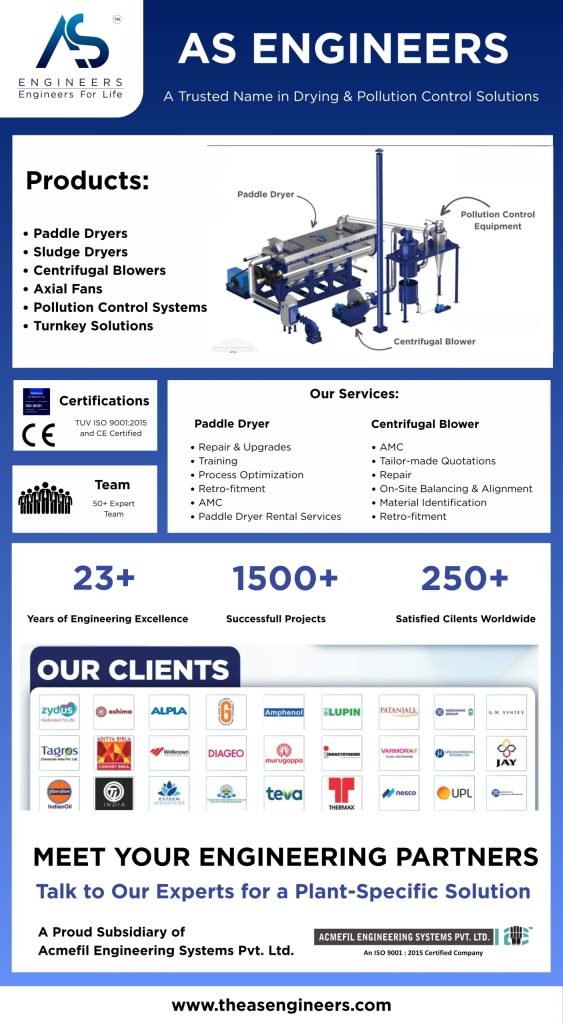
AS Engineers is based in Ahmedabad, Gujarat and works in fluid mechanics, drying solutions, paddle dryers, sludge dryers, centrifugal blowers and pollution-control equipment. The company’s approved material states 25+ years of industry experience, ISO 9001:2015 and CE certification, 500+ clients and 1500+ projects.
For sludge drying buyers, AS Engineers can support:
- Paddle dryer and sludge dryer manufacturing
- Standard, dual zone and vacuum dryer configurations
- Heating system integration
- Feeding and discharge system planning
- Cyclone, scrubber, bag filter, condenser, ID fan and FD blower integration
- Pilot trial support with a 50 kg/hr trial machine
- OEM spare parts and repair support
- Shaft, gearbox and bearing replacement
- Retrofitment and upgrades
- On-site alignment, service and AMC support
For the broader product page, you can visit AS Engineers’ paddle dryer product page.
FAQs
Who is a suitable paddle dryer manufacturer in India for sludge drying?
A suitable paddle dryer manufacturer should understand sludge behaviour, feed moisture, final moisture target, heating medium, MOC, vapour handling and discharge requirement before quoting. AS Engineers manufactures paddle dryer and sludge dryer systems for ETP, STP, CETP and industrial sludge drying applications.
What data is required to get a paddle dryer quotation?
For a useful quotation, share feed moisture, final moisture target, feed rate, sludge source, operating hours, heating medium, MOC preference, sludge behaviour, vapour-control requirement, discharge method and site layout. Without these inputs, the quotation may be technically incomplete.
Is a paddle dryer suitable for ETP sludge?
A paddle dryer can be suitable for ETP sludge after dewatering when the plant needs further moisture reduction, volume reduction and easier handling. Final suitability depends on sludge composition, stickiness, moisture, corrosion risk, disposal route and available heating medium.
Can AS Engineers do a pilot trial before final selection?
Yes. AS Engineers’ approved material mentions a 50 kg/hr paddle dryer pilot trial machine. A pilot trial is useful when the sludge is sticky, variable, solvent-bearing, difficult to discharge or when final moisture expectations need practical verification.
What heating medium is used in a paddle dryer?
A paddle dryer can use steam, thermic fluid, hot water or another suitable heating arrangement depending on the process. AS Engineers’ material mentions indirect steam heating up to 14.06 kg/cm² and thermal oil heating up to 400°C, depending on the application and design requirement.
Conclusion
Choosing the right paddle dryer manufacturer in India is an engineering decision, not only a purchase decision. The safest approach is to define the sludge source, moisture target, feed behaviour, heating medium, vapour handling, MOC and final disposal route before finalizing the dryer.
If you are planning a sludge drying project for ETP, STP, CETP, ZLD, chemical, pharma, food, paper or industrial sludge, share your feed details, utility availability and final moisture target with AS Engineers. The team can review the duty condition and suggest a paddle dryer configuration based on the actual site requirement.