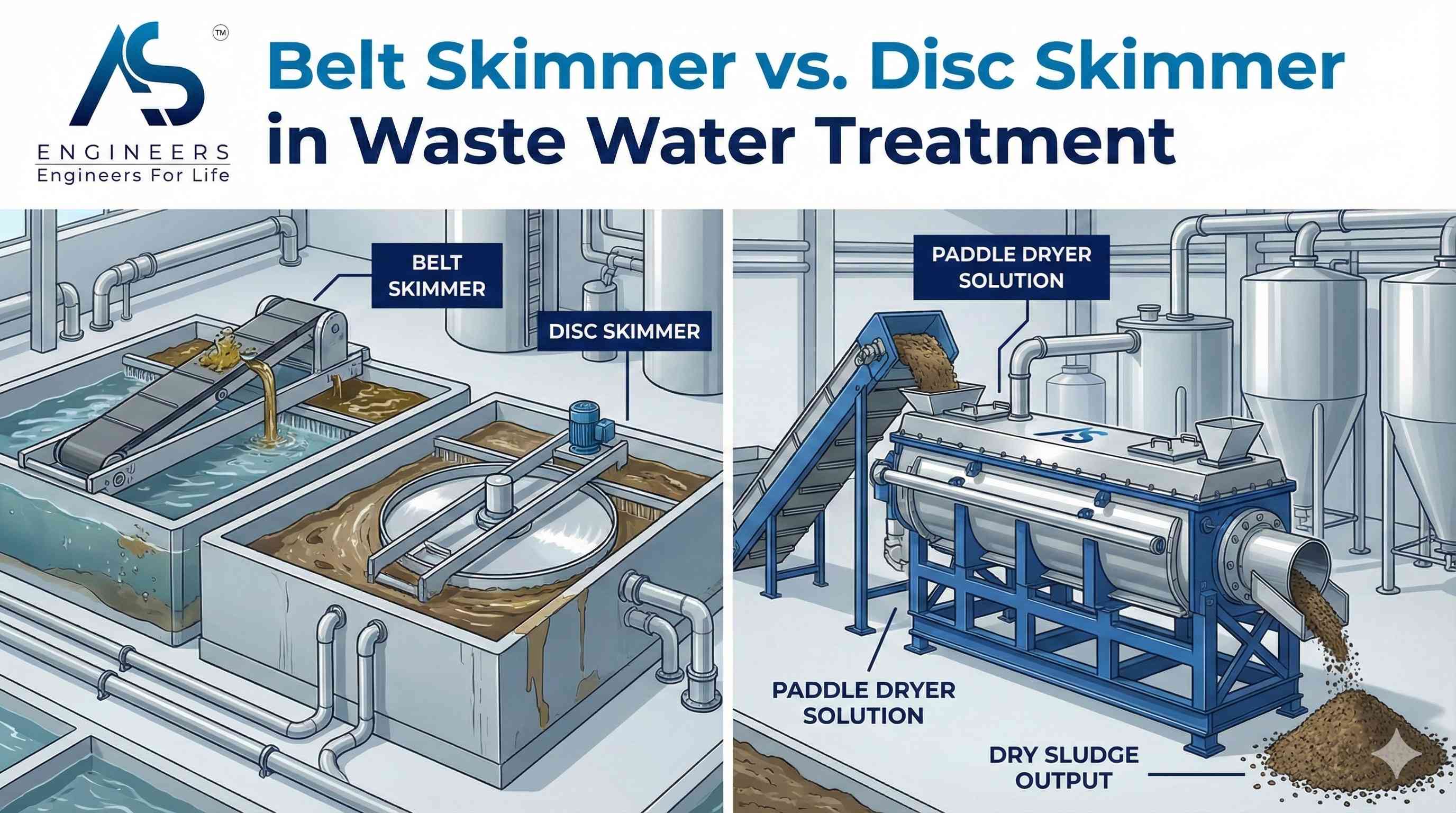
A belt skimmer is usually the better choice for deeper tanks, fluctuating water levels, larger sumps, and higher floating oil load. A disc skimmer is usually better for compact tanks, stable water levels, machine sumps, parts washing tanks, and smaller wastewater collection points.
Both belt skimmers and disc skimmers remove free-floating oil from wastewater. The right choice depends on tank depth, oil layer thickness, available mounting space, water level variation, oil viscosity, turbulence, maintenance access, and the role of the skimmer in the complete ETP process.
Oil skimming should be treated as a pretreatment step. It helps remove floating oil and grease before the wastewater moves to downstream treatment stages. It does not replace proper ETP design, oil-water separation, biological treatment, chemical treatment, sludge dewatering, or sludge drying where those steps are required.
For a broader oil removal overview, read our oil and grease trap oil skimmer selection guide.
Quick Decision Table
| Selection point | Belt skimmer | Disc skimmer |
|---|---|---|
| Best for | Deep tanks, collection pits, larger sumps, fluctuating levels | Small tanks, machine sumps, parts washers, compact ETP points |
| Water level condition | Handles level variation better | Needs a more stable liquid level |
| Installation space | Needs more vertical clearance | Needs less space |
| Oil loading | Better for moderate to higher free-floating oil load | Better for low to moderate oil load |
| Maintenance focus | Belt tension, belt condition, wiper blades, drive unit | Disc surface, wiper blades, drive unit |
| Main limitation | Needs proper mounting height and access | Limited by disc diameter and immersed surface area |
| Best buyer fit | ETP operators, industrial sump owners, plants with variable wastewater flow | Machine shops, compact treatment tanks, small process sumps |
What an Oil Skimmer Does in Wastewater Treatment
An oil skimmer removes free-floating oil, grease, and hydrocarbons from the surface of wastewater. Since many oils are lighter than water, they rise to the surface when the wastewater has enough calm retention time. The skimmer then collects this floating layer through an oil-attracting medium such as a belt or rotating disc.
In ETP and industrial wastewater systems, oil skimmers are commonly used before or near:
- Oil and grease traps
- Collection sumps
- Equalization tanks
- Oil-water separators
- Parts washing tanks
- Machine coolant tanks
- Primary treatment stages
- Industrial wastewater pits
The purpose is simple: remove free oil early before it spreads, emulsifies, coats equipment, interferes with downstream treatment, or increases sludge handling difficulty.
An oil skimmer works best when the oil is free-floating. It is not the best solution for strongly emulsified oil, dissolved contaminants, heavy solids, or chemical contamination. Those conditions may need pH correction, coagulation, flocculation, DAF, filtration, biological treatment, or other process-specific treatment.
What Is a Belt Skimmer?
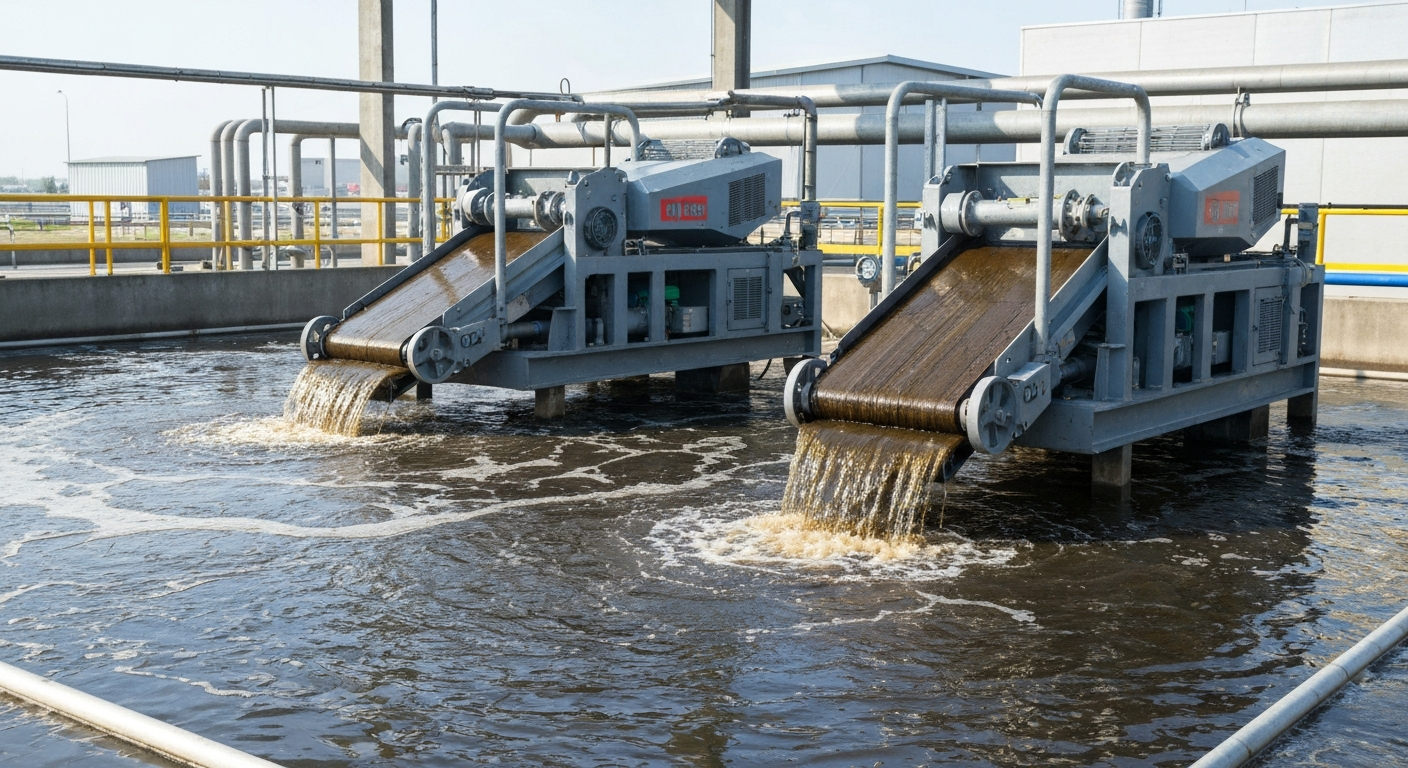
A belt skimmer uses a continuous belt that passes through the wastewater surface. Oil sticks to the belt, the belt moves upward, and wiper blades remove the collected oil into a tray or collection drum.
The belt may be made from stainless steel, polymer, or other oil-attracting material depending on the wastewater chemistry, oil type, temperature, and site condition.
Belt skimmers are commonly selected when the tank is deep, the oil layer is not always at the same level, or the plant needs a rugged skimmer for continuous oil removal.
How a Belt Skimmer Works
The belt moves through the wastewater surface and collects oil by surface affinity. Water drains back because the belt is designed to pick up oil more than water. The belt then passes through wiper blades, which scrape the oil into a collection channel.
Basic working sequence:
- Floating oil accumulates on the wastewater surface.
- The belt passes through the oil layer.
- Oil adheres to the belt surface.
- The belt carries oil out of the tank.
- Wiper blades remove oil from both sides of the belt.
- Oil flows into a collection container for disposal or recovery.
This makes belt skimmers useful for continuous, low-attention oil removal in industrial wastewater systems.
Where Belt Skimmers Fit Best
A belt skimmer is usually preferred when the plant has:
- Deep oil collection tanks
- Fluctuating water levels
- Larger wastewater pits
- Moderate to heavy floating oil
- Limited surface access but enough vertical height
- Outdoor or industrial-duty sump conditions
- Oil-water separator discharge points
- ETP collection tanks before downstream treatment
In many ETP plants, wastewater flow is not perfectly stable. Batch discharge, cleaning cycles, production shifts, and rainwater ingress can change the liquid level. In such cases, the longer reach of a belt skimmer gives it an advantage over a disc skimmer.
Main Advantages of Belt Skimmers
| Advantage | Why it matters in wastewater treatment |
|---|---|
| Better reach | Useful for deeper tanks and changing liquid levels |
| Higher adaptability | Works across different sump depths and tank conditions |
| Good oil removal capacity | Belt width and speed can support higher collection needs |
| Rugged design | Suitable for industrial sump and ETP duty |
| Low water pickup when selected correctly | Helps reduce collected waste volume |
| Simple maintenance | Main wear parts are belt, wipers, and drive components |
Limitations of Belt Skimmers
A belt skimmer is not the best choice for every tank. It may need more vertical clearance above the tank. It also needs proper mounting, safe access for maintenance, and correct belt material selection.
Common limitations include:
- More vertical space required
- Belt tension and tracking must be checked
- Belt material must suit wastewater chemistry
- Wiper blades need periodic replacement
- Installation may be difficult on very small tanks
- Turbulent water can reduce oil pickup efficiency
A belt skimmer should not be selected only because it has “higher capacity.” It should be matched to actual oil load, tank depth, wastewater condition, and maintenance access.
What Is a Disc Skimmer?
A disc skimmer uses a rotating disc that is partially submerged in the wastewater surface. Oil sticks to the rotating disc. As the disc moves out of the water, wiper blades scrape the oil into a collection trough.
Disc skimmers are compact and simple. They are commonly used in smaller tanks, machine coolant sumps, parts washers, and compact wastewater treatment points where the liquid level remains fairly constant.
How a Disc Skimmer Works
The lower part of the disc rotates through the floating oil layer. Oil adheres to the disc surface, while most water drains back. Wipers scrape the oil from both sides of the disc and guide it into a collection tray.
Basic working sequence:
- Oil floats on the wastewater surface.
- The disc rotates through the oil layer.
- Oil sticks to the disc surface.
- The disc carries oil above the waterline.
- Wipers scrape oil into the collection trough.
- Oil is collected for disposal or reuse where suitable.
The working principle is similar to a belt skimmer, but the collection area depends on the disc diameter and how much of the disc is properly immersed.
Where Disc Skimmers Fit Best
A disc skimmer is usually preferred when the plant has:
- Small wastewater tanks
- Machine coolant sumps
- Parts washing tanks
- Stable water levels
- Low to moderate floating oil load
- Limited installation space
- Simple maintenance access
- Compact pretreatment points before a larger ETP system
A disc skimmer can be a good choice where a belt skimmer is physically too large or unnecessary for the oil load.
Main Advantages of Disc Skimmers
| Advantage | Why it matters in wastewater treatment |
|---|---|
| Compact design | Fits small tanks and tight spaces |
| Simple operation | Easy to understand and maintain |
| Good for stable levels | Works well when the oil layer remains near the disc contact zone |
| Lower space requirement | Useful in machine shops and compact ETP areas |
| Low maintenance | Main recurring items are wipers and drive checks |
| Suitable for localized oil removal | Useful for individual sumps before wastewater reaches the main ETP |
Limitations of Disc Skimmers
A disc skimmer depends heavily on stable water level. If the water level drops below the disc contact zone, oil pickup reduces. If the water level rises too much or turbulence increases, water pickup and poor oil separation can occur.
Common limitations include:
- Not ideal for large level fluctuation
- Limited oil pickup area
- Capacity depends on disc diameter and rotation speed
- Less suitable for deep tanks
- Not ideal for large or irregular wastewater pits
- Performance reduces if oil does not collect near the disc
For fluctuating ETP tanks, a belt skimmer is usually safer than a disc skimmer.
Belt Skimmer vs Disc Skimmer: Detailed Comparison
| Factor | Belt skimmer | Disc skimmer | Practical selection note |
|---|---|---|---|
| Collection medium | Continuous belt | Rotating disc | Main design difference |
| Tank depth | Better for deeper tanks | Better for shallow or compact tanks | Check lowest operating water level |
| Liquid level fluctuation | Better tolerance | Lower tolerance | Important for ETP equalization tanks |
| Oil layer thickness | Handles moderate to heavier floating oil better | Handles light to moderate floating oil | For heavy oil, also check viscosity and heating need |
| Mounting | Needs vertical clearance | Needs side/top access but less vertical height | Site layout matters |
| Oil removal rate | Can be scaled with belt width and speed | Limited by disc size and immersion | Do not oversize without oil load data |
| Water pickup | Low when correctly selected | Low when level is stable | Wrong selection increases water carryover |
| Maintenance | Belt, wipers, pulleys, drive | Disc, wipers, drive | Both need routine checks |
| Best use | Industrial ETP, deep sump, collection pit | Machine sump, parts washer, compact tank | Match to tank geometry |
| Buyer risk | Wrong belt material or mounting height | Wrong disc size or unstable water level | Share real site data before ordering |
Which Skimmer Is Better for ETP Plants?
For most industrial ETP collection tanks with fluctuating level, a belt skimmer is usually the stronger option. It has better reach, handles changing liquid levels better, and can be selected for higher oil removal needs.
A disc skimmer is better when the ETP has a compact tank, stable liquid level, lower oil loading, and limited installation space.
The correct answer is not “belt is always better” or “disc is always better.” The correct answer depends on the operating condition.
Use this simple rule:
- Choose a belt skimmer for variable levels, deeper tanks, larger sumps, and higher oil load.
- Choose a disc skimmer for stable levels, small tanks, compact spaces, and localized oil removal.
Selection Factors Before Buying an Oil Skimmer
Before selecting a belt skimmer or disc skimmer, collect these inputs from the site.
| Input | Why it matters |
|---|---|
| Tank length, width, and depth | Determines reach, mounting, and skimmer size |
| Minimum and maximum water level | Decides whether disc skimmer can stay immersed correctly |
| Oil type | Light oil, heavy oil, grease, coolant oil, vegetable oil, or mixed oil behaves differently |
| Oil layer thickness | Helps estimate removal capacity |
| Oil viscosity | Thick oil may need slower pickup, heating, or different media |
| Wastewater temperature | Affects oil flow, skimmer material, and wiper performance |
| pH and chemical content | Helps select belt/disc material and corrosion resistance |
| Solids and floating debris | Can foul the skimmer and wiper system |
| Surface turbulence | Oil needs a calm zone to collect effectively |
| Available installation space | Belt skimmers need more vertical height, disc skimmers need compact access |
| Maintenance access | Operators must safely inspect wipers, drive, and collection container |
| Downstream treatment process | Skimmer should support, not disturb, the full ETP process |
Fit and No-Fit Guide
| Situation | Better option | Why |
|---|---|---|
| Deep sump with variable level | Belt skimmer | Longer reach and better level tolerance |
| Small machine coolant tank | Disc skimmer | Compact and simple |
| Parts washing tank | Disc skimmer | Good for stable, localized oil removal |
| Large ETP equalization tank | Belt skimmer | Better for larger volume and variable conditions |
| Very limited vertical height | Disc skimmer | Lower height requirement |
| Higher floating oil loading | Belt skimmer | More scalable collection area |
| Stable small collection chamber | Disc skimmer | Efficient when level remains stable |
| Irregular tank or hard-to-reach oil layer | Belt or tube/floating system after review | Geometry may decide the final choice |
| Strongly emulsified oil | Neither as standalone | Needs chemical/physical treatment beyond surface skimming |
| Heavy sludge with oil mixed into solids | Skimmer alone is not enough | Needs sludge handling, dewatering, and drying review |
Common Mistakes in Belt Skimmer and Disc Skimmer Selection
Choosing by equipment price only
A cheaper skimmer can become expensive if it fails to remove oil consistently, picks up too much water, or needs frequent operator attention.
Ignoring water level fluctuation
This is one of the biggest selection mistakes. A disc skimmer can work well in stable tanks, but it can lose efficiency quickly if the oil layer moves away from the disc contact area.
Not creating a calm oil collection zone
Oil skimmers need oil to collect at the surface. If the tank has too much turbulence, short-circuiting flow, aeration disturbance, or strong mixing near the skimmer, performance drops.
Selecting wrong material of construction
Wastewater chemistry matters. pH, temperature, solvents, salts, and chemical contaminants can affect belt, disc, wiper, and metallic parts.
Expecting skimmers to remove emulsified oil
Belt and disc skimmers are for free-floating oil. If oil is emulsified, chemically bonded, or finely dispersed, the plant may need chemical treatment, coalescing, DAF, or another separation method.
Not planning oil collection and disposal
Removing oil from the tank is only half the job. The recovered oil must be collected, stored, handled, and disposed of safely according to site requirements.
How Oil Skimming Connects With Sludge Treatment
Oil and grease removal affects the complete wastewater and sludge treatment chain. If floating oil is not removed early, it can increase downstream problems such as:
- Scum formation
- Poor settling
- Coating on equipment
- Odour issues
- Higher maintenance
- Poor biological treatment stability
- Increased sludge handling difficulty
- Higher risk of sticky or oily sludge
After primary treatment, sludge may still need thickening, dewatering, drying, or safe disposal depending on the plant process and sludge characteristics. For industrial plants generating wet sludge, review our guide on sludge dewatering techniques and ETP sludge challenges and disposal solutions.
Where the sludge remains wet, heavy, sticky, or costly to transport, thermal drying may be evaluated separately. A sludge dryer can help reduce sludge moisture after the correct upstream treatment and dewatering steps are completed.
RFQ Checklist for Belt Skimmer or Disc Skimmer Selection
Share these details before asking for a skimmer recommendation:
| RFQ input | Details to provide |
|---|---|
| Application | ETP, STP, machine sump, parts washer, oil-water separator, coolant tank, or process sump |
| Tank details | Length, width, depth, working level, lowest level, highest level |
| Oil type | Mineral oil, tramp oil, grease, coolant oil, vegetable oil, mixed hydrocarbon, or unknown |
| Oil load | Estimated litres per hour/day or visible layer thickness |
| Wastewater flow | Continuous, batch, shift-based, intermittent, or seasonal |
| Temperature | Normal and maximum wastewater temperature |
| pH and chemicals | Acidic, alkaline, solvent, salt, corrosive, or abrasive condition |
| Solids load | Floating debris, sludge, grit, fibers, or sticky matter |
| Available space | Mounting area, vertical clearance, side access, operator access |
| Power supply | Available voltage and site electrical preference |
| Discharge plan | Oil drum, collection tank, recovery system, or disposal route |
| Downstream process | Equalization, DAF, biological treatment, filter press, sludge drying, or ZLD |
This data helps avoid wrong selection and reduces the risk of poor oil removal after installation.
Maintenance Checklist
Belt skimmer maintenance
- Check belt tracking and tension.
- Inspect belt surface for damage, hardening, or chemical attack.
- Clean wiper blades and replace when worn.
- Check motor, gearbox, pulleys, and guards.
- Keep the oil discharge path clear.
- Empty the collection drum before overflow.
- Inspect mounting brackets and vibration.
Disc skimmer maintenance
- Clean disc surface if oil pickup reduces.
- Check wiper blade contact on both sides of the disc.
- Inspect disc alignment and rotation.
- Check motor and drive condition.
- Keep the collection trough clean.
- Confirm the liquid level remains in the correct operating range.
- Remove floating debris that may affect disc movement.
Both systems are simple, but they still need scheduled checks. A neglected skimmer can become a source of leakage, overflow, poor oil pickup, and avoidable operator work.
Belt Skimmer vs Disc Skimmer: Final Selection Rule
Choose a belt skimmer when the wastewater tank is deeper, oil load is higher, water level changes, or the site needs a more rugged ETP-duty oil removal system.
Choose a disc skimmer when the tank is compact, the water level is stable, the oil load is moderate, and the plant needs a simple localized oil removal system.
For difficult wastewater, do not select the skimmer in isolation. Review the complete process: oil separation, equalization, pH, solids, sludge dewatering, sludge drying, and final disposal route.
Conclusion
Belt skimmers and disc skimmers both remove free-floating oil from wastewater, but they are not interchangeable in every plant. A belt skimmer is usually better for deeper tanks, larger ETP sumps, fluctuating water levels, and higher oil loading. A disc skimmer is usually better for small tanks, stable levels, compact spaces, parts washers, and machine coolant sumps.
Before final selection, check tank dimensions, liquid level variation, oil type, oil load, wastewater chemistry, turbulence, available space, and maintenance access. The right skimmer should reduce floating oil load without disturbing the downstream treatment process.
If your plant is facing oily wastewater, sticky sludge, difficult sludge handling, or high sludge disposal cost, share your process details with AS Engineers. Our team can review the sludge handling and drying side of the system and help you evaluate where pretreatment, dewatering, and drying should fit in the complete treatment flow.
Frequently Asked Questions
Which is better, a belt skimmer or a disc skimmer?
A belt skimmer is better for deep tanks, fluctuating water levels, larger sumps, and higher floating oil load. A disc skimmer is better for compact tanks, stable liquid levels, and smaller oil removal points.
Can a disc skimmer work in an ETP plant?
Yes, a disc skimmer can work in an ETP plant if the tank is small or compact and the liquid level stays stable. For larger ETP tanks or fluctuating water levels, a belt skimmer is usually more suitable.
Does an oil skimmer remove emulsified oil?
No, a belt or disc skimmer mainly removes free-floating oil from the water surface. Emulsified oil may need chemical treatment, coalescing, DAF, filtration, or another process-specific treatment method.
What data is needed before selecting an oil skimmer?
You should provide tank size, water level variation, oil type, oil layer thickness, wastewater temperature, pH, chemical content, solids load, available mounting space, and downstream treatment process.
Can oil skimming reduce sludge handling problems?
Oil skimming can reduce floating oil load before downstream treatment, which may help reduce scum, coating, odour, and sticky sludge problems. It does not replace sludge treatment, dewatering, drying, or safe disposal planning.