Every industrial facility that treats its wastewater generates sludge. So does every municipal sewage treatment plant, every food processing unit, and every dairy or poultry operation running an effluent treatment system. The volumes are significant and growing, and the regulatory consequences of mismanagement are increasingly serious.
Sludge is the semi-solid residue that separates from water during biological, physical, or chemical treatment processes. Understanding what it is, where it comes from, and what treatment chain it requires is the starting point for any plant manager, ETP operator, or environmental compliance team responsible for managing it.
This article covers the fundamentals of sludge, the major types by source, their typical composition and properties, the full treatment chain from raw sludge to final disposal or reuse, and the India-specific regulatory framework that governs all of it.
What Is Sludge? A Working Definition
Sludge is a semi-solid material, typically 65–99% water by mass, that forms when suspended or dissolved solids are separated from liquid during wastewater treatment. It is not a single uniform substance. The composition, moisture content, hazard category, and treatability of sludge vary enormously based on the process that generated it.
The critical property that governs every downstream handling decision is moisture content. At 95% moisture, sludge is essentially liquid and cannot be handled as a solid. At 70% moisture (after mechanical dewatering), it behaves as a thick paste. At 10–15% moisture (after thermal drying), it is a dry, stable, transportable solid. The entire sludge treatment chain exists to move the material along this moisture reduction pathway in the most economical and compliant way possible.
Types of Sludge by Source
| Sludge Type | Source | Typical Moisture | Key Characteristics |
|---|---|---|---|
| Primary sludge | Municipal STP primary clarifier | 92–96% | Raw organics, high BOD, strong odor |
| Secondary (biological) sludge | STP biological treatment stage | 98–99% | Microbial biomass, difficult to dewater |
| Industrial ETP sludge | Factory effluent treatment plants | 65–80% post-dewatering | Composition varies by industry; may be hazardous |
| Chemical / pharmaceutical sludge | Chemical synthesis, pharma process ETP | 65–75% post-dewatering | May contain heavy metals, solvents, high COD |
| Water treatment sludge | Drinking water treatment plants | High moisture | Inorganic material, coagulant residues |
| Agricultural / livestock sludge | Farm runoff, dairy and poultry ETPs | 75–85% post-dewatering | Nutrient-rich (N, P), pathogen risk |
Industrial ETP sludge is the most diverse and often the most complex category. A chemical plant’s ETP sludge looks nothing like a food processor’s ETP sludge. One may require classification and disposal under India’s Hazardous and Other Wastes (Management and Transboundary Movement) Rules, 2016. The other may be amenable to composting or land application after treatment. The starting point is always characterization: knowing what is in the sludge before choosing how to treat it.


What Is in Sludge? Key Components
Organic matter. Proteins, carbohydrates, fats, and microbial biomass. High organic content is associated with high biological oxygen demand (BOD) and strong odor generation. It also makes the sludge a candidate for biogas production or composting if properly stabilized.
Inorganic material. Sand, silt, salts, and metal compounds. Heavy metal content (chromium in tannery sludge, lead and cadmium in battery manufacturing sludge) determines whether the material falls under hazardous waste classification and restricts disposal options.
Pathogens. Bacteria, viruses, and parasites are present in varying concentrations depending on source. Municipal sludge typically carries higher pathogen loads than industrial chemical sludge. Pathogen reduction is a regulatory requirement before sludge can be land-applied.
Nutrients. Nitrogen, phosphorus, and potassium are present in most organic sludge streams. At the right concentration and after adequate treatment, these nutrients give dried sludge value as a soil conditioner.
Chemical residues. Coagulants, flocculants, or process chemicals from the ETP itself may remain in the sludge. These influence digestion performance and can limit end-use options.
Why Sludge Management Matters in India: The Regulatory Framework
The original article cited the US EPA and European Commission as the governing regulatory bodies for sludge disposal. For Indian operations, those references are irrelevant. Here is the actual framework:
The Environment (Protection) Act, 1986 is the primary statute. It empowers the central government to set environmental standards and prohibits discharge or disposal of polluting matter in ways that exceed those standards. ETP sludge disposal is directly governed by this act through its rules and schedules.
The Hazardous and Other Wastes (Management and Transboundary Movement) Rules, 2016 classify industrial sludges by waste code. Sludge from electroplating, tanneries, pesticide manufacturing, dye intermediates, and several other sectors is classified as hazardous. Generators must maintain records, obtain authorization from their State Pollution Control Board (SPCB), and dispose only through approved facilities.
The Solid Waste Management Rules, 2016 prohibit open dumping of biodegradable waste. This applies to municipal and organic industrial sludge that is not hazardous but still cannot be disposed of in open land fills without treatment.
The Water (Prevention and Control of Pollution) Act, 1974 requires Consent to Operate from the SPCB for any facility discharging to a water body. ETP sludge is the concentrated residue of meeting that discharge standard. Managing it is part of the compliance obligation.
NGT orders across multiple states have specifically directed industrial clusters to demonstrate documented sludge treatment and disposal. These orders carry judicial authority and have resulted in show-cause notices, temporary closures, and penalties for facilities that cannot produce sludge disposal records.
The Sludge Treatment Chain: Five Stages
Sludge treatment is a sequence of processes, each reducing moisture and volume while stabilizing or neutralizing the material. No single technology handles the full chain.
Stage 1: Thickening. Gravity thickening or dissolved air flotation (DAF) concentrates dilute sludge from 1–3% total solids to 4–8%. This reduces the volume entering digestion or dewatering, cutting energy and equipment load downstream.
Stage 2: Stabilization. Anaerobic or aerobic digestion breaks down organic matter, reduces pathogen load, and controls odor. Lime stabilization (raising pH above 12) is used where digestion is impractical. Stabilization is mandatory before sludge can be land-applied in India under CPCB norms.
Stage 3: Conditioning. Polymer or coagulant addition prepares the sludge for mechanical dewatering by improving the binding of fine particles. Dosing rates are specific to sludge type and must be optimized for each ETP.
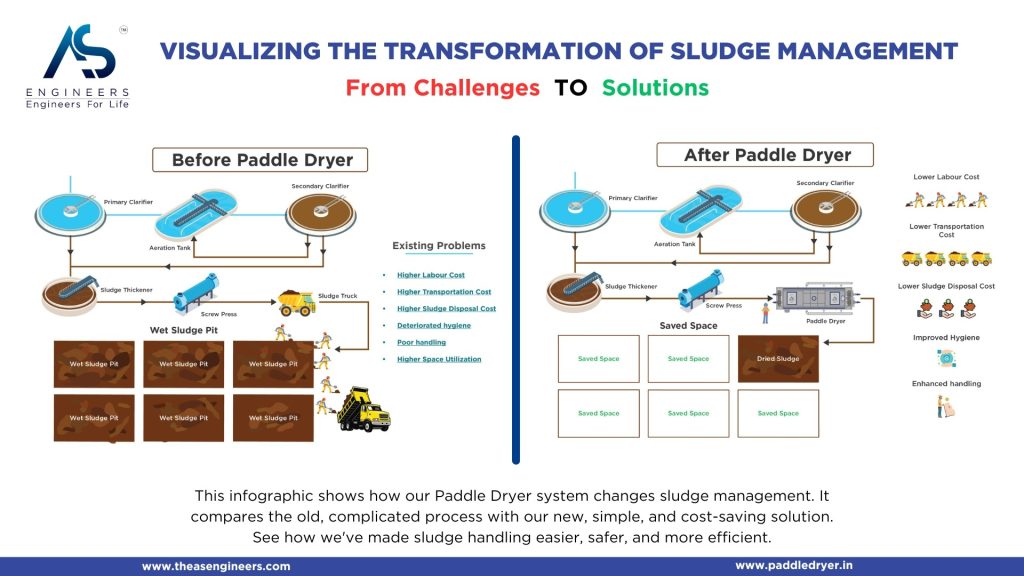
Stage 4: Mechanical dewatering. Filter presses, belt filter presses, centrifuges, and screw presses reduce moisture to 65–75%. This is where most Indian ETP operators stop. The result is a filter cake that still costs Rs 20–30/kg to transport and dispose of at authorized facilities.
Stage 5: Thermal drying. A paddle dryer or other thermal system reduces moisture from 65–75% down to 10–15%. At this level, the material is a dry, stable solid with 80–90% lower weight and volume than the wet cake. For industrial ETP sludge generating 300–1,000 kg/day of wet cake, this stage transforms the compliance burden into a manageable, often recoverable output.
The mistake most facility managers make is treating Stage 4 as the endpoint. Filter press cake at 65–70% moisture is not a disposal solution. It is a temporary storage problem that accumulates daily and creates pressure on SPCB compliance records. Thermal drying completes the chain.
Field Note — Karan Dargode, Head of Operations, AS Engineers “When we visit a new client site for a sludge dryer inquiry, the first thing I look for is how they are currently disposing of the filter press cake. If the answer involves a contractor who picks it up periodically and takes it somewhere unverified, that facility has a compliance exposure they are not tracking. The Pollution Control Board can ask for disposal records going back 3 years. If those records do not exist or point to unregistered disposal sites, the consent renewal becomes a serious issue. A paddle dryer solves the technical problem, but it also creates the documented disposal chain that the compliance audit needs.”
Sludge Disposal Options: What the Rules Allow
After treatment, the final disposal or reuse route depends on sludge type, treatment level, and applicable regulations.
Land application as biosolids. Permitted for treated municipal and organic industrial sludge that meets CPCB pathogen reduction standards and heavy metal concentration limits. Requires documentation and periodic soil testing at application sites.
Co-processing in cement kilns. Dried sludge with a calorific value of approximately 3,000–3,500 kcal/kg (organic-rich industrial ETP sludge dried to 10% moisture) is accepted as an alternate fuel by many cement plants. This route requires coordination with the cement plant and approval from the SPCB.
Composting. Suitable for nutrient-rich agricultural and municipal sludge. Requires adequate land, 3–6 month processing time, and pathogen reduction to CPCB standards before compost is sold or applied.
Authorized landfill. Permitted only for treated sludge at authorized solid waste or hazardous waste facilities. Volume reduction through thermal drying significantly lowers landfill disposal costs per tonne.
Incineration. Used for hazardous sludge where other options are not viable. Requires emission controls and is subject to CPCB standards for stack emissions.
Frequently Asked Questions About Sludge
Q1. What is the difference between sludge and biosolids?
Sludge is the raw semi-solid residue from wastewater treatment before adequate processing. Biosolids are treated sludge that has undergone pathogen reduction and stabilization to the point where it meets regulatory standards for beneficial reuse, such as land application as a soil amendment. In India, CPCB guidelines define the treatment requirements before sludge is considered safe for agricultural use.
Q2. Is all industrial sludge classified as hazardous in India?
No. The Hazardous and Other Wastes Rules, 2016 classify specific industrial sludge types as hazardous based on waste codes assigned to the generating process. Sludge from electroplating, tanneries, pesticide and dye manufacturing, and similar processes is hazardous. ETP sludge from food processing, dairy, or general manufacturing may not be, but characterization is required. Classification determines storage, transport, treatment, and disposal requirements.
Q3. What happens if a facility does not manage its ETP sludge properly?
Under the Environment (Protection) Act, 1986 and the Hazardous Waste Rules, 2016, improper sludge disposal is a punishable offense. State Pollution Control Boards can issue show-cause notices, impose fines, suspend Consent to Operate, and seek closure. NGT orders have resulted in sealed operations at industrial units that could not produce sludge disposal records. The compliance risk is real and increasing.
Q4. What is the typical moisture content of ETP sludge after a filter press?
A plate-and-frame filter press typically produces cake at 65–75% moisture. A screw press or belt press tends to produce wetter cake, often 70–80% moisture. The exact value depends on sludge type, polymer dosing, press pressure, and filter cloth condition. This post-dewatering moisture level is the starting point for any thermal drying calculation.
Q5. Where does a paddle dryer fit in the sludge treatment chain?
A paddle dryer-based sludge drying system is the thermal drying stage that follows mechanical dewatering. It accepts filter press cake or centrifuge cake at 65–80% moisture and dries it to 10–15% moisture using indirect conductive heat transfer. This is Stage 5 in the treatment chain and delivers the most significant volume reduction. It converts a daily accumulating disposal problem into a manageable, documented dry output.
If your ETP generates sludge daily and your current disposal arrangement does not have a documented treatment and disposal chain that survives a Pollution Control Board inspection, that is a compliance gap that needs addressing before the next consent renewal. Contact AS Engineers at +91 99090 33851 or connect@theasengineers.com to discuss your sludge characterization and system requirements.