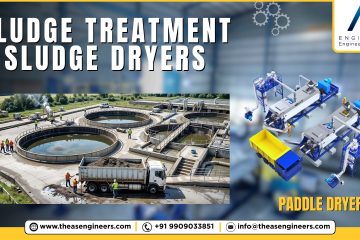
A sludge press machine mechanically removes water from sludge before transport, disposal, drying or further treatment. The right choice depends on sludge type, feed solids, target cake dryness, daily quantity, polymer response, working hours, available space, maintenance capacity and final disposal route.
For most ETP and STP plants, the best decision is not “which machine is cheapest?” The better question is, “What level of moisture reduction does the plant actually need, and what happens to the sludge after dewatering?”
Quick selection summary
| Sludge handling goal | Better-fit equipment | Why it fits |
|---|---|---|
| Continuous low-speed dewatering with compact footprint | Screw press | Good for automated operation, smaller plants and sludge that responds well to polymer conditioning |
| Drier cake from batch operation | Plate and frame filter press | Suitable when batch cycles are acceptable and higher cake dryness is needed |
| Higher dryness than standard filter press | Membrane filter press | Adds secondary squeezing after filtration |
| Large continuous municipal or STP sludge flow | Belt filter press | Good for high-throughput continuous operation where floor space and wash water are available |
| Maximum moisture reduction after mechanical dewatering | Paddle dryer / sludge dryer | Uses thermal drying to evaporate remaining moisture and reduce final disposal load |
A sludge press is normally the mechanical dewatering step. A thermal sludge drying system is the next stage when the plant needs further moisture reduction beyond press output.
What is a sludge press machine?
A sludge press machine is a dewatering machine used to separate water from sludge generated in wastewater treatment. It reduces sludge volume by applying mechanical force through screw compression, filter plates, belts, rollers or membranes.
In simple terms, a sludge press converts loose wet sludge into a more compact sludge cake. This makes sludge easier to store, handle, transport and send for disposal or further drying.
Common names include:
- Sludge press machine
- Sludge dewatering machine
- Sludge filter press
- Screw press dewatering machine
- Belt filter press
- Plate and frame sludge press
- Membrane filter press
For a broader selection view, also review this guide on sludge dewatering techniques.
Why sludge dewatering matters in ETP and STP plants
Wet sludge creates four common problems in wastewater treatment plants.
First, it increases transport cost because the plant is moving water along with solids. Second, it needs more storage space. Third, it can create odor, hygiene and handling issues. Fourth, it can make disposal planning difficult when moisture content is inconsistent.
Mechanical dewatering reduces free water, but it does not remove all bound moisture. That is why many plants use sludge presses first and then consider drying when disposal cost, TSDF load, storage space or final moisture target becomes critical.
In industrial plants, the sludge source also matters. Chemical sludge, biological sludge, petroleum sludge, textile sludge, pharma sludge, food sludge and paper sludge do not behave the same way during pressing.
Main types of sludge press machines
Screw press machine
A screw press uses a rotating screw inside a screen, drum or ring structure. As sludge moves forward, pressure gradually increases and water drains out through the filtration area.
A screw press is generally selected when the plant wants continuous operation, compact layout and lower operator attention. It is commonly considered for municipal sludge, biological sludge, food-processing sludge and some industrial ETP sludge where polymer conditioning works well.
Best fit:
- Small to medium ETP or STP plants
- Continuous dewatering requirement
- Plants with limited manpower
- Sludge that does not need extreme cake dryness
- Sites where compact footprint is important
Watch-outs:
- Final cake dryness depends heavily on sludge type and conditioning
- Fibrous or oily sludge should be tested before selection
- Screen/ring wear and cleaning access should be reviewed
- Feed consistency affects output consistency
For a direct comparison, use this page on belt filter press vs screw press.
Plate and frame filter press
A plate and frame filter press is a batch dewatering system. Sludge is pumped into chambers between filter plates. Water passes through the filter cloth and solids remain inside the chambers as cake.
This equipment is often used where the plant wants a firm filter cake and can manage batch operation.
Best fit:
- Chemical and industrial ETP sludge
- Plants where batch operation is acceptable
- Sludge that forms a good cake under pressure
- Applications where cake dryness is more important than continuous flow
Watch-outs:
- Filter cloth cleaning and replacement must be planned
- Cycle time affects daily throughput
- Labour and automation level matter
- Feed pump selection is critical
For more detail, see the plate and frame sludge press guide.
Membrane filter press
A membrane filter press works like a standard filter press, but it adds a secondary squeeze. After the chamber is filled, membranes expand and apply extra pressure to the cake.
This helps remove additional water compared with a standard plate press.
Best fit:
- Plants where lower final moisture is required
- Industrial sludge with higher disposal cost
- Applications where cycle time is acceptable
- Sludge that responds well to pressure filtration
Watch-outs:
- Higher equipment complexity
- Membrane maintenance must be considered
- Compressed air or water requirements must be checked
- Not every sludge gives meaningful improvement without testing
Belt filter press
A belt filter press dewaters sludge continuously between moving belts. The process normally includes gravity drainage, wedge pressure and roller pressure.
Belt presses are common in municipal and high-flow wastewater plants because they can handle continuous throughput.
Best fit:
- Large STP or municipal sludge flows
- Continuous operation
- Plants with available floor space
- Sludge that drains well after polymer conditioning
Watch-outs:
- Belt washing water requirement
- Belt tracking and wear
- Odor and splash control
- More open design compared with enclosed systems
Centrifuge
A centrifuge is not always called a sludge press, but it is a major sludge dewatering option. It separates solids and liquid by high-speed rotation.
Best fit:
- High-throughput dewatering
- Sites where compact footprint is needed
- Plants with trained maintenance teams
- Sludge that responds well to centrifugal separation
Watch-outs:
- Higher-speed rotating equipment
- Power consumption and wear parts
- Vibration and balancing requirements
- Maintenance skill requirement
Sludge press machine comparison table
| Parameter | Screw press | Plate and frame filter press | Membrane filter press | Belt filter press | Paddle dryer |
|---|---|---|---|---|---|
| Process type | Continuous | Batch | Batch | Continuous | Continuous thermal drying, design-dependent |
| Main action | Gradual screw compression | Pressure filtration | Pressure filtration plus membrane squeeze | Belt and roller pressure | Indirect heat evaporation |
| Best for | Compact automated dewatering | Firmer cake with batch cycles | Higher dryness target | Large continuous flows | Moisture reduction beyond mechanical dewatering |
| Typical plant use | STP, ETP, biological sludge | Industrial ETP, chemical sludge | Industrial sludge with disposal-cost pressure | Municipal and large STP sludge | ETP/STP/industrial sludge drying |
| Operator attention | Low to medium | Medium | Medium | Medium | Depends on automation and system design |
| Maintenance focus | Screw, screen, rings, seals | Cloth, plates, hydraulic system | Membranes, cloth, plates | Belts, rollers, wash system | Shafts, paddles, seals, heating system, vapour handling |
| Space need | Compact | Medium | Medium | Higher | Medium, system-dependent |
| Best selection basis | Feed solids and polymer response | Cake formation and cycle time | Additional squeeze value | Throughput and wash water | Final moisture target and disposal route |
Mechanical dewatering vs sludge drying
Mechanical dewatering and sludge drying are not the same process.
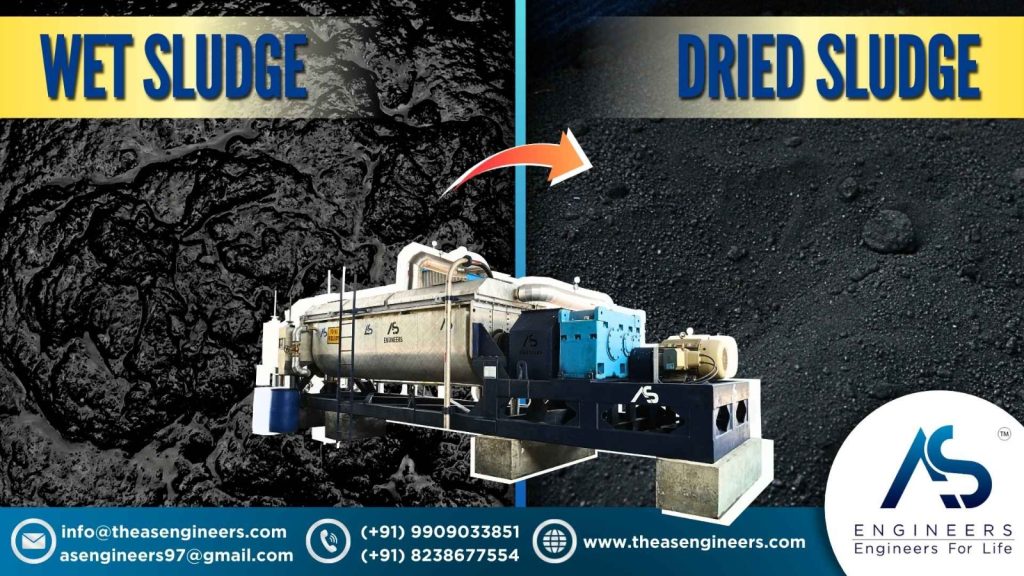
A sludge press removes free water as liquid. A sludge dryer removes remaining moisture by evaporation. That difference matters because some plants expect press equipment to deliver a dry, granular final material. In many cases, that is not realistic without a thermal drying step.
Use this simple decision logic:
| Plant condition | Recommended direction |
|---|---|
| Sludge is too liquid for handling | Use thickening and mechanical dewatering |
| Sludge cake is still costly to transport | Review better press performance or add drying |
| Disposal cost depends strongly on weight | Compare press output with dryer output |
| Sludge is sticky, oily or difficult to press | Conduct dewatering and drying trials |
| Plant wants dried sludge for approved reuse route | Lab analysis, regulatory review and dryer evaluation are needed |
AS Engineers’ paddle dryer uses indirect heating through hollow shafts and jacket, with paddle agitation to support sludge drying. Company materials mention heating through steam or thermal oil, self-cleaning wedge-shaped paddles, dual counter-rotating shafts and configuration options such as standard, dual zone and vacuum dryer.
Where paddle dryer fits after a sludge press
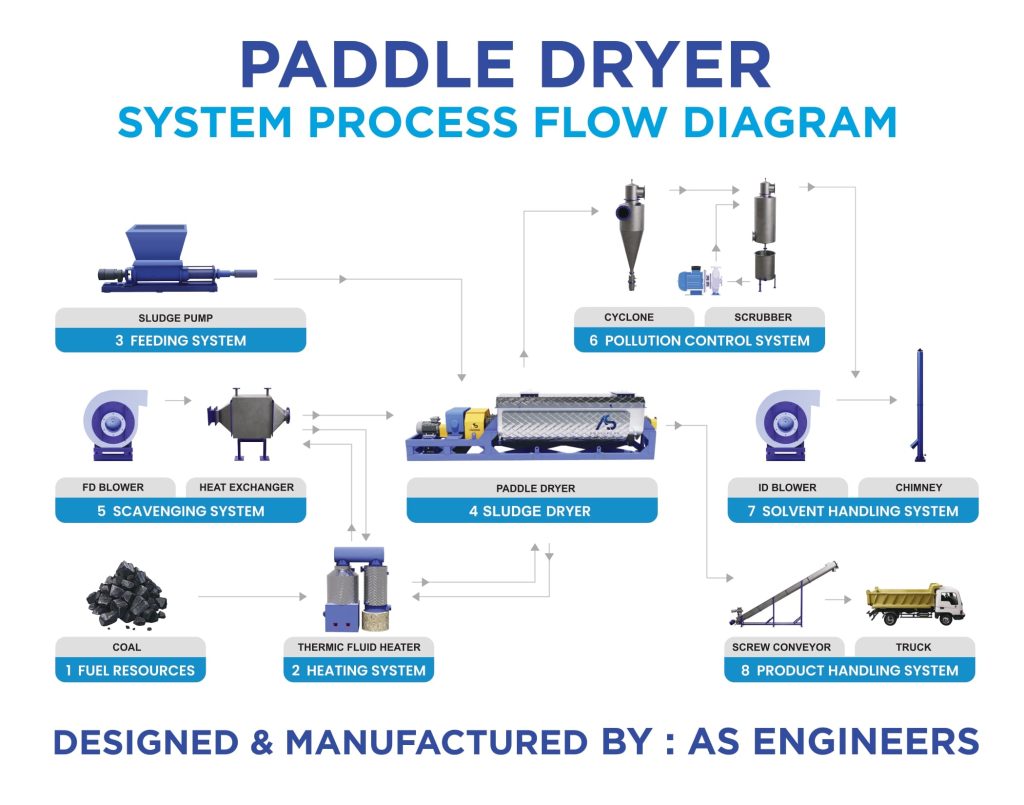
A paddle dryer is useful when mechanical dewatering alone does not reduce moisture enough for the plant’s disposal, storage or handling target.
In a typical sludge handling line, the flow can look like this:
- Sludge collection from ETP, STP or process plant
- Sludge thickening or equalization
- Feed transfer through pump, screw feeder or conveyor
- Mechanical dewatering using screw press, filter press, belt press or centrifuge
- Thermal drying using paddle dryer when required
- Dried sludge handling, bagging, storage, disposal or approved reuse review
For dryer selection, the plant should not share only “tons per day.” The buyer should share feed moisture, final moisture target, sludge source, heating medium, operating hours, vapour handling requirement, MOC expectation and disposal route.
AS Engineers company material also mentions a 50 kg/hr paddle dryer pilot trial machine for demonstrations, with trials possible at AS Engineers’ works or at the client site on a paid basis, waived upon order placement. Use this claim only where the current sales team confirms it is still active.
How to choose the right sludge press machine
Start with sludge type
Do not select a sludge press only by capacity. Start with the sludge source.
Important inputs include:
- ETP, STP, CETP or process sludge
- Primary, secondary, biological, chemical or mixed sludge
- Feed solids percentage
- Oil and grease level
- Fibre content
- Particle size and grit load
- pH and corrosive nature
- Temperature
- Odor and volatile content
- Hazardous or non-hazardous classification
- Polymer response
For industrial plants, also check the industrial sludge disposal route before selecting equipment.
Define the final cake requirement
A plant may need sludge cake only for easier transport. Another plant may need much lower moisture because TSDF cost, landfill cost, incineration cost or storage space is high.
Ask these questions before RFQ:
- What is the current sludge quantity per day?
- What is the current moisture or solids percentage?
- What final moisture is acceptable?
- Is the plant paying disposal by weight?
- Is there a storage-space problem?
- Is dried sludge planned for co-processing, fuel, bricks, composting or any reuse route?
- Is the sludge hazardous or restricted?
Do not assume dried sludge can be reused or sold. Reuse depends on lab analysis, end-use acceptance and applicable regulatory permissions.
Check operation style
A continuous plant may prefer screw press, belt press or centrifuge. A batch plant may accept plate and frame or membrane filter press.
If the plant has limited manpower, automation, cleaning access and spare-part availability become more important than the basic machine price.
For connected equipment planning, check sludge transfer pumps because poor feed transfer can disturb dewatering performance.
Compare total cost, not only machine price
Online sludge press machine prices are usually not enough for industrial buying. Actual cost depends on:
- Capacity
- Sludge characteristics
- MOC
- Automation level
- Feed pump and polymer dosing system
- Filter area or screw size
- Control panel
- Washing system
- Civil foundation and installation
- Spares and service
- Required accessories
- Downstream dryer or conveying system
A lower-cost machine can become expensive if it produces wet cake, needs frequent cleaning or cannot handle actual sludge variation.
RFQ checklist for sludge press machine suppliers
Before asking for a quote, prepare this data:
| RFQ input | Why it matters |
|---|---|
| Sludge source | Determines whether sludge is biological, chemical, oily, fibrous or mixed |
| Feed quantity per day | Defines capacity |
| Operating hours per day | Converts daily sludge load into hourly throughput |
| Feed moisture or solids percentage | Required for sizing |
| Target cake moisture | Defines performance expectation |
| pH and temperature | Affects MOC and component life |
| Oil, grease and fibre content | Affects clogging and press performance |
| Polymer trial data | Helps estimate real dewatering behaviour |
| Available space | Affects equipment layout |
| Power and water availability | Important for belt washing, pumps and controls |
| Disposal route | Determines how dry the cake needs to be |
| Downstream drying need | Decides whether paddle dryer should be evaluated |
For a wider buying framework, use this sludge dewatering machine guide.
Common mistakes while buying a sludge press machine
Selecting by price only
A sludge press is not a standard commodity item. Two machines with the same name can behave differently on the same sludge. Compare output cake, filtrate clarity, cleaning requirement, polymer consumption, service access and spare availability.
Ignoring sludge variability
ETP sludge changes when production changes. STP sludge changes when organic load, season, retention and biological activity change. A trial should include realistic sludge, not only a clean sample.
Expecting press output to behave like dried sludge
Mechanical dewatering can reduce free water, but it cannot replace thermal drying where very low final moisture is required. For high moisture reduction, compare a press-only system with press plus paddle dryer manufacturer in India evaluation.
Not checking filtrate quality
Dewatering is not only about cake dryness. The separated water returns to the treatment stream or moves to further treatment. Poor solids capture can increase load on the plant.
Forgetting disposal compliance
For industrial and hazardous sludge, disposal and reuse routes should be checked with the responsible EHS team and applicable authority. Use this guide on CPCB hazardous waste disposal as a starting point, but final compliance should be reviewed case by case.
Maintenance checklist
Before finalizing a sludge press machine, ask the supplier about:
- Daily cleaning procedure
- Weekly inspection points
- Filter cloth or belt life
- Screw, ring, screen or plate wear parts
- Bearing and gearbox lubrication
- Polymer dosing maintenance
- Hydraulic system maintenance
- Wash water requirement
- Access for cleaning and inspection
- Spare part availability
- Local service support
- Commissioning and operator training
For paddle dryer support, AS Engineers material mentions services such as shaft, gearbox and bearing replacement, system repair and upgrades, retrofitment solutions and OEM spare parts.
Best-fit recommendation by plant type
| Plant type | Typical sludge issue | Practical equipment direction |
|---|---|---|
| Small STP | Limited manpower, moderate sludge load | Screw press or compact dewatering system |
| Large municipal STP | Continuous high volume sludge | Belt filter press, centrifuge or multiple screw presses |
| Chemical ETP | Variable chemical sludge, corrosion risk | Filter press or membrane press after material testing |
| Pharma ETP | Disposal sensitivity, possible sticky sludge | Dewatering trial plus dryer review if moisture target is strict |
| Food and biological sludge | Organic, odorous, moisture-heavy sludge | Screw press or belt press, then drying if transport cost is high |
| Petroleum or oily sludge | Oily, sticky, difficult to press | Trial mandatory, drying may be required |
| CETP | Mixed sludge from multiple industries | Lab testing, careful MOC, press trial and disposal-route review |
When to contact AS Engineers
Contact AS Engineers when the question is not only “Which sludge press should we buy?” but also “How do we reduce final sludge moisture, handling difficulty and disposal load after dewatering?”
Share these details:
- Sludge source and industry
- Current sludge quantity per day
- Feed moisture or solids percentage
- Target final moisture
- Present dewatering method
- Current disposal route and cost basis
- Available heating medium, such as steam or thermic fluid
- Space and layout limitations
- Vapour handling or pollution-control requirement
- Whether pilot testing is required
AS Engineers can review sludge drying requirements where a paddle dryer or sludge dryer is suitable. Final equipment selection should be based on actual sludge behaviour and site operating data.
FAQs
What is the best sludge press machine?
There is no single best sludge press machine for every plant. Screw press is useful for compact continuous operation, filter press is useful for firmer batch cake, membrane filter press is useful for higher dryness, and belt press is useful for large continuous sludge flow. The right machine depends on sludge type, target moisture, throughput and disposal route.
Is a screw press better than a filter press?
A screw press is usually better when the plant wants continuous low-speed operation, compact footprint and lower operator attention. A filter press is often better when the plant can accept batch operation and wants a firmer sludge cake. A trial with actual sludge is the safest comparison.
Can a sludge press machine make sludge completely dry?
No. A sludge press mechanically removes water, but it does not fully dry sludge. If the plant needs much lower moisture or dry granular sludge, a thermal dryer such as a paddle dryer may be required after mechanical dewatering.
What information is required for sludge press machine selection?
Share sludge source, daily quantity, working hours, feed solids, target cake moisture, pH, temperature, oil and grease content, polymer response, available space, power, water, disposal route and whether downstream drying is planned.
Can dried sludge be reused?
Dried sludge may have possible routes such as co-processing, fuel use, bricks, composting or land application depending on its composition. It should not be assumed as reusable without lab analysis, buyer acceptance and applicable regulatory permission.
Conclusion
A sludge press machine is an important first step for reducing sludge volume, but it should not be selected only by equipment name or online price. The correct choice depends on sludge behaviour, press output, operating style, maintenance capacity and final disposal route.
For ETP, STP, CETP, pharma, chemical, food, paper, textile and refinery sludge, the strongest buying approach is to compare the full sludge handling chain: thickening, feed transfer, mechanical dewatering, drying, vapour handling, storage and disposal.
Where a press produces cake that is still too wet, heavy or expensive to dispose of, evaluate sludge drying as the next step. AS Engineers can review paddle dryer requirements based on feed moisture, final moisture target, heating medium, sludge type, throughput and site conditions.