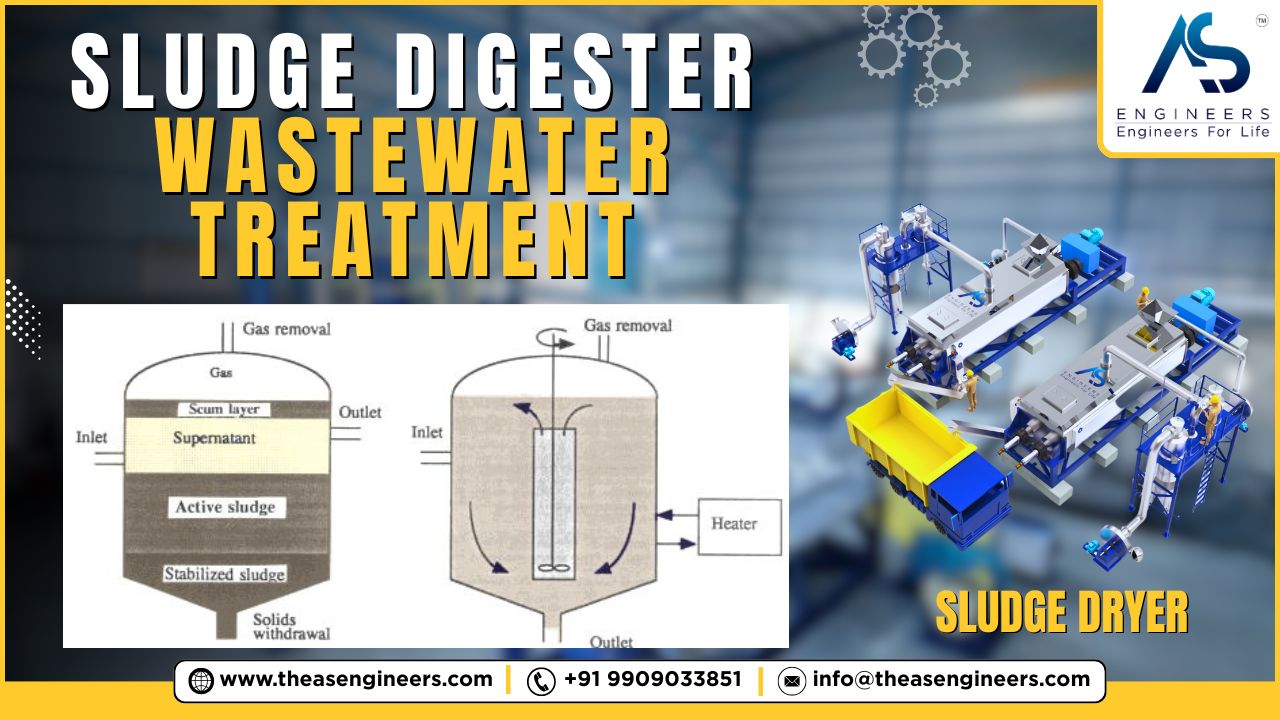
Sludge digester wastewater treatment is the controlled biological stabilization of sludge before final handling. In simple terms, a digester helps reduce the unstable organic load in sewage sludge or biodegradable industrial sludge. Anaerobic digesters work without oxygen and can produce biogas. Aerobic digesters use oxygen and are often simpler for smaller plants.
But digestion is not the final disposal step. After digestion, most plants still need thickening, dewatering, drying, storage, transport, reuse planning, or approved disposal.
For plant managers, EHS teams, consultants, and purchase teams, the important question is not only “Which digester do we need?” It is also “What will we do with the digested sludge after the digester?”
What is a sludge digester in wastewater treatment?
A sludge digester is a treatment vessel where biological activity stabilizes sludge from a wastewater treatment plant. It is commonly used in sewage treatment plants, municipal wastewater facilities, and some industrial plants where sludge contains biodegradable organic matter.
In a typical wastewater treatment plant, sludge may come from primary clarification, secondary biological treatment, or a combination of both. Before it reaches the digester, it may pass through screening, grit removal, thickening, pumping, and equalization depending on the plant design.
The digester’s main role is to reduce sludge instability. It can help reduce odor risk, reduce volatile organic matter, support biosolids handling, and improve downstream sludge management. It does not automatically make sludge dry, light, or ready for every reuse route.
Where digestion fits in the sludge treatment line
A sludge digester normally sits between sludge generation and final sludge handling.
A practical sludge line may look like this:
- Wastewater treatment creates primary sludge, secondary sludge, or mixed sludge.
- Sludge is screened, pumped, thickened, or equalized.
- Sludge enters the digester for biological stabilization.
- Digested sludge is stored or conditioned.
- Digested sludge is dewatered using a centrifuge, belt press, screw press, filter press, or similar equipment.
- Dewatered sludge may go for drying, disposal, co-processing, composting, incineration, land application where legally allowed, or other approved routes.
If your team is still comparing sludge types, this guide on primary sludge vs secondary sludge is a useful supporting page.
Anaerobic vs aerobic sludge digestion
Both systems stabilize sludge, but they are not selected for the same operating conditions.
| Point | Anaerobic sludge digester | Aerobic sludge digester |
|---|---|---|
| Oxygen condition | Works without oxygen | Requires oxygen |
| Common use | Medium to large sewage sludge and high-organic biological sludge applications | Smaller plants, extended aeration systems, and simpler stabilization duties |
| Main output | Digested sludge, liquid sidestream, and biogas | Stabilized sludge and treated liquid sidestream |
| Energy angle | Can recover energy through biogas if properly designed and maintained | Requires aeration energy |
| Complexity | More process-sensitive | Usually simpler to operate, but aeration cost matters |
| Key watch-outs | Temperature, loading, mixing, pH stability, biogas safety, foaming, scum, grit | Oxygen transfer, aeration energy, mixing, sludge age, odor control |
| Downstream need | Dewatering and often drying may still be required | Dewatering and often drying may still be required |
If the plant has high biodegradable organic sludge and a long-term plan for biogas handling, anaerobic digestion can be attractive. If the plant is smaller and wants simpler stabilization, aerobic digestion may be easier to manage.
The correct choice depends on sludge character, flow variation, operating manpower, energy cost, available space, odor control needs, and final sludge disposal route.
How the sludge digestion process works
The biological reactions inside a digester are complex, but for plant-side understanding, the process can be viewed in stages.
Sludge receiving and thickening
Raw sludge should not be treated as a fixed material. Its solids concentration, grit load, oil and grease, fiber, pH, and biological activity can change daily.
Thickening before digestion can reduce the volume entering the digester. This can help reduce tank load, pumping volume, and heating demand in anaerobic systems. Poorly thickened or highly diluted sludge can make the digester larger and more expensive to operate.
Biological breakdown
Inside the digester, microorganisms break down biodegradable organic matter. In anaerobic digestion, this happens without oxygen. In aerobic digestion, oxygen is supplied through aeration.
For anaerobic systems, digestion is often explained through hydrolysis, acid formation, and methane formation. In real plant operation, these stages overlap. If the plant overloads the digester or allows the chemistry to become unstable, gas generation, odor, foaming, or poor stabilization can follow.
Stabilization
The goal is to make sludge less putrescible and more stable for downstream handling. Stabilized sludge is generally easier to manage than raw sludge, but it still contains water and solids.
This is where many projects make a wrong assumption. A digester reduces instability. It does not replace dewatering equipment. It does not replace drying equipment. It does not remove every contaminant. It does not solve a disposal route that has not been planned.
Post-digestion handling
After digestion, sludge usually needs dewatering. Depending on final moisture target, storage constraints, transport distance, disposal cost, or reuse route, drying may also be required.
For this stage, teams should compare sludge dewatering techniques and then evaluate whether a thermal sludge drying system is required after dewatering.
What a sludge digester can and cannot do
| Requirement | Can a digester help? | Practical note |
|---|---|---|
| Stabilize organic sludge | Yes | Best suited when sludge has biodegradable organic matter |
| Reduce odor potential | Yes, when operated correctly | Poor loading or poor mixing can still create odor issues |
| Produce biogas | Yes, in anaerobic systems | Needs gas handling, safety, monitoring, and maintenance |
| Reduce water content significantly | No | Dewatering or drying is still needed |
| Reduce transport weight by itself | Limited | Real weight reduction usually comes after dewatering and drying |
| Treat high-inorganic sludge | Limited | Chemical and mineral-heavy sludge may not digest well |
| Make sludge automatically reusable | No | Reuse depends on composition, regulation, contamination, drying level, and final application |
| Replace final disposal planning | No | Disposal or reuse route must be planned before equipment selection |
When I review sludge projects, this is one of the first points I check. If the buyer expects the digester to solve moisture, storage, transport, and disposal together, the plant design will usually create problems later.
Key design and operation inputs before selecting a sludge digester
A sludge digester should not be selected only by plant capacity. The sludge data matters more.
| Input | Why it matters |
|---|---|
| Sludge source | Primary, secondary, mixed, STP, ETP, biological, food, pharma, chemical, municipal |
| Total solids and volatile solids | Shows how much material is present and how much may biologically degrade |
| Daily and peak sludge quantity | Affects tank sizing, pumping, retention, storage, and downstream handling |
| Grit, sand, fiber and plastics | Can settle, block, wear equipment, or reduce effective volume |
| Oil and grease | Can affect scum formation, mixing, and digestion stability |
| pH and alkalinity | Important for biological stability, especially in anaerobic digestion |
| Temperature | Affects microbial activity and heating needs |
| Inhibitors or toxic compounds | Important for industrial ETP sludge where chemicals may disturb biology |
| Mixing requirement | Poor mixing can create dead zones, scum, short-circuiting, and odor |
| Biogas handling plan | Required for anaerobic digestion safety and useful gas recovery |
| Final sludge route | Determines dewatering, drying, storage, disposal, or reuse planning |
For industrial plants, sludge character must be checked carefully. Some ETP sludge streams may contain chemicals, metals, salts, solvents, or process contaminants that need separate review before any biological digestion route is assumed.
Sludge digester problems plant teams should expect
A digester is not a “fit and forget” system. It needs operating discipline.
Common problems include:
- Foaming due to loading changes, filamentous organisms, fats, oils, grease, or poor process balance
- Scum formation due to floating grease, fiber, plastics, or poor mixing
- Grit settlement, which reduces effective digester volume
- Poor gas production due to low biodegradable content or process instability
- Odor complaints due to poor sludge handling, storage, or venting
- Pumping issues due to thick sludge, rags, fibers, or inconsistent solids
- Poor dewatering after digestion due to sludge chemistry or polymer mismatch
- High wet sludge transport cost when drying is not planned
For pumping-side issues, refer to this guide on sludge pumps in wastewater treatment.
Why digestion alone does not finish sludge management
Digested sludge still contains a large amount of water. Even after mechanical dewatering, the cake may remain heavy, bulky, sticky, and costly to transport.
That is why many plants evaluate sludge drying after digestion and dewatering.
Drying may be considered when the plant wants to:
- Reduce wet sludge volume and weight
- Improve storage and handling
- Reduce frequent sludge transport
- Prepare sludge for approved reuse or co-processing routes
- Reduce hygiene and odor issues from wet sludge storage
- Improve disposal planning where wet sludge cost is high
This is where the selection should move from “digester design” to “complete sludge line design.”
Where a paddle dryer fits after sludge digestion
A paddle dryer is not a sludge digester. It is a thermal drying system used after sludge has already been collected, thickened, digested, or dewatered depending on the plant layout.
In a post-digestion sludge line, the usual placement is:
Digester → digested sludge storage → dewatering → wet cake handling → paddle dryer → dried sludge handling → approved disposal or reuse route
An indirect paddle dryer can be useful when the plant needs controlled heat transfer, enclosed processing, reduced off-gas volume, and steady handling of sludge cake. In AS Engineers’ sludge drying system, the broader configuration can include feeding, heating medium, paddle dryer, scavenging air, pollution control equipment, vapour management, and product handling.
A practical buyer should not ask only for dryer price. The better question is: “What feed moisture, final moisture target, daily sludge quantity, heating medium, vapour handling, MOC, and product handling arrangement are suitable for my digested sludge?”
For dryer selection, use this sludge paddle dryer selection guide and this paddle dryer configuration guide.
Anaerobic digester with sludge dryer: when this combination makes sense
A digester plus dryer combination may make sense when the plant has both stabilization and volume-reduction requirements.
| Plant condition | Why the combination may help |
|---|---|
| Large sewage sludge generation | Digestion stabilizes sludge, drying helps reduce wet disposal load |
| Long transport distance | Dryer can reduce dependence on frequent wet sludge movement |
| Limited storage area | Dried sludge is easier to store than wet sludge cake |
| Odor complaints from wet sludge | Digestion and drying can reduce wet sludge handling issues when designed correctly |
| Potential approved reuse route | Drying may support handling for co-processing or reuse, subject to composition and regulation |
| Higher wet sludge disposal cost | Drying may improve the economics, but the project needs site-specific calculation |
For cost evaluation, see this guide on industrial sludge dryer machine price. Treat pricing as application-specific, not a fixed catalogue number.
When a sludge digester may not be the right first solution
A sludge digester is not always the best first investment.
It may not be suitable as the primary solution when:
- Sludge has very low biodegradable organic content
- Sludge is mostly inorganic, mineral, ash, metal hydroxide, lime, or chemical precipitate
- Toxic process chemicals may inhibit biological activity
- The plant has no space for tankage, gas handling, storage, and safety systems
- The operator team cannot maintain biological process control
- The real pain point is transport moisture, not sludge instability
- The final disposal or reuse route is not defined
In some industrial plants, the better first step may be thickening, dewatering, chemical conditioning, drying, or disposal-route correction instead of a digester.
RFQ checklist for digested sludge drying
Before asking for a sludge dryer proposal after digestion, share these inputs:
| RFQ input | What to provide |
|---|---|
| Sludge source | STP, ETP, municipal, food, pharma, chemical, paper, textile, refinery, or mixed |
| Digestion type | Anaerobic, aerobic, planned, existing, or not installed |
| Feed to dryer | Digested sludge cake, dewatered sludge, filter cake, centrifuge cake, or screw press cake |
| Feed moisture | Current moisture percentage or lab test report |
| Final moisture target | Required dryness or handling condition |
| Daily quantity | kg/hr, ton/day, operating hours per day |
| Sludge behavior | Sticky, pasty, fibrous, granular, oily, abrasive, corrosive |
| Heating medium | Steam, thermic fluid, hot water, hot air generator, or site fuel option |
| Vapour condition | Water vapour, solvent vapour, odor, dust, fumes, or special handling requirement |
| Pollution control need | Cyclone, scrubber, bag filter, condenser, chimney, or existing system interface |
| Material of construction | CS, SS304, SS316, duplex, or application-specific alloy requirement |
| Discharge plan | Bagging, screw conveyor, silo, truck loading, or downstream process |
This data helps avoid wrong dryer sizing, wrong MOC selection, poor vapour handling, and unrealistic moisture expectations.
Common mistakes in sludge digester wastewater treatment projects
Selecting by plant capacity only
Two plants with the same MLD capacity can produce very different sludge. Sludge character, biological load, grit, solids content, industrial contamination, and operating pattern matter.
Ignoring the post-digestion sludge route
A digester stabilizes sludge, but it does not automatically solve dewatering, drying, storage, transport, or disposal.
Treating STP sludge and ETP sludge as the same
STP sludge is usually more biological in nature. ETP sludge can vary widely based on the industry. Chemical, pharma, textile, dye, refinery, and metal-finishing sludge need careful review.
Not planning gas safety in anaerobic digestion
Anaerobic systems can generate biogas. Gas collection, pressure control, leak checking, flame arresting, venting, maintenance, and operator training need proper design and safety review.
Expecting drying equipment to correct upstream instability
A dryer can reduce moisture, but it cannot fix unstable digestion, poor sludge conditioning, uncontrolled feed variation, or wrong dewatering chemistry.
Practical selection logic
Use a digester when the sludge has enough biodegradable organic matter and the plant wants stabilization, odor control, biogas recovery, or biosolids conditioning.
Use dewatering when the main issue is water removal before transport or drying.
Use drying when the plant needs lower moisture, smaller volume, improved handling, reduced storage issues, or a better final disposal or reuse route.
For many STP and organic sludge projects, the correct answer is not one machine. It is a complete sludge line: thickening, digestion, dewatering, drying, vapour handling, product handling, and approved final route.
Conclusion
Sludge digester wastewater treatment is useful when the plant needs biological stabilization of sewage sludge or biodegradable organic sludge. Anaerobic digestion can also support biogas recovery when the system is properly designed and operated. Aerobic digestion can be simpler for smaller or lower-complexity plants.
But digestion should not be treated as the final sludge management solution. Digested sludge still needs a downstream plan. Dewatering, drying, storage, transport, disposal, reuse, and regulatory review must be considered before the project is finalized.
For AS Engineers, the correct positioning is clear: a sludge digester stabilizes sludge, and a sludge dryer helps manage moisture, handling, volume, and downstream logistics after digestion or dewatering. Share your sludge source, feed moisture, final moisture target, daily quantity, heating medium, vapour handling requirement, and disposal route so the right sludge drying configuration can be reviewed.
FAQs
What is sludge digester wastewater treatment?
Sludge digester wastewater treatment is the biological stabilization of sludge generated from sewage or wastewater treatment. It helps reduce sludge instability and odor potential, and in anaerobic systems it can produce biogas.
Does a sludge digester dry sludge?
No. A sludge digester stabilizes organic matter, but it does not dry sludge. Digested sludge usually still needs thickening, dewatering, and sometimes thermal drying before final handling.
Which is better, anaerobic or aerobic sludge digestion?
Neither is always better. Anaerobic digestion is useful for higher organic sludge loads and biogas recovery. Aerobic digestion can be simpler for smaller plants, but aeration energy matters. The right choice depends on sludge type, plant size, operating team, space, energy cost, and final sludge route.
Can industrial ETP sludge be treated in a digester?
Only some industrial sludge streams are suitable. If the ETP sludge contains biodegradable organic matter, digestion may be possible. If it contains toxic chemicals, high salts, metals, solvents, or mostly inorganic solids, it needs detailed review before digestion is assumed.
Why is sludge drying needed after digestion?
Drying may be needed when digested and dewatered sludge is still too wet, heavy, bulky, sticky, or costly to transport. A dryer can help reduce moisture and improve handling, storage, disposal, or approved reuse planning.