Most ETP and STP plants look at dewatering or sludge drying when sludge handling cost increases. In many cases, the problem starts earlier, at the sludge thickener.
A sludge thickener concentrates dilute sludge before dewatering. In a gravity thickener, solids settle under gravity, clear supernatant overflows from the top, and thickened sludge is withdrawn from the bottom. Better thickening reduces sludge volume, improves dewatering stability, and lowers the thermal load on the sludge dryer.
What Is a Sludge Thickener?
A sludge thickener is a wastewater treatment unit used to increase the solids concentration of sludge before the next treatment stage.
In practical terms, it removes part of the free water from sludge while keeping the sludge pumpable. The output is not dry cake. It is still wet sludge, but with higher total solids and lower volume.
A sludge thickener is normally placed before equipment such as a filter press, belt press, screw press, centrifuge, digester, drying bed, or thermal sludge dryer.
For a full sludge handling chain, thickening is usually the first serious volume-reduction step before sludge dewatering and sludge drying.
Simple Answer: What Does a Gravity Sludge Thickener Do?
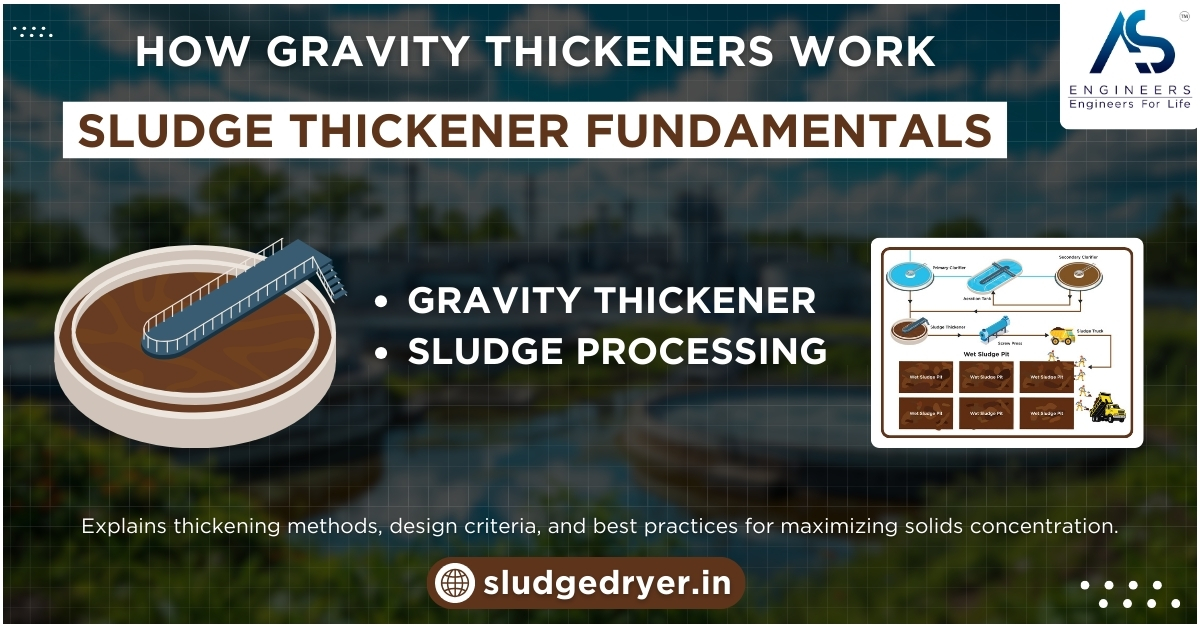
A gravity sludge thickener uses settling to separate sludge solids from water. Sludge enters a circular tank through a central feedwell. Heavier solids settle toward the bottom. Slowly rotating rake arms move the settled sludge toward a central hopper. The clearer liquid, called supernatant, overflows from the top and returns to the treatment process. The concentrated underflow goes to dewatering or further sludge treatment.
The main purpose is volume reduction before downstream processing.
How a Gravity Thickener Works
A gravity thickener looks similar to a clarifier, but its job is different.
A clarifier is mainly designed to produce clearer water. A thickener is designed to produce concentrated sludge underflow.
The working sequence is simple:
| Stage | What happens | Why it matters |
|---|---|---|
| Feed entry | Sludge enters through the central feedwell | Reduces turbulence and spreads the flow |
| Settling | Solids settle downward by gravity | Separates solids from free water |
| Sludge blanket formation | Settled solids form a thicker layer near the bottom | Creates compression and further water release |
| Rake movement | Slow rake arms move sludge toward the centre | Prevents dead zones and supports withdrawal |
| Supernatant overflow | Clearer liquid exits from the top weir | Returns liquid to the treatment system |
| Underflow withdrawal | Thickened sludge is pumped or drained out | Feeds dewatering or further treatment |
The thickener depends on calm flow. High turbulence, wrong feedwell design, excessive hydraulic loading, or poor sludge settling can disturb the sludge blanket and reduce performance.
Gravity Thickening vs Clarification
Many buyers confuse a sludge thickener with a clarifier because both use settling. The operating objective is different.
| Point | Clarifier | Gravity sludge thickener |
|---|---|---|
| Main output | Clearer treated water | Concentrated sludge |
| Main concern | Effluent clarity | Underflow solids concentration |
| Sludge blanket | Kept controlled to avoid solids carryover | Used as part of thickening and compaction |
| Bottom mechanism | Scrapes settled sludge | Moves and compresses sludge mass |
| Downstream link | Treated water discharge or reuse | Dewatering, digestion, drying, or disposal |
If your plant is sending dilute underflow to the filter press or centrifuge, the downstream problem may not be the dewatering machine alone. The thickener performance must be checked first.
Where the Sludge Thickener Fits in the Treatment Chain
A typical sludge handling chain looks like this:
Primary / secondary treatment → sludge thickener → dewatering equipment → sludge dryer → disposal, reuse, co-processing, or further handling
In an ETP or STP, the thickener does not replace dewatering or drying. It prepares the sludge for them.
When thickening is poor, downstream equipment receives more water than expected. That means:
| Downstream unit | Effect of poor thickening |
|---|---|
| Filter press | Longer cycle time, wetter cake, higher cloth blinding risk |
| Belt press | Higher hydraulic load and unstable cake formation |
| Screw press | Lower cake solids if feed consistency changes |
| Centrifuge | Higher power, more polymer demand, unstable separation |
| Sludge dryer | Higher evaporation load and higher thermal energy demand |
This is why sludge thickener performance should be reviewed before selecting a larger dewatering machine or a larger thermal dryer.
Primary Sludge, Secondary Sludge, and Mixed Sludge Behave Differently
Not all sludge settles the same way.
Primary sludge usually contains heavier solids and settles better. Waste activated sludge from biological treatment is lighter, more compressible, and more difficult to thicken by gravity alone.
| Sludge type | Gravity thickening behaviour | Practical note |
|---|---|---|
| Primary sludge | Usually suitable | Settles better and can produce stronger underflow |
| Waste activated sludge | Often difficult | May need polymer, DAF, belt thickener, or centrifuge thickening |
| Mixed primary + biological sludge | Depends on ratio and SVI | Must be checked through plant data or lab testing |
| Industrial ETP sludge | Highly variable | Settling depends on chemistry, oil, pH, solids type, and upstream treatment |
| Septage / faecal sludge | Variable and high-risk | Needs careful screening, grit removal, odour control, and safety review |
For a deeper comparison, connect this page with primary sludge vs secondary sludge and activated sludge troubleshooting.
Key Parameters That Control Sludge Thickener Performance
A gravity thickener is not judged only by tank size. The real performance depends on the sludge behaviour and operating parameters.
| Parameter | What to check | Why it matters |
|---|---|---|
| Feed flow rate | m³/day or m³/hour | Too much flow causes hydraulic overloading |
| Feed solids | % total solids or TSS | Determines solids loading |
| Sludge type | Primary, WAS, mixed, ETP, STP, CETP | Controls settling and compaction |
| Sludge volume index | Mainly for biological sludge | High SVI indicates poor settling |
| Sludge blanket depth | Operating depth inside the tank | Too low reduces compaction, too high can cause odour and carryover |
| Rake speed and torque | Drive load and movement | Wrong speed can disturb settled solids |
| Underflow withdrawal rate | Pump rate or draw-off frequency | Too fast gives dilute sludge, too slow causes septic conditions |
| Supernatant quality | TSS, turbidity, visible carryover | Shows whether solids are escaping |
| Odour and gas bubbles | Septic condition indicators | Gas can float solids and break the blanket |
| Polymer use | Dose and effect | Can help settling, but may affect downstream dewatering |
When I review a sludge handling issue, I do not start with the dryer alone. I first ask for feed solids, underflow solids, dewatering cake moisture, daily sludge quantity, and how stable the thickener operation is across shifts.
Practical Performance Ranges to Expect
Exact performance depends on sludge characteristics, chemistry, temperature, and operation. Still, the following ranges are useful as a practical starting point for discussion.
| Sludge type | Typical feed solids range | Possible thickened solids range |
|---|---|---|
| Primary sludge | 2 to 7% TS | 5 to 10% TS |
| Waste activated sludge | 0.2 to 1% TS | 2 to 3% TS |
| Primary + waste activated sludge | 0.5 to 4% TS | 4 to 7% TS |
| Trickling filter sludge | 1 to 4% TS | 3 to 6% TS |
| Primary + lime sludge | 3 to 4.5% TS | 10 to 15% TS |
Use these numbers as a diagnostic reference, not as a guarantee. Industrial ETP sludge can behave very differently from municipal sludge because pH, salts, polymers, oils, metals, biological activity, and upstream treatment chemistry all affect settling.
When Gravity Thickening Works Well
Gravity thickening is suitable when sludge settles naturally and the plant has enough footprint for a circular tank.
It usually works well when:
- Sludge has good settling characteristics.
- Primary sludge is a major part of the feed.
- Feed flow is not highly fluctuating.
- The plant can maintain stable sludge blanket depth.
- Supernatant return can be handled by the treatment process.
- Odour risk is controlled through proper withdrawal and detention time.
- Downstream dewatering needs stable feed solids.
Gravity thickening is also attractive because it is simple, familiar, and usually lower in power demand than mechanical thickening systems.
For a broader method-level comparison, link this topic with gravity vs mechanical sludge thickener comparison.
When Gravity Thickening Is Not the Best Choice
Gravity thickening is not always the right solution.
It may perform poorly when:
| Condition | Why it becomes a problem |
|---|---|
| Waste activated sludge dominates the feed | Biological sludge settles slowly and compresses poorly |
| SVI is high | Bulking sludge resists settling |
| Feed flow fluctuates heavily | Blanket disturbance and solids carryover increase |
| Oil and grease are high | Scum, floatables, and odour problems increase |
| Septic sludge enters the tank | Gas bubbles lift solids and disturb thickening |
| Space is limited | Gravity thickeners need more footprint than compact mechanical systems |
| Higher underflow solids are required | Centrifuge, DAF, belt, or rotary drum thickening may be better |
For WAS-heavy plants, DAF thickening, centrifuge thickening, belt thickening, or rotary drum thickening should be evaluated instead of assuming gravity thickening will solve the issue.
Common Sludge Thickener Problems and Root Causes
Thickener problems are often visible before lab reports arrive. Operators should watch the surface, overflow clarity, odour, pump behaviour, and underflow consistency.
| Problem | Likely causes | What to check first |
|---|---|---|
| Dilute underflow | High withdrawal rate, short-circuiting, high hydraulic load | Feed flow, underflow pump setting, weir level |
| Solids in overflow | Overloading, poor settling, disturbed blanket | Supernatant TSS, feedwell, rake speed |
| Septic odour | Long retention, low withdrawal, biological activity | Sludge age, blanket depth, withdrawal frequency |
| Floating solids | Gas formation, grease, scum buildup | Surface scum, odour, dissolved air, oil and grease |
| High rake torque | Excess solids buildup, grit, jammed mechanism | Drive torque, rake arms, grit removal |
| Uneven overflow | Unlevel weir, turbulence, short-circuiting | Weir level, inlet baffles, feedwell condition |
| Pump blockage | Grit, fibrous solids, grease | Screening, grit removal, pump suction condition |
Do not solve every thickener problem by increasing polymer. Polymer can help in some cases, but wrong dosing increases chemical cost and may create problems in downstream dewatering.
How Sludge Thickening Affects Dewatering
Dewatering machines perform best when feed solids are stable.
If the thickener sends inconsistent sludge to the dewatering unit, the dewatering machine keeps chasing changing conditions. Operators adjust polymer, belt speed, pressure, centrifuge differential speed, or filter press cycle time, but the root issue may still be upstream.
A good thickener helps dewatering by:
- Reducing hydraulic load.
- Stabilising feed solids.
- Lowering free water entering the dewatering unit.
- Improving cake formation.
- Reducing unnecessary cycle time.
- Making the next stage easier to size.
For equipment selection after thickening, see how to choose the right sludge dewatering equipment and belt filter press vs screw press for sludge management.
How Sludge Thickening Affects Sludge Dryer Performance
A sludge dryer is designed to remove moisture thermally. If the sludge cake entering the dryer is wetter than expected, the dryer must evaporate more water.
That affects:
| Dryer factor | Impact of weak thickening upstream |
|---|---|
| Thermal load | More water must be evaporated |
| Fuel or heating medium demand | Energy demand increases |
| Dryer throughput | Actual output may reduce |
| Vapour handling | More vapour load enters the system |
| Dust and fines management | Feed instability can affect dried product behaviour |
| Product handling | Inconsistent moisture affects discharge and bagging |
In AS Engineers’ sludge drying systems, the paddle dryer stage is usually reviewed along with feeding, dewatering, vapour handling, pollution-control equipment, and final product handling. A sludge dryer should not be selected only from wet sludge quantity. Feed moisture, cake consistency, final moisture target, heating medium, MOC, and upstream thickening performance all matter.
For dryer-side selection, refer to sludge dryer types, working principle, and selection guide and AS Engineers’ expert support page on paddle dryers for sludge drying.
Gravity Thickener Selection Checklist for ETP and STP Plants
Before selecting or troubleshooting a sludge thickener, collect the following data.
| Input | Required detail |
|---|---|
| Sludge source | Primary, secondary, mixed, ETP, STP, CETP, ZLD, septage |
| Daily sludge quantity | m³/day and peak m³/hour |
| Feed solids | % TS or TSS |
| Current underflow solids | % TS after thickening |
| Supernatant quality | TSS, turbidity, visible solids carryover |
| Sludge settleability | SVI, jar test, settling curve, blanket behaviour |
| Oil and grease | Present or absent, concentration if available |
| pH and chemistry | pH, coagulant, lime, polymer, salts |
| Upstream treatment | Clarifier, biological system, DAF, chemical precipitation |
| Downstream equipment | Filter press, screw press, belt press, centrifuge, dryer |
| Current pain point | Dilute sludge, odour, solids carryover, pump choking, wet cake |
| Space available | Tank footprint and installation limitations |
| Safety and odour controls | Ventilation, covers, scrubber, worker access, confined-space controls |
For industrial plants, this data is more useful than asking for a thickener price directly. Without these inputs, any thickener recommendation is incomplete.
Fit / No-Fit Guidance
| Plant condition | Recommended direction |
|---|---|
| Primary sludge with good settling | Gravity thickener can be evaluated |
| Mixed sludge with stable settling | Gravity thickener may work with correct loading |
| WAS-dominant sludge | Evaluate DAF, belt, drum, or centrifuge thickening |
| High oil and grease | Check scum handling before selecting gravity thickening |
| High odour risk | Review detention time, withdrawal frequency, cover, and odour control |
| Limited footprint | Mechanical thickening may be more practical |
| Dryer already overloaded | Audit thickener, dewatering cake moisture, and dryer feed moisture together |
| ZLD or high-salt sludge | Do lab testing before equipment selection |
Common Mistakes to Avoid
Do not treat the thickener as only a civil tank. Rake drive, feedwell, weir level, sludge withdrawal, blanket control, and scum handling all matter.
Do not compare thickeners only by tank diameter. Sludge type, solids loading, hydraulic loading, and downstream goals decide performance.
Do not ignore supernatant quality. Solids carryover returns load back to the treatment system and can create circular inefficiency.
Do not allow sludge to sit too long in the thickener. Excessive detention can create septic conditions, gas bubbles, floating solids, and odour.
Do not size the sludge dryer from wet sludge quantity alone. The dryer must be selected using dewatered cake moisture and real feed behaviour, not only thickener underflow volume.
Practical RFQ Inputs for AS Engineers Review
When sharing a sludge thickener, dewatering, or sludge dryer requirement, include:
- Plant type: ETP, STP, CETP, FSTP, or ZLD plant
- Industry: chemical, pharma, textile, food, paper, municipal, refinery, agrochemical, or other
- Sludge source and type
- Daily sludge quantity
- Feed solids before thickening
- Thickened sludge solids after thickening
- Dewatered cake moisture, if available
- Existing dewatering equipment
- Final disposal or reuse route
- Target moisture after drying
- Heating medium available for dryer
- MOC concerns, such as corrosion, salts, solvent, or high pH
- Space limitations and installation layout
- Odour, vapour, or pollution-control requirements
This helps the AS Engineers team review the complete sludge chain rather than recommending one machine in isolation.
Frequently Asked Questions
What is the main purpose of a sludge thickener?
The main purpose of a sludge thickener is to increase sludge solids concentration and reduce sludge volume before dewatering, digestion, drying, transport, or disposal. It does not create dry sludge. It prepares the sludge for the next treatment step.
Is a sludge thickener the same as a clarifier?
No. A clarifier is mainly designed to produce clearer water. A sludge thickener is designed to produce concentrated sludge underflow. Both use settling, but the design objective and operating control are different.
What is the difference between gravity thickening and mechanical thickening?
Gravity thickening uses natural settling in a tank. Mechanical thickening uses equipment such as a belt thickener, rotary drum thickener, screw thickener, DAF thickener, or centrifuge. Gravity thickening is simple and low-energy, but it needs more space and may not work well for difficult biological sludge.
Why is my thickener underflow still too dilute?
Common reasons include hydraulic overloading, poor sludge settleability, high SVI, excessive underflow pumping, damaged feedwell, short-circuiting, unlevel weirs, wrong rake operation, or too much waste activated sludge in the feed. Check feed flow, feed solids, blanket depth, supernatant quality, and withdrawal rate before increasing chemicals.
Does better thickening reduce sludge dryer operating load?
Yes. Better thickening can reduce the water load reaching dewatering equipment. If dewatering then produces more consistent cake, the sludge dryer receives more stable feed and has less unnecessary evaporation load. The exact saving depends on sludge quantity, feed solids, cake moisture, heating medium, dryer design, and operating conditions.
Conclusion
A sludge thickener is a small-looking part of the sludge handling chain, but it has a large effect on dewatering, drying, transport, and disposal cost.
For ETP and STP plants, gravity thickening is useful when sludge settles well and the plant has enough space. It is not the best answer for every sludge type, especially difficult waste activated sludge or unstable industrial sludge.
Before upgrading a dewatering machine or increasing sludge dryer size, first check the thickener. Feed solids, underflow solids, supernatant quality, sludge blanket depth, SVI, odour, and withdrawal rate often reveal the real bottleneck.
If you are reviewing a full sludge handling chain, share your sludge quantity, feed solids, cake moisture, final moisture target, heating medium, and disposal route. AS Engineers can review the thickening, dewatering, and sludge drying stages together so the final system is selected around actual plant conditions.