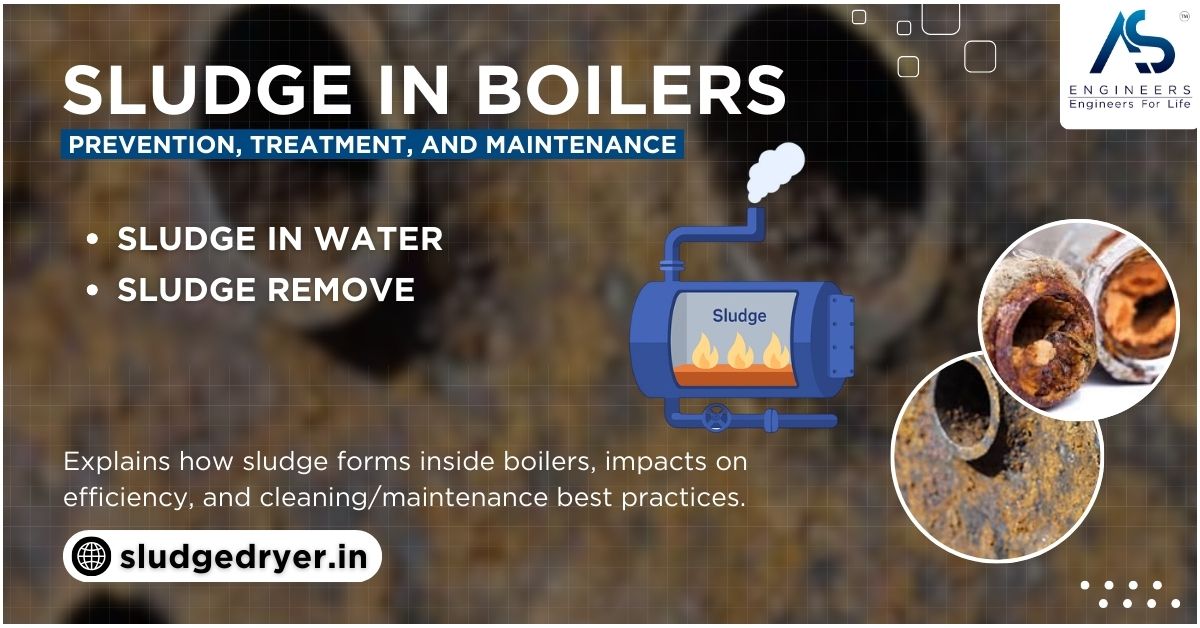
Sludge in boilers has two different meanings. It can mean sludge deposits inside the boiler water circuit, or it can mean dried wastewater sludge being considered as boiler fuel. These are not the same problem. Boiler-water sludge needs water treatment, blowdown, and inspection. Wastewater or industrial sludge should not be fed wet into a normal boiler without drying, fuel testing, emission review, ash handling planning, and regulatory approval.
At AS Engineers, I do not treat “sludge in boilers” as a simple fuel-saving idea. The first question is: are we talking about sludge formed inside the boiler, or dried sludge prepared before combustion?
What does sludge in boilers mean?
In industrial discussions, “sludge in boilers” usually creates confusion because the phrase is used in two ways.
| Meaning | Where it occurs | Main concern | Correct action |
|---|---|---|---|
| Boiler-water sludge | Inside steam boilers, water circuits, mud drums, tubes, and low-flow areas | Heat transfer loss, scale, corrosion, carryover, tube overheating | Water treatment, TDS control, bottom blowdown, inspection, cleaning |
| Dried sludge as fuel | Outside the boiler, after ETP/STP sludge dewatering and drying | Moisture, calorific value, ash, chlorine, sulfur, heavy metals, feeding, emissions | Dewatering, thermal drying, lab testing, boiler OEM review, pollution-control approval |
Both topics are important, but they require different engineering decisions.
If you are new to sludge classification, start with what sludge is and how it forms before deciding whether it belongs in a boiler, dryer, landfill, TSDF, cement kiln, or waste-to-energy route.
Boiler-water sludge: the deposit problem inside boilers
Boiler-water sludge is a deposit formed from suspended solids, mineral precipitation, corrosion products, treatment chemical reaction products, and feedwater contamination. In steam boilers, these solids tend to settle in low-flow areas and mud zones.
The U.S. Department of Energy explains boiler blowdown as a method to control suspended solids and total dissolved solids. Bottom blowdown is used to remove settled solids that can form heavy sludge in the boiler water system.
In practical plant operation, boiler-water sludge can cause:
- Lower heat transfer efficiency
- Tube hot spots
- Poor steam quality
- Foaming and carryover
- Higher blowdown requirement
- Corrosion under deposits
- Tube failure risk in severe cases
- Increased cleaning shutdowns
This part of the problem is not solved by sludge dryers. It is solved by boiler water treatment, feedwater quality control, blowdown discipline, periodic inspection, and competent boiler maintenance.
Common causes of boiler-water sludge
Boiler-water sludge usually develops because the boiler water chemistry is not staying within the required control window.
| Cause | What happens inside the boiler | Plant-side check |
|---|---|---|
| High TDS | Dissolved solids concentrate as steam is generated | Conductivity and TDS logs |
| High hardness | Calcium and magnesium salts precipitate | Softener, DM/RO plant, hardness test |
| Corrosion products | Iron oxide particles circulate and settle | Oxygen control, pH control, condensate return quality |
| Poor blowdown | Settled solids remain in the mud drum or low points | Bottom blowdown frequency and procedure |
| Contaminated condensate | Oil, process leakage, or chemical contamination enters the boiler | Condensate testing and return-line inspection |
| Wrong chemical dosing | Treatment chemicals create unwanted precipitates | Boiler water treatment vendor review |
For boiler-water sludge prevention, the operating team should work with a boiler water treatment specialist. A sludge dryer is not the solution for internal boiler deposits.
Dried sludge as boiler fuel: when does it make sense?
The second meaning of sludge in boilers is more relevant to ETP, STP, CETP, paper mill, chemical, food, textile, pharma, and municipal wastewater plants.
In this context, wet sludge is first dewatered and dried. After drying and testing, some sludge streams may be considered for controlled combustion, co-processing, or waste-to-energy use.
Dried sludge may be considered for boiler or thermal use only when:
- The sludge has enough calorific value
- Moisture is reduced to a manageable level
- Ash percentage is acceptable
- Chlorine, sulfur, heavy metals, and hazardous constituents are within the permitted route
- The boiler, furnace, or WtE system is designed for that fuel
- Air pollution control equipment is suitable
- Ash disposal or reuse route is approved
- The local SPCB/PCC and site EHS team approve the route
The U.S. EPA recognizes land application, landfilling, and incineration as common sewage sludge use/disposal routes, but incineration is a regulated combustion route, not a casual disposal shortcut. In India, plants should check current CPCB/SPCB requirements, especially when hazardous or industrial sludge is involved.
For comparison of disposal choices, read land application vs incineration for sludge disposal.
Why wet sludge should not go directly into boilers
Wet sludge is difficult for boilers because most of its weight is water. Before the organic or combustible fraction can release useful heat, the boiler has to spend energy evaporating moisture.
That creates several operating problems:
| Wet sludge issue | Boiler impact |
|---|---|
| High moisture | Poor net heat value and unstable flame |
| Sticky feed | Feeding, bridging, and choking problems |
| Variable composition | Difficult combustion control |
| High ash | More bottom ash, fly ash, fouling, and handling load |
| Chlorine or sulfur | Corrosion and emission-control concern |
| Heavy metals | Ash and stack-emission compliance risk |
| Odour and biological instability | Storage and handling challenge |
| Large particle variation | Uneven burning and feed system blockage |
This is why drying is normally the critical step before any serious sludge-to-fuel evaluation.
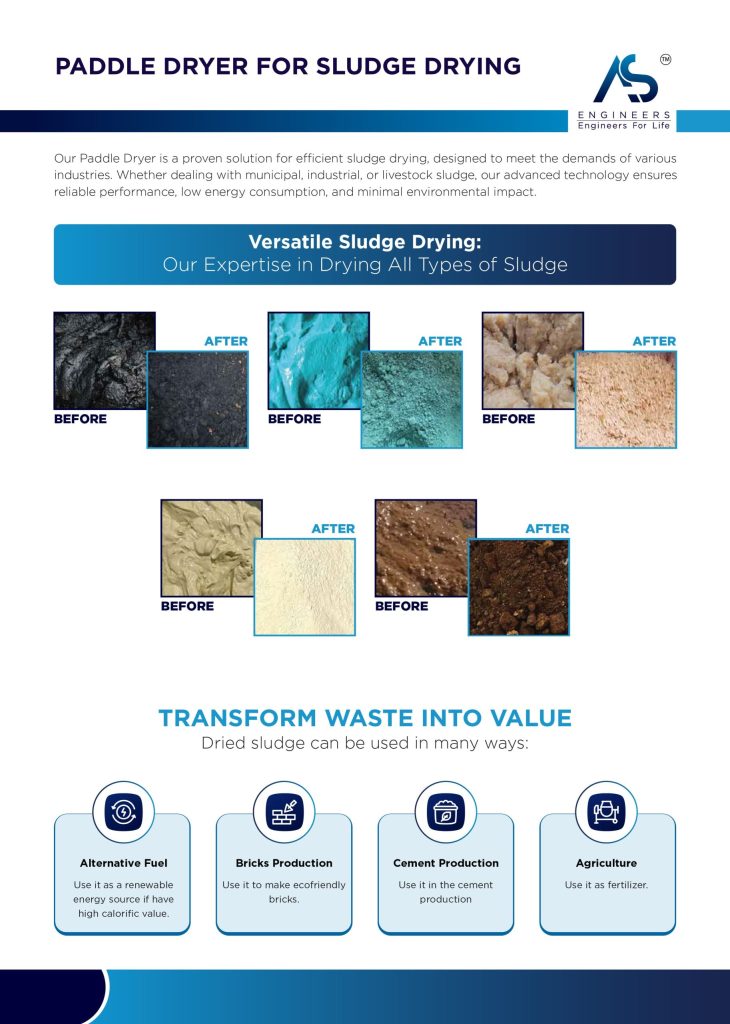
A well-designed thermal sludge drying system helps convert wet, sticky sludge into a more manageable dried material. It does not automatically make the sludge a legal or suitable boiler fuel. That decision still depends on lab reports, boiler design, emission limits, and approval route.
Which sludge types are more suitable for thermal use?
Not all sludge is suitable for boiler fuel, even after drying.
| Sludge type | Fuel potential | Risk level | Comment |
|---|---|---|---|
| Municipal sewage sludge | Possible after drying and approval | Medium to high | Needs pathogen, ash, heavy metal, odour, and emission review |
| Biological sludge | Possible in selected cases | Medium | Moisture and organic content matter |
| Paper mill sludge | Sometimes possible | Medium | Ash and fibre content need testing |
| Food industry sludge | Sometimes possible | Medium | Fat, protein, odour, biological stability, and storage need review |
| Textile sludge | Case-specific | High | Dyes, salts, ash, and chemical contaminants matter |
| Chemical sludge | Usually high-risk | High | Must be tested for hazardous constituents |
| Paint sludge | Usually not direct boiler fuel | Very high | Solvents, pigments, metals, and hazardous classification risk |
| Refinery/oily sludge | Highly controlled route only | Very high | Hydrocarbon, metal, odour, fire, and compliance risk |
For risky waste streams, first review hazardous sludge handling and CPCB-related hazardous waste disposal guidance before considering any thermal route.
The correct route: from wet sludge to boiler-ready evaluation
The right workflow is not “collect sludge and burn it.” The correct workflow is staged.
| Stage | What to check | Why it matters |
|---|---|---|
| Sludge identification | Source, industry, ETP/STP process, chemicals used | Determines risk category |
| Sampling | Representative sampling across batches | Avoids wrong fuel decision from one good sample |
| Dewatering | Filter press, screw press, centrifuge, belt press | Reduces free water load before dryer |
| Drying | Moisture reduction through sludge dryer | Improves handling and combustion evaluation |
| Fuel analysis | GCV/NCV, moisture, ash, volatile matter, fixed carbon | Shows whether thermal use is practical |
| Elemental analysis | C, H, N, S, O, chlorine | Helps predict combustion and corrosion issues |
| Contaminant analysis | Heavy metals, halogens, hazardous markers | Determines regulatory and ash risk |
| Physical handling test | Bulk density, flowability, dusting, bridging | Affects storage and feeding |
| Boiler review | Fuel feed system, grate/burner suitability, residence time | Prevents unstable operation |
| Air pollution review | Cyclone, scrubber, bag filter, ID fan, stack monitoring | Needed for emission control |
| Approval route | SPCB/PCC, EHS, boiler inspector, OEM, consultant | Prevents unsafe or non-compliant use |
For dewatering-stage planning, see why sludge dewatering is key to efficient waste management and sludge dewatering techniques.
How a sludge dryer helps before boiler or WtE use
A sludge dryer does not replace the boiler. It prepares the sludge for safer handling, testing, transport, storage, or downstream thermal evaluation.
AS Engineers’ sludge drying approach is based on indirect heat transfer. In a paddle dryer, heat is transferred through hollow shafts and the jacket. Wedge-shaped paddles agitate and break down the wet feed, while the system supports controlled drying of slurries, pastes, cakes, powders, and granular materials.
For sludge-to-fuel evaluation, drying helps in five practical ways:
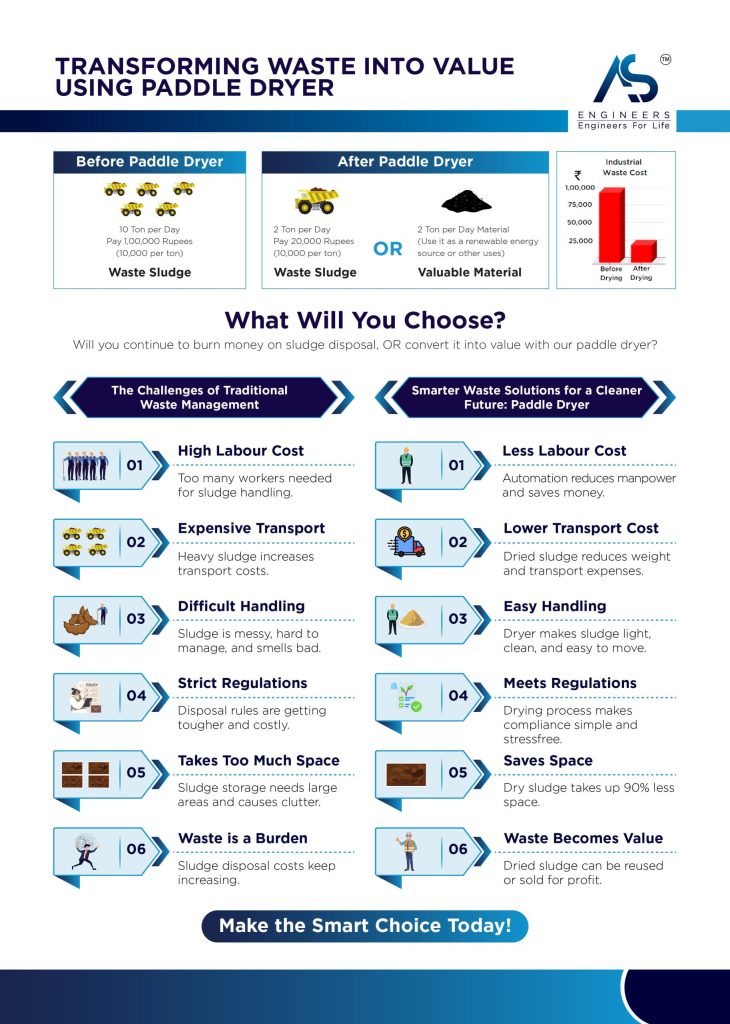
- Reduces moisture load before combustion
- Improves handling compared with wet sludge
- Reduces transport and storage burden
- Helps make lab testing more consistent
- Supports controlled feeding through conveyors, bagging, silo, or truck disposal systems
The AS Engineers paddle dryer process can include feeding, heating, drying, scavenging air, cyclone/scrubber/bag filter support, solvent/vapour handling, and dried product handling depending on the application.
For equipment-level understanding, review the sludge dryer guide and AS Engineers’ paddle dryers for sludge drying.
Boiler and air pollution control checks before using dried sludge
Dried sludge creates a combustion and emission-control question. The boiler team should not approve it from moisture data alone.
| Area | Minimum check before approval |
|---|---|
| Boiler design | Is the boiler designed for solid waste-derived fuel or only conventional fuel? |
| Fuel feeding | Can the system feed dried sludge consistently without bridging, choking, or dust escape? |
| Flame stability | Will the fuel support stable combustion or require auxiliary fuel? |
| Ash behaviour | Is ash high, sticky, corrosive, or likely to cause clinker/fouling? |
| Corrosion | Are chlorine, sulfur, alkali, and moisture levels acceptable? |
| Particulate load | Is cyclone/bag filter/ESP capacity suitable? |
| Acid gas | Is scrubber or other treatment needed? |
| ID fan duty | Can the ID fan handle gas volume, dust load, temperature, and pressure drop? |
| FD/combustion air | Is combustion air adequate for the changed fuel mix? |
| Stack monitoring | Are required emission parameters monitored? |
| Ash disposal | Is bottom ash and fly ash disposal route approved? |
| Legal route | Is the use permitted under applicable consent and waste authorization? |
For boiler draft and gas movement, the ID fan side is important. Use supporting resources on boiler ID fan functionality, boiler fan and ID fan manufacturers, and high-pressure blowers in boiler applications when planning the complete thermal system.
When dried sludge should not be used in boilers
Dried sludge should not be used in a boiler when the plant cannot control fuel quality, emissions, or ash safely.
Avoid boiler use when:
- Sludge composition changes frequently
- Heavy metals or hazardous constituents are high
- Chlorine or sulfur levels create corrosion or emission risk
- The boiler is not designed for solid waste-derived fuel
- Feeding is manual, open, dusty, or unstable
- Pollution-control equipment is not suitable
- Ash disposal route is not approved
- The plant does not have written permission or consent coverage
- The EHS team cannot verify the risk
For many industrial sludge streams, TSDF disposal, cement kiln co-processing, controlled incineration, or drying before authorized disposal may be safer than direct boiler use.
Common mistakes plants make with sludge in boilers
Treating all sludge as fuel
Sludge is not a standard fuel. Sludge from STP, ETP, chemical plants, paint booths, refineries, food plants, and paper mills can behave very differently.
Looking only at moisture
Moisture is important, but it is not the only decision point. Ash, calorific value, chlorine, sulfur, heavy metals, particle size, odour, and feeding behaviour matter.
Ignoring boiler OEM limits
A boiler designed for coal, biomass, gas, or furnace oil should not automatically be assumed suitable for dried sludge.
Forgetting ash handling
If dried sludge has high ash, the plant may reduce disposal weight but create a new ash management problem.
Using drying as a compliance shortcut
Drying reduces moisture and improves handling. It does not remove the need for testing, authorization, emission control, or EHS review.
RFQ checklist for sludge drying before boiler evaluation
When sending an RFQ for a sludge dryer or pre-combustion drying system, share these details:
| RFQ input | Why AS Engineers needs it |
|---|---|
| Sludge source | STP, ETP, CETP, paper, food, chemical, pharma, textile, refinery, paint, etc. |
| Current moisture | Defines drying load |
| Target moisture | Impacts dryer sizing and energy requirement |
| Daily sludge quantity | Defines capacity |
| Dewatering method | Filter press, centrifuge, screw press, belt press, etc. |
| Sludge behaviour | Sticky, pasty, fibrous, oily, granular, abrasive, corrosive |
| Available heating medium | Steam, thermic fluid, hot water, other site utilities |
| Fuel or waste heat availability | Helps evaluate operating economics |
| Lab analysis | Moisture, ash, GCV/NCV, chlorine, sulfur, heavy metals |
| Vapour handling need | Water vapour, solvent, odour, condensate, scrubber requirement |
| Product handling plan | Bagging, silo, screw conveyor, truck loading, storage |
| End-use route | Boiler fuel, cement, incineration, disposal, landfill reduction |
| Compliance route | Consent condition, SPCB/PCC requirement, hazardous classification |
For detailed dryer selection, use how to choose a sludge paddle dryer and paddle dryer configuration guide.
If your actual problem is boiler-water sludge
If your plant is facing sludge deposits inside the boiler, do not jump to sludge drying content. Follow a boiler maintenance route:
- Test feedwater, boiler water, and condensate
- Review TDS, hardness, pH, dissolved oxygen, alkalinity, and conductivity
- Check bottom blowdown and surface blowdown practice
- Inspect mud drum, tubes, strainers, and low-flow zones
- Check for oil or process contamination in condensate return
- Review dosing with the water treatment vendor
- Plan mechanical or chemical cleaning only through qualified boiler service teams
Use the U.S. Department of Energy boiler blowdown guidance or a qualified boiler-water specialist for the deposit-control side. Use sludge drying guidance only when the sludge is an external waste stream coming from wastewater treatment or industrial processing.
Conclusion
Sludge in boilers should never be treated as a simple yes-or-no topic. First identify the meaning. If it is sludge inside the boiler water circuit, solve it through water treatment, blowdown, inspection, and boiler maintenance. If it is wastewater or industrial sludge being considered as boiler fuel, dry it first, test it properly, review the boiler and air pollution system, and confirm the regulatory route before use.
For plants evaluating sludge drying before disposal, co-processing, waste-to-energy, or boiler fuel testing, AS Engineers can review the sludge source, moisture, daily quantity, heating medium, vapour handling, product handling, and end-use plan before recommending a sludge dryer configuration.
FAQs
Can sludge be used as boiler fuel?
Some dried sludge streams may be evaluated for boiler, incineration, co-processing, or waste-to-energy use, but wet sludge should not be treated as ready boiler fuel. Suitability depends on moisture, calorific value, ash, chlorine, sulfur, heavy metals, feeding behaviour, boiler design, emission control, and regulatory approval.
Is boiler-water sludge the same as wastewater sludge?
No. Boiler-water sludge is a deposit formed inside the boiler water system from suspended solids, mineral precipitation, corrosion products, and treatment reactions. Wastewater sludge is an external waste stream from ETP, STP, CETP, or industrial treatment plants.
Why is drying important before sludge combustion?
Drying reduces moisture, improves handling, stabilizes feeding, reduces transport burden, and allows more consistent fuel testing. It does not automatically make sludge suitable for combustion, but it is usually an important pre-treatment step.
Which sludge types are risky for boiler use?
Paint sludge, refinery sludge, oily sludge, chemical sludge, textile sludge, and hazardous industrial sludge are high-risk streams. They need detailed lab analysis, hazardous waste classification, emission review, and regulatory approval before any thermal route is considered.
What data should I share before selecting a sludge dryer?
Share sludge source, current moisture, target moisture, daily quantity, dewatering method, sludge behaviour, heating medium, lab analysis, vapour handling needs, product handling plan, and intended end-use route.